DIY Hand-Crank Power: Generate Electricity Without Fuel or Sunlight
When fuel runs dry and skies stay cloudy, human power may be your last resort. Learn how to build and use hand-crank generators for reliable off-grid electricity.

When the Grid Goes Down, Your Legs and Arms Become the Power Plant
Most preppers have a solar panel or two stashed away. Many have a fuel-powered generator sitting in the garage. But what happens when it's been cloudy for five days straight, your fuel supply runs dry, and you still need to charge a radio, run a light, or keep a medical device alive? This is the scenario where human-powered generators stop being a novelty and start being a lifeline.
Hand-crank and pedal-powered electricity generation isn't new — the physics behind it dates back to the 1830s with Faraday's discovery of electromagnetic induction. What is new is the quality, portability, and accessibility of modern human-powered generators. Understanding how they work, what they can realistically power, and how to integrate them into a layered preparedness system could be the edge that keeps your household functional when every other power source fails.
How Human-Powered Generators Actually Work
At the core of any hand-crank or pedal generator is a permanent magnet alternator (PMA). When you rotate the shaft — whether by turning a handle or pedaling a drive mechanism — the spinning magnets induce an electrical current in surrounding coils of wire. That raw alternating current (AC) is then typically rectified into direct current (DC) for charging batteries or USB devices, or delivered as AC through an outlet.
The critical variable is rotational speed. Most hand-crank generators require you to maintain 100–150 RPM to produce usable voltage. Pedal generators are more efficient because your leg muscles are significantly stronger and more endurance-capable than your arms — the average adult can sustain roughly 75–100 watts of pedaling output over an extended period, compared to just 10–30 watts from sustained hand-cranking.
Realistic Power Output: What You Can and Can't Run
Let's be honest about limitations. Human-powered generators are not going to run your refrigerator, air conditioner, or power tools. What they can do — reliably and indefinitely — is keep your critical communication and low-draw devices alive. Here's a practical breakdown:
- LED lighting: A single efficient LED bulb draws 5–10 watts. Easy to power with hand-cranking.
- Smartphones and tablets: Most smartphones require 5–18 watts to charge. Achievable with sustained cranking into a battery buffer.
- Two-way radios and weather radios: Typically 1–5 watts. Very manageable.
- Laptops: 45–65 watts minimum. Requires a pedal generator with a battery bank.
- CPAP machines: 30–60 watts depending on settings. Borderline — possible with a good pedal setup and stored battery capacity.
- Small fans: 15–35 watts. Feasible with pedal power.
The most effective strategy is to use your human-powered generator to charge a battery bank or power station, then draw from that storage as needed. Trying to power devices directly from the generator while cranking is inefficient and exhausting.
The Best Entry-Level Tool: Hand-Crank Generators
For most households, a quality hand-crank generator is the logical starting point. They're compact, require no setup, and can be kept in a bug-out bag or emergency kit without taking up significant space.
The BROWEY Portable Power Station 153Wh Camping Small Solar Generator with Hand Crank 120V 150W AC Outlet Lithium Battery Power Bank, Wireless Charging Emergency Charger for Outdoor Travel Home Backup is one of the most respected options in this category. It delivers a genuine 10 watts of 120V AC power — enough to charge phones, USB devices, and small electronics — through a standard household outlet. Weighing under a pound, it slips into any pack and needs no batteries, no fuel, and no sunlight. It's the kind of tool you can hand to any family member and have them generating usable electricity within seconds.
For emergency communication specifically, dedicated hand-crank radios belong in every preparedness kit. The Eton FRX5-BT Hand Turbine Weather Radio combines NOAA weather band reception, Bluetooth, a built-in flashlight, and a hand turbine charger that can also charge your phone via USB. Similarly, the Midland ER310 Emergency Hand Crank Weather Radio is a rugged, field-tested unit trusted by emergency management professionals, offering multiple charging inputs including hand crank, solar, and USB. The Hand Crank Solar Emergency Radio rounds out the category with a compact form factor that's ideal for bug-out bags and vehicle kits.
Stepping Up: Pedal Generators for Serious Output
If you want to generate meaningful electricity over sustained periods, you need to graduate from hand-cranking to pedal power. The biomechanical advantage of using your legs is substantial — studies in human power output have consistently shown that leg muscles can sustain two to four times the wattage of arm muscles before fatigue sets in.
The K-TOR Power Box 50 Watt Pedal Generator is built around exactly this principle. It operates like a stationary bike connected to an alternator, producing up to 50 watts of AC power through a standard outlet — enough to charge laptops, run LED lighting systems, or top off battery banks steadily over an afternoon of use. An average adult pedaling at moderate effort can realistically generate 1–2 amp-hours per hour depending on the load and their fitness level. Over a full day of rotating shifts among family members, that adds up to meaningful stored energy.
The Critical Role of Battery Storage
Human-powered generation becomes dramatically more useful when paired with a quality battery-based power station. Rather than cranking or pedaling constantly to meet real-time demand, you generate and store — then use your stored power on demand.
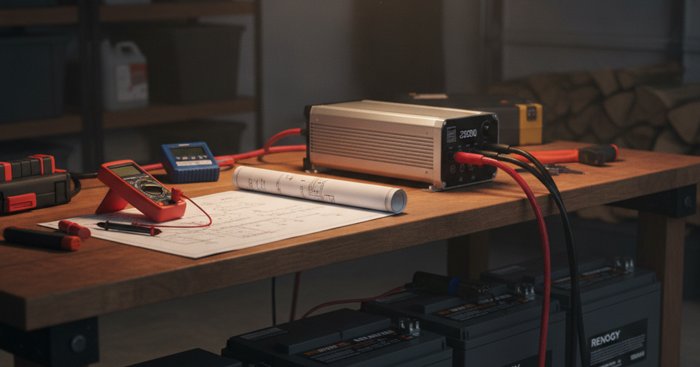
The 200 Portable Power Station is an excellent pairing with human-powered generators. It accepts input from solar panels, wall outlets, and car chargers — and with the right adapter, from a hand-crank or pedal generator. Its internal lithium battery provides a buffer that smooths out the irregular voltage that human cranking can produce, protecting your devices while giving you stored capacity to work from.
Building a Practical Human-Power System
The most effective approach layers multiple generation and storage methods together. Here's a practical framework:
- Daily communication needs: Keep a hand-crank weather radio charged and accessible for information. Two minutes of cranking keeps most models operational for 30+ minutes of listening.
- Phone and device charging: Designate daily "charging shifts" where family members take turns on the pedal generator, feeding into a central battery bank.
- Critical device priority: Establish a load priority list — medical devices first, communication second, lighting third, everything else last.
- Rotate operators: Human fatigue is real. Plan for 20–30 minute cranking or pedaling sessions before rotating to the next person.
- Track your energy budget: Know the watt-hour capacity of your battery storage and the approximate watt-hour draw of each device per day. Math keeps you from running out.
Maintenance, Durability, and Long-Term Reliability
One of the most overlooked advantages of human-powered generators is their extreme longevity and minimal maintenance requirements. A quality unit has no combustion engine, no carburetor to gum up, no fuel to go stale, and no solar cells to degrade. The primary wear components are bearings and brushes, both of which can last decades under normal use.
Store your unit in a dry location, apply a light lubricant to any exposed moving parts annually, and inspect wiring connections periodically. That's largely the extent of required maintenance. Unlike a gasoline generator, your hand-crank will work just as reliably in year fifteen as it did on day one — provided you haven't physically damaged it.
What You'll Need
Tools
- Hand-crank generator or pedal generator
- Multimeter (for measuring output voltage and verifying connections)
- DC-to-DC voltage regulator or charge controller (if connecting directly to a battery)
- Appropriate output cables and adapters (DC barrel connectors, USB-A, USB-C)
Supplies
- Portable power station or lithium battery bank (for energy storage)
- Heavy-duty extension cord or short interconnect cable matched to your generator's output
- Electrical tape and heat-shrink tubing (for securing any custom connections)
- Light machine oil or white lithium grease (for annual bearing lubrication)
- Notepad or energy log sheet (for tracking daily watt-hour generation and consumption)
Step-by-Step Instructions
Step 1: Audit Your Critical Power Needs Before Any Emergency Strikes
Walk through your home and list every device you would need to operate during a prolonged grid-down event. Write down the wattage of each device — usually found on a label on the bottom or back — and estimate how many hours per day you'd need to run it. Add those figures together to arrive at a daily watt-hour target your human-powered system must be capable of meeting or approaching.
Step 2: Select the Right Generator Type for Your Household's Output Goals
If your daily watt-hour target is under 50Wh and your primary needs are a weather radio, phone charging, and basic LED lighting, a quality hand-crank generator paired with a small battery bank is sufficient. If you need to sustain a CPAP machine, charge laptops, or power small fans for hours per day, budget for a pedal generator — the leg-driven output difference is too significant to ignore. Match the tool to the realistic demand before spending money.
Step 3: Connect Your Generator to a Battery Storage Device, Not Directly to Loads
Run your generator's output cable into a portable power station or through a DC charge controller into a lithium battery bank rather than plugging devices directly into the generator while cranking. This approach smooths out voltage irregularities produced by inconsistent cranking speed, protects sensitive electronics, and allows you to accumulate stored energy during active generation sessions that you can then draw from whenever needed.
Step 4: Verify Output With a Multimeter Before Relying on the System
Before an emergency occurs, connect your generator to its storage device and crank or pedal at a steady pace while measuring the output voltage with a multimeter at the generator's terminals. Confirm you're reaching the expected voltage range — typically 12–14V DC for most systems feeding a battery bank. If output is low, increase your cranking speed or check the output cable connections for looseness or corrosion.
Step 5: Establish Scheduled Charging Shifts Among Household Members
Human fatigue is the biggest limiting factor in a sustained human