Concealed Carry for Preppers: How to Choose, Train, and Carry a Handgun Every Day
A concealed handgun is one of the most powerful personal security tools a prepper can have — but only if you choose the right one and train consistently.
Most preppers spend serious time and money building a survival kit, stocking emergency food storage, and assembling a bug out bag — yet they give little thought to the one tool most likely to save their life in a real emergency: the handgun on their hip. According to the FBI's Uniform Crime Report, violent crime remains a persistent threat in both urban and rural communities, and the Department of Justice has estimated that Americans use firearms defensively between 60,000 and 2.5 million times per year. For the serious prepper, concealed carry isn't optional — it's a foundational layer of emergency preparedness.
Whether you live in a downtown apartment, a suburban neighborhood, or on a rural homestead, carrying a handgun every day is one of the highest-leverage decisions you can make for your personal safety. But doing it well requires more than buying a gun and shoving it in your waistband. This guide covers everything you need to know: choosing the right handgun, selecting a quality holster, building real skills through training, and maintaining the situational awareness to use your tool effectively.
Why Everyday Concealed Carry Is a Core Prepper Skill for SHTF Scenarios
Most SHTF scenarios don't begin with a nuclear event or grid-down collapse. They begin with a mugging in a parking garage, a carjacking at a gas station, or a home invasion at 2 a.m. The threat landscape is constant, not hypothetical. For urban and suburban preppers especially, personal security is the first line of defense — long before your bug out bag gets packed or your off grid retreat becomes relevant.
Rural preppers face their own calculus. Response times in rural areas can exceed 30 minutes — sometimes much longer. In those environments, you are the first responder, full stop. A concealed handgun bridges the gap between the moment danger presents itself and the moment help arrives (if it arrives at all).
For deeper context on building a comprehensive personal defense posture, see our related guide: Self-Defense for Preppers: How to Choose the Right Firearm for Home and Bug-Out Survival.
How to Choose the Best Everyday Carry Handgun for Concealed Carry
Choosing a carry gun involves balancing four competing priorities: reliability, concealability, caliber, and shootability. There is no perfect handgun — only the best compromise for your specific body type, lifestyle, and skill level.
Reliability First, Always
Your carry gun must function every single time you pull the trigger. This means buying from proven manufacturers — Glock, Sig Sauer, Smith & Wesson, Springfield Armory, and Ruger all have strong track records. Once you select a gun, run at least 500 rounds through it without cleaning before you trust it for carry. If it fails during that test, it doesn't belong on your hip.
Caliber Considerations
The long-running 9mm vs. .45 ACP debate has largely been settled by modern ballistic testing. The FBI's own research, which led to their 2015 return to 9mm, confirmed that modern 9mm hollow-point ammunition performs comparably to larger calibers in terminal ballistics — while offering higher magazine capacity and reduced recoil. For most preppers, 9mm is the practical choice. The Glock 19 and Sig P365 are two of the most widely carried handguns in the country for exactly this reason.
Size and Concealability
Full-size handguns are easier to shoot accurately but harder to conceal. Micro-compact pistols conceal easily but are harder to shoot well under stress. A mid-size or compact pistol — like the Glock 19, Sig P365XL, or Springfield Hellcat Pro — represents the sweet spot for most everyday carry scenarios. If you're carrying concealed in an urban environment where grey man tactics matter, a bulge printing through your shirt is a liability.
Selecting the Right Concealed Carry Holster: IWB, OWB, and Ankle Options
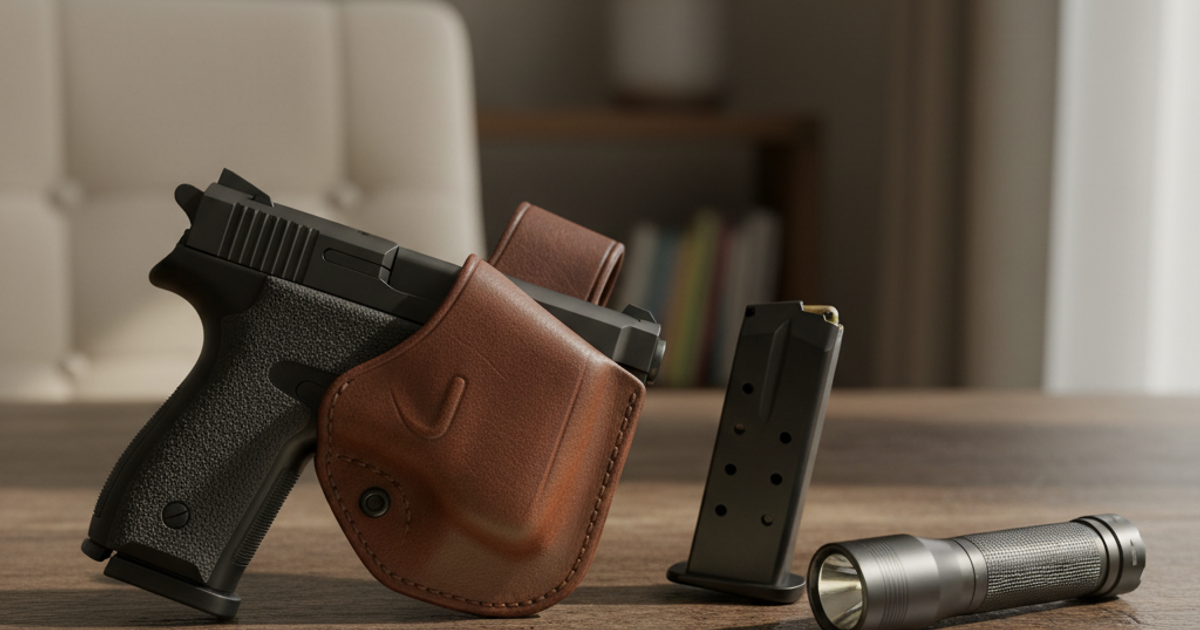
A quality holster is as important as the gun itself. Your holster must cover the trigger guard completely, retain the gun securely, and allow a clean, repeatable draw. Never carry in a pocket without a dedicated pocket holster, and never carry without a holster at all — negligent discharges are overwhelmingly caused by objects contacting unprotected triggers.
Inside the Waistband (IWB) Holsters
IWB holsters are the gold standard for concealed carry because they place the firearm inside the waistband, close to the body. The Alien Gear Cloak Tuck IWB holster is a popular option that combines a neoprene backing for all-day comfort with a rigid Kydex shell for trigger guard protection and consistent retention — making it a strong choice for preppers who carry through long, active days.
If you prefer a more minimalist and lightweight option, the Vedder LightTuck Kydex holster is one of the thinnest IWB holsters available, machined precisely for your specific firearm and offering adjustable ride height and cant — critical features for dialing in a comfortable and concealable carry position.
For Glock 19 owners specifically, there is a wide selection of purpose-built options. Searching for a dedicated Glock 19 concealed carry holster will surface dozens of fit-specific options from reputable manufacturers, allowing you to match the holster precisely to your pistol and any weapon-mounted lights or optics you may be running.
Ankle Holsters for Deep Concealment
Ankle carry is a viable option for a backup gun or for environments where waistband carry is impractical — such as desk jobs, extended vehicle operations, or in situations where a cover garment isn't feasible. The Galco Ankle Glove holster is widely regarded as one of the most comfortable and secure ankle holster systems on the market, featuring a reinforced thumb break and a neoprene ankle band that stays put through a full day of movement.
Carrying a Spare Magazine: Why It Matters More Than You Think
Most defensive gun uses don't require a reload — but equipment failures do. A magazine-related malfunction is one of the most common causes of semi-automatic pistol stoppages, and the fastest fix is to drop the bad mag and reload from a spare. Carrying at least one spare magazine is standard doctrine for serious armed citizens. The Blackhawk concealed carry magazine pouch offers a low-profile, ambidextrous option that can be worn on the opposite side of your holster without adding significant bulk — keeping your load-out streamlined under a grey man profile.
CCW Training: Building Real Skills That Hold Up Under Stress
Owning a carry gun without training is like keeping a fire extinguisher without knowing how to use it. Your situational awareness and decision-making skills must be developed alongside your shooting fundamentals. Here's how to build a serious training foundation:
- Obtain your CCW permit: Even in constitutional carry states, completing a formal course exposes you to legal use-of-force doctrine, safe handling, and basic marksmanship standards.
- Seek force-on-force training: Scenario-based training using airsoft or Simunitions is widely considered the single most effective way to stress-inoculate your decision-making. Look for classes from IDPA, USPSA, or private instruction from vetted instructors.
- Dry fire daily: Ten minutes of daily dry fire practice — drawing from concealment, acquiring your sight picture, and pressing the trigger without disturbing your aim — will improve your skills faster than a monthly range trip.
- Train in your actual carry gear: Always practice drawing from the holster you carry every day, wearing the clothes you typically wear. Drawing from an untucked shirt is very different from drawing from a tucked button-down.
- Study legal use of force: Understanding when you are legally justified in using deadly force is not optional. Andrew Branca's The Law of Self Defense is the standard reference and should be on every armed citizen's bookshelf.
For those building a broader urban security posture, pair your carry training with the principles outlined in our guide to Situational Awareness: How to Detect Threats Before They Become Dangerous.
Practical Everyday Carry Tips for Urban, Suburban, and Rural Preppers
Urban Preppers
In dense urban environments, urban survival tactics emphasize blending in. Avoid tactical clothing, patch-covered range bags, and anything that signals "armed" to a potential aggressor or attracts unwanted attention. A grey man approach means carrying a normal-looking bag, dressing appropriately for your environment, and keeping your weapon completely concealed. Know which buildings in your area are off-limits for carry under your state's law — government buildings, schools, and some private establishments.
Suburban Preppers
Suburban environments offer more flexibility in cover garment choices. Appendix IWB carry or strong-side hip carry both work well for the suburban prepper who moves between their vehicle, office, and home throughout the day. Consider how your carry position interacts with a seatbelt — appendix and 3 o'clock positions both allow reasonably quick access while seated and belted.
Rural Preppers
Rural preppers often transition between concealed carry in public and open carry on their own property. On a homestead or rural property, a full-size handgun in an OWB holster offers better access and capacity. Practice transitioning between configurations so the mechanics become automatic. Your emergency preparedness plan should also account for carry during a bug-out scenario — ensure your holster and carry rig are compatible with your bug out bag setup and don't interfere with your pack's hip belt.
Building Your Complete Everyday Carry Self-Defense System
A handgun is one layer of a complete personal defense system. Serious everyday carry preppers also carry a quality folding knife, a medical tourniquet (CAT or SOFT-T Wide), a flashlight, and a phone loaded with relevant emergency apps. Your everyday carry loadout should enable you to fight, render immediate medical aid, communicate, and navigate — the four core functions of individual survival in an emergency. For a complete breakdown of non-firearm EDC essentials, see our guide on Everyday Carry (EDC) Essentials: What Every Prepper Should Have on Them at All Times.
Don't neglect the medical side of armed self-defense. Gunshot wounds and traumatic injuries require immediate intervention that no amount of situational awareness can substitute for. Our guide on First Aid Without a Doctor: Building a Trauma Kit for Long-Term Emergencies covers what you need to know about building a carry-ready trauma kit.
What You'll Need
- Handgun appropriate for concealed carry (9mm or larger caliber recommended)
- Quality holster (IWB or OWB depending on preference)
- Gun belt designed to support concealed carry weight
- Ammunition for training and self-defense (practice rounds and hollow points)
- Hearing and eye protection
- Gun cleaning kit and lubricant
- Concealed carry permit (where required by law)
- Gun safe or locking storage device
Step-by-Step Instructions
Step 1: Research and Select Your Handgun Platform
Begin by researching reliable handgun models known for concealed carry, focusing on proven platforms like Glock, Smith & Wesson M&P, Sig Sauer P365, or Springfield Hellcat. Visit a gun range that offers rentals to test-fire multiple models and determine which fits your hand size, shooting style, and comfort level. Consider factors like caliber (9mm offers the best balance of stopping power and capacity), weight, size, and magazine capacity for everyday carry situations.
Step 2: Obtain Proper Training and Certification
Enroll in a comprehensive concealed carry course that covers firearms safety, local laws, marksmanship fundamentals, and defensive shooting scenarios. Seek out instructors with real-world experience and credentials from recognized organizations like the NRA, USCCA, or local law enforcement training programs. Complete the required hours for your state's concealed carry permit, then continue with advanced courses covering draw techniques, shooting under stress, and low-light scenarios to build competence beyond basic certification.
Step 3: Choose the Right Holster and Carry Position
Invest in a quality holster that securely retains your firearm, covers the trigger guard completely, and allows for a consistent draw stroke. Test different carry positions such as appendix (AIWB), strong-side hip (3-4 o'clock), or behind-the-hip (5 o'clock) to find what conceals best with your body type and clothing. Ensure your holster is made from durable materials like Kydex or leather with reinforced stitching, and pair it with a proper gun belt that won't sag under the weight of your loaded handgun.
Step 4: Establish a Regular Training Schedule
Commit to live-fire practice at least once per month, dedicating sessions to fundamental skills like grip, sight alignment, trigger control, and accuracy at various distances from 3 to 25 yards. Incorporate dry-fire practice at home 3-5 times per week to build muscle memory for your draw stroke, sight picture, and trigger press without expending ammunition. Gradually add realistic drills such as shooting from concealment, one-handed shooting, malfunction clearances, and multiple target engagement to prepare for actual defensive situations.
Step 5: Develop Your Everyday Carry System
Build a consistent daily carry routine that includes your handgun, holster, spare magazine, tactical flashlight, and first aid supplies like a tourniquet. Adjust your wardrobe to accommodate concealment, choosing slightly larger or untucked shirts, jackets, and pants that prevent printing while allowing quick access. Create a ritual for checking your equipment each morning—verifying your firearm is loaded, holster is secure, and all gear is accessible—so carrying becomes second nature and you remain prepared in any situation.
Step 6: Study Legal Responsibilities and Use-of-Force Laws
Thoroughly research your state and local laws regarding concealed carry, including where you can and cannot carry, duty to inform law enforcement, and castle doctrine or stand-your-ground provisions. Understand the legal standard for justified use of deadly force, which typically requires reasonable fear of imminent death or serious bodily harm to yourself or others. Consider joining organizations like USCCA or CCW Safe that provide legal defense insurance, access to attorneys, and ongoing education about changing laws and real-world self-defense cases.
Step 7: Maintain Your Firearm and Reassess Regularly
Clean and inspect your carry gun every 200-300 rounds or monthly if not shooting regularly, checking for wear on springs, sights, and critical components while ensuring proper lubrication. Rotate your defensive ammunition every 6-12 months as carry ammo can accumulate lint and moisture, and test-fire at least one magazine of your carry rounds annually to verify reliability. Periodically reassess your entire carry setup—including holster condition, belt integrity, and equipment placement—to ensure everything functions optimally and adapt to any changes in your lifestyle, fitness level, or threat environment.
Frequently Asked Questions
What is the best concealed carry handgun for a beginner prepper?
For most beginners, the Glock 19 or Sig Sauer P365 are the top recommendations. Both are reliable, widely supported with holsters and accessories, chambered in 9mm, and have proven track records in real-world defensive use. The Glock 19 offers a slightly larger grip for easier shooting, while the P365 is significantly more compact for deep concealment. Visit a range that rents firearms and try both before buying.
How do I conceal carry comfortably all day without printing?
Comfortable all-day carry comes down to three factors: the right holster for your body type, the right carry position, and wearing appropriate cover garments. A quality IWB Kydex holster with adjustable cant and ride height — like the Vedder LightTuck or Alien Gear Cloak Tuck — allows you to fine-tune the fit until the gun disappears under a normal untucked shirt. Appendix carry works well for slender builds; strong-side 3-4 o'clock carry works better for larger builds. Avoid tight-fitting athletic wear, which will print with virtually any handgun.
Do I need a CCW permit if my state has constitutional carry?
Even in constitutional carry states, obtaining a formal CCW permit is strongly recommended for several reasons. First, many constitutional carry states still require a permit for reciprocity in other states — meaning your permit lets you carry legally when you travel. Second, completing a formal CCW course provides legal use-of-force education that could keep you out of prison after a justified defensive shooting. Third, a permit establishes a documented record of your training and intent to comply with the law, which matters if you're ever involved in a legal proceeding.
Affiliate Disclosure: SHTF Plan participates in the Amazon Services LLC Associates Program. Some links are affiliate links — we may earn a small commission at no extra cost to you.