Everyday Carry (EDC) Essentials: What Every Prepper Should Have on Them at All Times
Your EDC loadout could be the difference between life and death. Here's exactly what to carry and why it matters before SHTF.
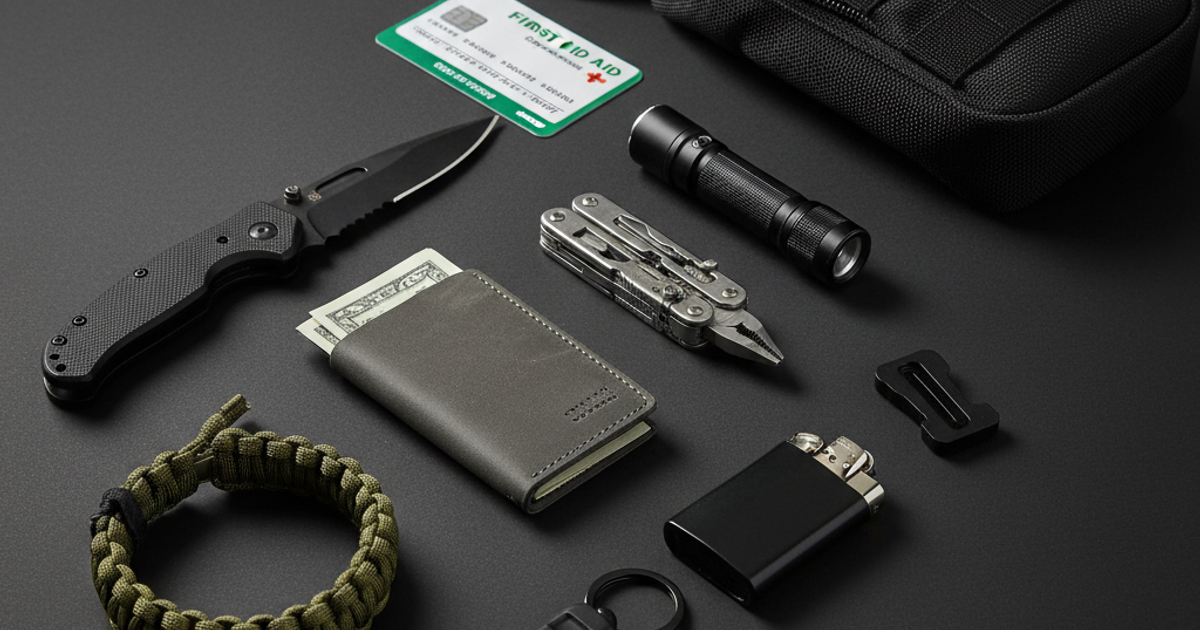
Most disasters don't announce themselves. A grid-down event, a car breakdown in a dangerous neighborhood, a sudden medical emergency, or a rapidly deteriorating social situation can happen anywhere, anytime — whether you're walking through a city, commuting in the suburbs, or working a rural property miles from the nearest town. Your bug out bag sitting at home does you no good when the emergency finds you at the gas station or the office. That's exactly why everyday carry (EDC) is one of the most important and most overlooked pillars of serious emergency preparedness.
EDC is the philosophy and practice of carrying a consistent, curated set of tools and gear on your person every single day — not just when you're headed into the woods or expecting trouble. The best EDC loadout is one you barely notice until you need it desperately. This guide breaks down exactly what every prepper should carry, how to build a tiered system that scales with threat level, and how to do it without looking like you raided a military surplus store.
Why Every Prepper Needs a Solid EDC Loadout
According to FEMA, nearly 60% of Americans have not practiced or prepared for a disaster scenario. Of those who do prepare, most focus on home-based preps — food storage, water reserves, backup power — while neglecting the hours they spend outside their homes every day. The average American spends roughly 90% of their time indoors, but the time spent commuting, running errands, or traveling represents some of the highest-risk exposure windows during any SHTF scenario.
Your EDC kit is essentially a wearable, portable survival kit — the first layer of a broader preparedness system that includes your vehicle kit, get-home bag, and full bug out bag. If you're serious about urban survival or simply being self-reliant in any environment, EDC is where preparedness becomes a daily lifestyle rather than a weekend hobby.
The Core EDC Toolkit: What Belongs on Your Person Every Day
A Quality Multitool: The Single Most Versatile Piece of Survival Gear You Can Carry
If you carry only one piece of survival gear on you at all times, make it a multitool. A good multitool consolidates pliers, wire cutters, multiple blades, a screwdriver, a file, a saw, and more into a package that fits in your pocket or on your belt. The utility is almost limitless — from field-stripping gear to improvising repairs to cutting a seatbelt in a vehicle accident.
The Leatherman Wave Plus multitool is widely considered the gold standard for everyday carry. It features 18 tools including needlenose pliers, wire cutters, multiple knife blades, a wood/metal file, and scissors — all accessible from the outside of the handles without opening the tool. It's built to last a lifetime of hard use, and its compact form factor makes it practical for both office workers in the city and ranchers working rural land.
For those who want something even more minimal and budget-friendly, the Gerber Dime mini multitool with pocket clip is an excellent secondary option. It clips directly onto a pocket or bag and provides a surprising range of functions in a package roughly the size of a lighter. Carry one in your main pocket and stash another in your everyday bag or glove compartment for redundancy.
An EDC Knife: Your Most Critical Single-Blade Tool
A dedicated folding knife is a non-negotiable part of any serious EDC loadout. A knife is one of the oldest and most fundamental survival tools in human history — it cuts cordage, prepares food, assists in field first aid, serves as a defensive tool of last resort, and handles dozens of daily utility tasks. The key is choosing a blade that's legal in your jurisdiction, appropriately sized, and built to perform under real stress.
The Benchmade Griptilian EDC pocket knife consistently ranks among the top choices for serious preppers and professionals alike. It features Benchmade's AXIS lock mechanism — one of the strongest and most reliable folding knife lock systems available — along with a high-quality steel blade that holds an edge through serious use. The ergonomic handle provides a secure grip even with wet or gloved hands, which matters when conditions deteriorate.
Always check local and state knife laws before carrying. Blade length restrictions vary significantly between urban jurisdictions and rural areas, and the last thing you need is a legal complication on top of an emergency situation.
A Tactical Flashlight: Because Darkness Is a Threat Multiplier
Power outages are among the most common emergencies people face, and they happen in every environment — from apartment buildings during storms to rural areas after ice events. A quality flashlight dramatically improves your situational awareness, aids in navigation, and can serve as a defensive tool in a close-quarters confrontation. The key for EDC is finding a light that's small enough to carry every day without friction.
The Streamlight MicroStream USB tactical flashlight hits the sweet spot between compact size and genuine performance. It produces up to 250 lumens from a AAA battery, fits in a shirt pocket, and the USB rechargeable version eliminates the need to constantly buy batteries. Streamlight is a brand trusted by law enforcement and military professionals — this isn't a novelty keychain light, it's a tool built to perform when the stakes are high.
The Classic Swiss Army Knife: The Grey Man's Best Friend
Not every EDC environment is permissive. If you work in a professional office environment, travel frequently, or live in an urban area with strict blade laws, a classic Swiss Army Knife offers an excellent low-profile option that won't raise eyebrows. The Victorinox Swiss Army Knife EDC provides scissors, a blade, a file, a screwdriver, and other useful tools in a form factor that reads as completely benign to most people.
This is where the grey man philosophy intersects directly with EDC. The grey man concept — blending into your environment and not attracting attention — is especially critical in urban survival scenarios where drawing attention to your preparedness could make you a target. Carrying a Swiss Army Knife rather than a large tactical folder in a business meeting or a city environment is smart, adaptive thinking. Check out our guide on Top 10 Tips for Using Gray Man Methodology in a Societal Breakdown for a deeper dive on this critical skill.
Building a Tiered EDC System: Scaling Your Loadout to Threat Level
Tier 1: On-Body Carry (Pockets and Belt)
This is your absolute baseline — the items that are physically on your person at all times, regardless of environment. Keep this layer as light and friction-free as possible or you won't maintain the habit consistently.
- Folding knife (primary blade)
- Multitool (belt pouch or pocket)
- Tactical flashlight (pocket clip)
- Phone (with offline maps, emergency contacts, and key data stored locally)
- Cash (small bills — electronic payments fail in grid-down scenarios)
- Paracord bracelet or keychain (10–15 feet of usable cordage)
- Personal medications (at least a 24-hour supply)
- Lighter or fire starter (even urban environments have fire-starting scenarios)
Tier 2: EDC Bag or Pack (Daily Carry)
This is your everyday bag — a backpack, sling bag, or briefcase that travels with you most of the time. It should bridge the gap between your on-body carry and a full get-home bag.
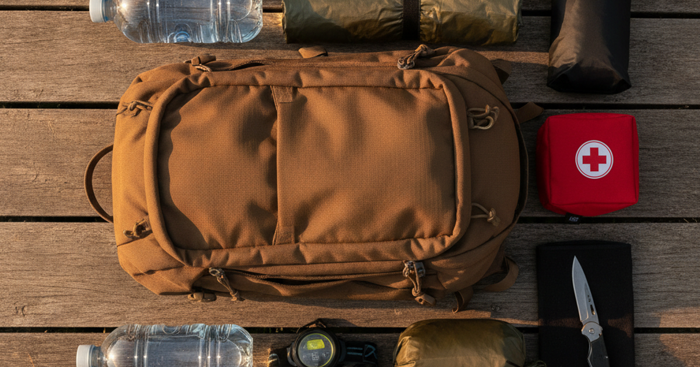
- First aid kit (tourniquet, pressure bandage, nitrile gloves, wound closure strips)
- Water bottle and small water purification option (Sawyer Squeeze or iodine tabs)
- Energy bars or calorie-dense snacks (enough for 12–24 hours)
- Phone charger and backup power bank
- Compact emergency poncho
- Pen and waterproof notepad
- Copy of key documents (ID, insurance, emergency contacts)
- N95 masks (filtration, not just for biological threats — wildfires, chemical spills)
For a detailed breakdown of how to extend this into a full 72-hour system, see our Complete 72-Hour Bug Out Bag Checklist for Urban Survival.
Tier 3: Vehicle Kit (Extended Capability)
Your vehicle is a mobile supply depot if you stock it correctly. This layer extends your capability significantly and handles scenarios your on-body carry can't manage alone.
- Full get-home bag with 48–72 hours of supplies
- Emergency food storage (calorie-dense, temperature-stable rations)
- Water storage and larger filtration system
- Change of clothes and weather-appropriate gear
- Jumper cables, tow strap, basic tools
- Paper maps of your region
- Fixed-blade knife and folding saw
- Emergency radio (hand-crank or battery-powered)
EDC Considerations for Urban, Suburban, and Rural Environments
One size does not fit all in EDC. An apartment dweller in a dense city faces different threats and different legal constraints than a homesteader on 40 rural acres. Here's how to think about customizing your loadout:
Urban preppers should prioritize concealability and legal compliance. Emphasis belongs on grey man aesthetics, urban navigation tools, and awareness of local ordinances. A compact multitool, a legal-length folder, and a quality flashlight can all disappear into a business bag without notice. Focus on tools that don't require explanation.
Suburban preppers often have the most flexibility — less restrictive laws than dense urban cores, more vehicle time, and typically a home base within reasonable reach. Build out your vehicle kit robustly and keep a full get-home bag in the trunk. Suburban environments also tend to have more social complexity in a crisis — neighbor dynamics and security considerations come into play quickly.
Rural preppers can carry more openly but face different challenges: longer distances from emergency services, greater self-reliance demands, and higher-consequence injuries from farm and outdoor work. Fixed blades, larger multitools, and more comprehensive first aid capability make sense here. Your EDC should reflect the specific hazards of your work environment — whether that's livestock, power tools, or remote terrain.
For more on how to approach trauma medical readiness — a critical complement to any EDC system — read our guide on First Aid Without a Doctor: Building a Trauma Kit for Long-Term Emergencies.
Situational Awareness: The EDC Tool That Costs Nothing
No amount of survival gear compensates for poor situational awareness. The most effective prepper tool you carry is your mind — specifically, a trained habit of observing your environment, identifying exits, noting anomalies, and trusting your instincts. Former military and law enforcement professionals consistently rank awareness as the number one survival skill, above any piece of equipment.
Practice the Cooper Color Code as a mental framework: White (unaware, relaxed), Yellow (relaxed alertness, appropriate for daily life), Orange (specific alert, something has triggered concern), Red (ready to act). Most people walk around in White all day. Preppers should operate in Yellow as a baseline — aware without being paranoid.
Keep your phone in your pocket more often than in your hand. Heads-up, eyes-scanning awareness is a force multiplier for every other tool in your EDC loadout.
Common EDC Mistakes to Avoid
- Carrying gear you haven't trained with. A folding knife you've never deployed under stress is less useful than you think. Practice drawing and opening your blade until it's muscle memory.
- Overloading your loadout. If your EDC is uncomfortable or cumbersome, you'll leave it home. Ruthlessly audit what you actually carry versus what looks good on a flat lay.
- Neglecting medical gear. Most EDC guides emphasize blades and lights but skip trauma gear. A tourniquet and pressure bandage are compact, lightweight, and address the most statistically likely life-threatening emergency you'll face.
- No redundancy. Single points of failure are dangerous. Have a backup light. Have a backup cutting tool. Carry extra cash.
- Ignoring local laws. Illegal carry creates legal liability that compounds your emergency. Know the rules for every environment you operate in.
Recommended Gear Summary
To build a solid EDC foundation, start with these proven tools. The Leatherman Wave Plus multitool and the Benchmade Griptilian EDC pocket knife form the backbone of any serious loadout. Add the Streamlight MicroStream USB tactical flashlight for reliable illumination and the Victorinox Swiss Army Knife EDC for low-profile utility in restricted environments. Round out your pocket carry with the Gerber Dime mini multitool with pocket clip as a lightweight redundant option or dedicated bag tool. You can find additional vetted options through our Recommended Survival Gear & Equipment page.
EDC is not about paranoia. It's about the same quiet confidence that leads a professional to carry a first aid kit in their car or a contractor to always have a tape measure on their belt. You carry these tools because problems don't schedule themselves — and because the gap between a bad situation and a catastrophic one is often filled by the prepared person who had the right tool at the right moment.
What You'll Need
- Quality multi-tool or folding knife
- Compact flashlight (LED, 100+ lumens)
- Fire-starting kit (lighter, ferrocerium rod, waterproof matches)
- Paracord (10-15 feet minimum)
- First aid supplies (bandages, antiseptic, pain relievers)
- Water purification tablets or filtration straw
- Emergency cash and copies of important documents
- Durable EDC pouch or organizer
Step-by-Step Instructions
Step 1: Select Your Primary Cutting Tool
Choose a reliable folding knife or multi-tool that balances functionality with portability. Your blade should be between 2.5 to 3.5 inches for legal compliance in most areas while remaining effective for cutting cordage, opening packages, and emergency situations. Test the locking mechanism thoroughly and ensure it can be operated with one hand. Consider a multi-tool if you need additional functions like pliers, screwdrivers, and wire cutters in a single compact package.
Step 2: Establish Your Illumination System
Carry a compact LED flashlight with at least 100 lumens output and multiple brightness settings. Select a model that uses common battery types like AA or AAA, or invest in a rechargeable version with USB charging capability. Keep a small backup light on your keychain as redundancy is crucial for preparedness. Always carry at least one spare set of batteries in your EDC kit.
Step 3: Build Your Fire-Starting Capability
Assemble multiple fire-starting methods following the "two is one, one is none" principle. Include a reliable butane lighter as your primary method, a ferrocerium rod for waterproof backup, and storm-proof matches in a waterproof container. Practice using each method in different weather conditions before relying on them in emergencies. Store these items in a small waterproof pouch to protect them from moisture and accidental discharge.
Step 4: Integrate Cordage and Utility Items
Wrap 10-15 feet of 550 paracord around a small spool or weave it into a bracelet or keychain for easy carry. Paracord provides incredible versatility for repairs, shelter building, securing gear, and emergency medical applications. Add a small roll of duct tape (wrap some around a old credit card to save space) and safety pins to your kit. These simple additions exponentially increase your ability to solve problems and make field repairs.
Step 5: Pack Essential Medical Supplies
Create a compact first aid kit containing adhesive bandages, gauze pads, medical tape, antiseptic wipes, and over-the-counter pain relievers. Include any personal prescription medications you require, along with antihistamines for allergic reactions. Add a small tube of antibiotic ointment and a pair of nitrile gloves for treating wounds safely. Review and rotate medical supplies every six months to ensure nothing has expired.
Step 6: Prepare Water Purification Solutions
Carry water purification tablets or a compact filtration straw that can make questionable water sources safe to drink. These lightweight items take up minimal space but provide critical capability during emergencies or unexpected situations. Include a collapsible water bottle or heavy-duty plastic bag that can hold purified water. Remember that hydration is one of your top survival priorities and can become critical within hours.
Step 7: Organize and Maintain Your EDC System
Consolidate all items into a durable EDC pouch, belt organizer, or distribute them across your pockets in a consistent pattern you'll remember under stress. Create a written inventory and check your EDC items weekly to ensure nothing is missing, damaged, or depleted. Include emergency cash in small denominations, photocopies of important documents, and emergency contact information in a waterproof sleeve. Practice accessing and using each item until it becomes second nature, because emergencies don't allow time for learning curves.
Frequently Asked Questions
What is the most important item to carry in an EDC kit for everyday preparedness?
The single most impactful item in most EDC loadouts is a quality multitool, because it replaces dozens of individual tools in a compact, always-available package. However, the "most important" item depends on your specific environment and threat profile. For urban preppers, a reliable flashlight and a legal folding knife may take priority. For anyone spending time in remote or rural areas, a trauma-capable first aid kit — including a tourniquet — addresses the most statistically dangerous scenarios. The best EDC kit is one you've thought through, practiced with, and actually carry every single day.
How do I build an EDC kit without looking like a prepper or drawing attention?
This is exactly where the grey man philosophy applies to everyday carry. The goal is to carry capable gear in a way that reads as completely ordinary to observers. Choose neutral-colored, non-tactical-looking bags. Opt for a classic Swiss Army Knife over a large tactical folder in professional or urban settings. Carry your flashlight in a pocket rather than clipped visibly to your belt. Avoid overt military or tactical branding on your gear when operating in public spaces. The most prepared person in the room is often the least visible one — and that's intentional. You can read more about this approach in our guide on Gray Man Methodology in a Societal Breakdown.
What's the difference between an EDC kit and a bug out bag, and do I need both?
Yes, you need both — they serve fundamentally different purposes. Your EDC kit is what you carry on your person every day: compact, lightweight tools designed for immediate, on-the-spot problem solving. A bug out bag is a larger, pre-packed kit designed to sustain you for 72 hours or more if you need to evacuate your home quickly. Think of EDC as your first layer of preparedness and your bug out bag as the layer you reach for when EDC alone isn't sufficient. If a crisis catches you away from home, your EDC buys you time and capability until you can reach your vehicle kit or get-home bag — which in turn bridges the gap back to your full emergency preparedness supplies. For help building that next layer, see our Complete 72-Hour Bug Out Bag Checklist for Urban Survival.
Affiliate Disclosure: SHTF Plan participates in the Amazon Services LLC Associates Program. Some links are affiliate links — we may earn a small commission at no extra cost to you.