Dead Air: How to Use Ham Radio Nets and Emergency Frequencies When Communication Infrastructure Collapses
When cell towers go dark and the internet dies, ham radio nets become your lifeline. Here's how to find, join, and use them when it matters most.
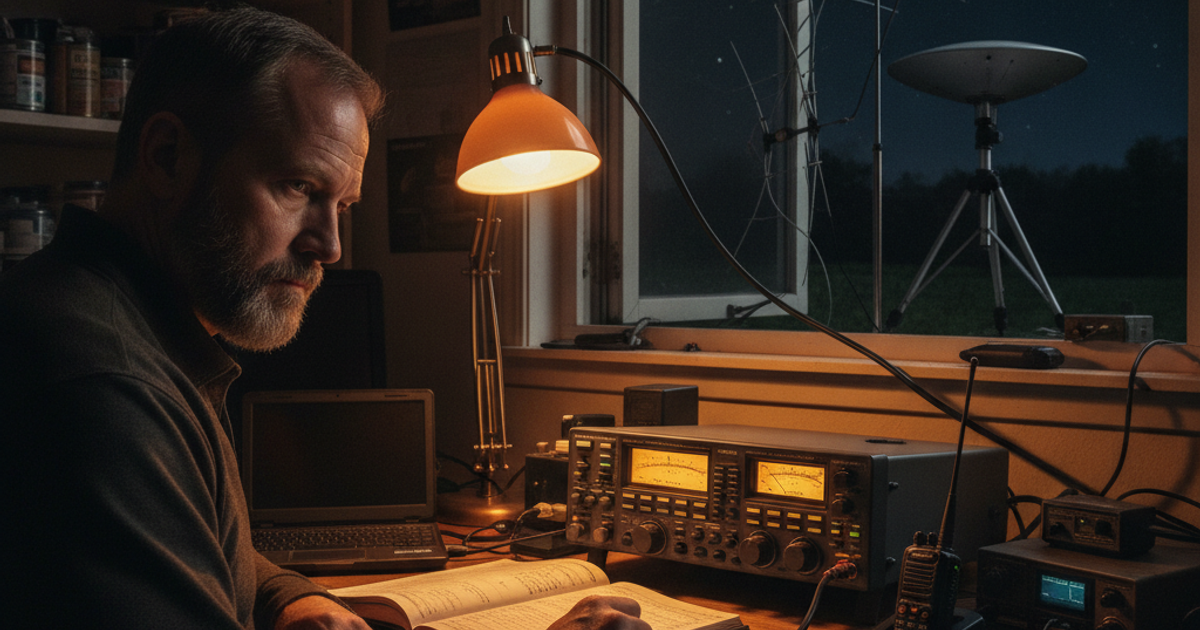
When the cell towers go silent, the internet drops, and landlines become useless relics, most people will be completely isolated — unable to reach family, coordinate with neighbors, or gather situational awareness about what's happening beyond their block. Amateur radio operators won't be. Ham radio has served as the backbone of emergency communication during disasters from Hurricane Katrina to the 2011 Tōhoku earthquake, and understanding how to use it effectively — not just how to turn it on — separates prepared communicators from people holding expensive paperweights.
This isn't a beginner's introduction to ham radio. This is about the operational side: nets, emergency frequencies, communication protocols, and how to integrate amateur radio into a functional SHTF communication plan whether you're in a high-rise apartment in Chicago, a suburban neighborhood in Phoenix, or a rural homestead with no neighbors for miles.
For those still building their layered communication strategy, our guide on how to build a layered emergency communication plan that works without cell service covers the full spectrum from CB radio to satellite messengers. This article goes deep on the amateur radio layer specifically.
What You'll Need
Tools
- Baofeng UV-5R dual band ham radio transceiver
- Yaesu FT-60R handheld amateur radio transceiver
- Icom IC-7300 HF transceiver
- Nagoya NA-771 high gain antenna
- SignaLink USB audio interface for digital modes
Supplies
- Goal Zero Yeti portable power station
- Printed frequency reference cards (laminated)
- Extra batteries or battery packs for handheld radios
- Coax cable and connectors
Understanding Ham Radio Nets: The Organized Communication Backbone
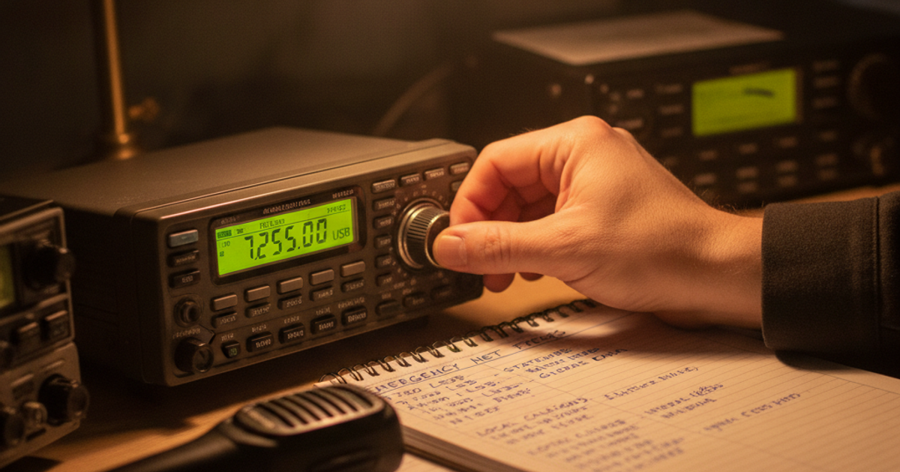
A ham radio net is a scheduled, organized on-air meeting of amateur radio operators on a specific frequency. Nets exist for countless purposes — traffic handling, emergency coordination, weather reporting, and simple community check-ins. During a SHTF event, nets become the primary mechanism through which real intelligence flows: road conditions, shelter locations, resource availability, and threat information.
There are three types of nets every prepper should understand:
- Emergency Nets: Activated during disasters, coordinated through ARES (Amateur Radio Emergency Service) and RACES (Radio Amateur Civil Emergency Service). These nets carry priority traffic and coordinate with served agencies like FEMA, Red Cross, and local emergency management.
- Traffic Nets: Designed to relay formal messages across geographic areas using the National Traffic System (NTS). A properly formatted radiogram can carry a message from a disaster zone to a family member hundreds of miles away even when all other communication is down.
- Preparedness Nets: Community-organized check-in nets that operate regularly in normal times and become critical coordination tools during emergencies. Many local ham clubs run weekly nets on their repeaters — find yours now, before you need it.
According to the ARRL (American Radio Relay League), there are over 750,000 licensed amateur radio operators in the United States alone. That network represents a massive, distributed communication infrastructure that requires no internet, no cell towers, and no centralized control to function.
Critical Emergency Frequencies Every Ham Prepper Must Know
Knowing your radio's capabilities means nothing if you don't know where to listen. These are the frequencies that matter when infrastructure collapses:
National and Regional Calling Frequencies
- 146.520 MHz (2-meter FM simplex): The national 2-meter simplex calling frequency. When repeaters go down, this is where local operators coordinate. Any ham in your area will monitor this frequency during an emergency.
- 446.000 MHz (70cm FM simplex): The national UHF simplex calling frequency. Shorter range than 2 meters but useful in urban environments and through repeaters.
- 14.300 MHz (20-meter HF): The Maritime Mobile Service Net and a major international emergency calling frequency. During regional disasters, HF operators can relay traffic to unaffected areas.
- 7.285 MHz (40-meter HF): The 40-meter voice calling frequency. Excellent for regional communication at 300–500 miles, particularly at night when propagation extends dramatically.
- 3.985 MHz (75/80-meter HF): Short to medium-range HF communication, highly effective for local-to-regional coordination after dark.
ARES and RACES Frequencies
Your local ARES group will have designated emergency frequencies that you need to look up before a disaster occurs. Contact your local ARRL Emergency Coordinator, attend a local ham club meeting, or visit the ARRL website to find your regional frequency plan. These are published publicly — there's no excuse for not having them written down and stored with your survival kit.
NOAA Weather Radio Frequencies
Most dual-band handhelds receive NOAA weather broadcasts. The seven national frequencies are 162.400, 162.425, 162.450, 162.475, 162.500, 162.525, and 162.550 MHz. Program all seven into your radio so it automatically scans to the strongest signal. During infrastructure collapse, NOAA weather radio often continues broadcasting long after other systems fail.
HF Radio for Long-Distance SHTF Communication
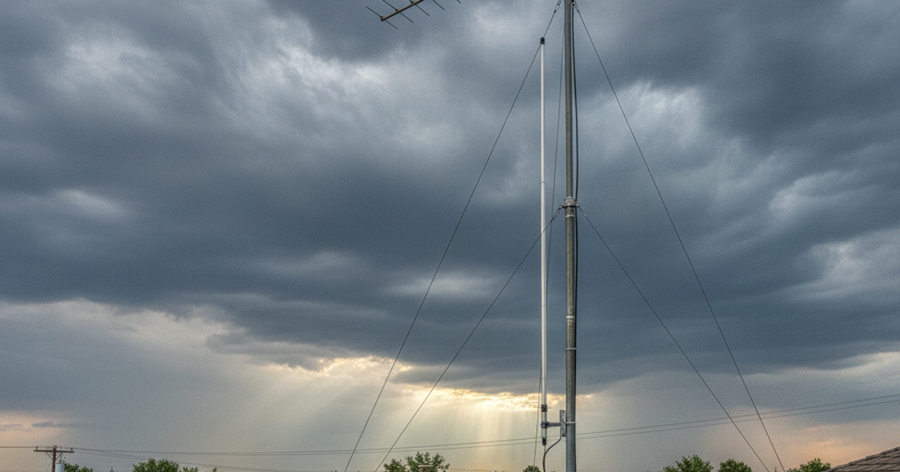
VHF and UHF frequencies (2 meters and 70cm) are excellent for local communication — typically 10–50 miles depending on terrain and antenna. But when you need to reach out further, HF radio is the tool. HF signals bounce off the ionosphere and can travel hundreds to thousands of miles without any infrastructure whatsoever.
The Icom IC-7300 HF transceiver is widely considered one of the best base station HF radios available today, featuring a direct-sampling SDR architecture, built-in spectrum scope, and exceptional receive sensitivity — capabilities that matter enormously when you're trying to pull weak signals out of a noisy, post-disaster radio environment.
For preppers who need a portable HF option that can go in a vehicle or bug-out location, the Yaesu FT-891 portable HF ham radio transceiver delivers full 100-watt output in a compact, vehicle-mountable package that runs efficiently on 12V power — ideal for mobile operations or a generator-powered emergency station.
Antenna performance is everything on HF. A great radio with a poor antenna will lose to a mediocre radio with a great antenna every time. The Buddipole portable HF antenna is a configurable, portable dipole system that can be set up and taken down quickly, making it suitable for apartment dwellers who need to deploy temporarily from a rooftop or window, suburban operators with HOA restrictions, and rural preppers who want a field-deployable option that doesn't require permanent installation.
Digital Modes: The Secret Weapon for Weak-Signal Emergency Communication
Voice communication is intuitive, but digital modes are far more effective when signal conditions are poor — and in a chaotic post-disaster environment, signal conditions will often be poor. Modes like JS8Call, Winlink, and WSPR can successfully decode messages at signal levels completely inaudible to the human ear.
Winlink deserves special attention for emergency preparedness. It's a global amateur radio email network that allows operators to send and receive email messages through radio — completely independent of the internet. During Hurricane Maria, Winlink was one of the only functioning communication systems in parts of Puerto Rico for weeks.
JS8Call is a keyboard-to-keyboard messaging mode that operates under weak signal conditions and includes a relay feature, meaning your message can be passed through multiple stations to extend range dramatically.
To run digital modes, you need an audio interface between your radio and computer. The SignaLink USB audio interface is the gold standard for this purpose — it provides clean, isolated audio in both directions with built-in level controls, eliminating the hum and interference that plague cheaper solutions. Pair it with free software like Winlink Express or JS8Call, and you have a serious long-range digital communication capability that most preppers never think to build.
Repeaters: Your Local Force Multiplier (And What Happens When They Go Down)
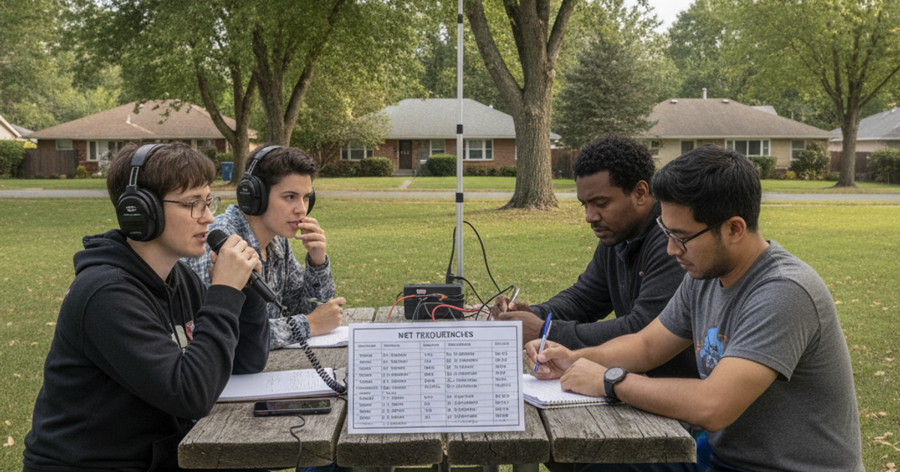
Repeaters are radio stations — usually on hilltops or tall buildings — that receive on one frequency and simultaneously retransmit on another, dramatically extending the range of handheld radios. Most local ham activity happens through repeaters in normal times. Many repeaters have backup power (batteries, generators) and will continue operating for hours to days after a grid failure.
Know your local repeaters now. The RepeaterBook app and website list virtually every repeater in North America with frequency, tone, and location data. Download or print a regional list and store it with your emergency preparedness supplies. When SHTF, you'll want to know which repeater has the best coverage in your area and which ones have backup power.
However, do not make repeaters your only plan. When a disaster is severe enough or extended enough, repeaters will eventually fail — batteries die, fuel for generators runs out. This is why knowing your simplex calling frequencies is non-negotiable. The Baofeng UV-5R dual band ham radio transceiver remains one of the most cost-effective entry points into amateur radio — a capable dual-band handheld that lets you program both repeater and simplex frequencies, receive weather broadcasts, and maintain basic local communication for under $30. Its low cost makes it realistic to have multiple units cached throughout your preparedness system.
For operators who want a step up in durability and reliability, the Yaesu FT-60R handheld amateur radio transceiver is a rugged, weather-resistant dual-band radio with excellent receiver sensitivity and a superior build quality compared to budget Chinese handhelds. Its WIRES internet linking system won't matter when infrastructure collapses, but its RF performance and durability absolutely will.
One of the most impactful and low-cost upgrades you can make to any handheld radio is replacing the stock rubber duck antenna. The Nagoya NA-771 high gain antenna is a dual-band whip that significantly improves both transmit and receive performance over factory antennas — a simple swap that can mean the difference between making contact and getting nothing but static.
Power: Keeping Your Radios Running When the Grid Is Gone
A radio is useless without power. HF base stations draw 20–25 amps at full transmit power. Even a handheld running continuously will drain batteries within hours. Power planning is as critical as frequency planning.
The Goal Zero Yeti portable power station is an excellent off-grid power solution for radio operations — it can run handheld chargers, laptop-based digital mode operations, and even smaller HF radios for extended periods, and it recharges via solar panels for truly indefinite off-grid operation. Pair it with a foldable solar panel and your communication station becomes genuinely self-sustaining.
For broader off-grid power planning, our article on how to choose the right solar panel system for home and bug-out power covers sizing and setup in detail.
Step-by-Step Instructions
Step 1: Obtain Your Amateur Radio License Before You Need It
The Technician class license is the entry point for amateur radio and covers VHF/UHF operation including all local and regional emergency frequencies. Study using the free ARRL Technician manual or the Ham Study app, pass a 35-question multiple choice exam at a local exam session, and you'll have a license valid for 10 years. The General class upgrade adds HF privileges and should be your next step — it's the license that gives you access to the emergency HF frequencies that reach beyond your region.
Step 2: Program Your Radios With Emergency Frequencies Before Disaster Strikes
Use CHIRP — free, open-source radio programming software — to program your handhelds with the national simplex calling frequencies (146.520 and 446.000 MHz), local repeaters with their correct CTCSS tones, all seven NOAA weather frequencies, and any ARES/RACES designated frequencies for your area. Print and laminate a frequency reference card and store one copy with each radio and another in your bug out bag.
Step 3: Identify and Check Into Local Nets Before an Emergency
Find your local ARES/RACES net schedule through the ARRL website or your local ham club. Check into these nets regularly — not just when SHTF. Net managers know participating operators, which means during a real emergency your calls will be recognized and your traffic prioritized. Familiarity with net protocol (how to check in, how to pass traffic, how to request priority) is a skill that only comes from practice.
Step 4: Establish a Pre-Planned Communication Schedule With Your Preparedness Group
Agree on specific frequencies and check-in times with family members or your survival group. A twice-daily check-in — say 0700 and 1900 local time — on a pre-agreed simplex frequency gives everyone a predictable communication window without requiring anyone to monitor a frequency continuously. Use phonetic alphabet (Alpha, Bravo, Charlie) for clarity, and develop a brief, structured reporting format: location, status, needs, and information to pass.
Step 5: Set Up and Test Your HF Digital Mode Capability
Install Winlink Express and JS8Call on a laptop, connect your SignaLink interface to your HF radio, and make test contacts before an emergency. Send a test Winlink email through the radio network. Make a JS8Call contact. These skills take time to develop and troubleshoot — audio levels, software settings, and antenna tuning all require adjustment. Discover and solve these problems now, not in the middle of a crisis.
Step 6: Build a Backup Power System Sized for Your Radio Equipment
Calculate your radio power requirements: a 100W HF radio draws roughly 20A at transmit, 2A at receive. A dual-band handheld draws less than 2A transmitting, milliamps receiving. Build your power system around actual operating patterns — most emergency communication involves far more receive time than transmit. A 100Ah AGM battery with solar charging can sustain HF operations indefinitely with disciplined operating habits.
Step 7: Store Your Critical Radios in a Faraday Enclosure
An EMP or severe solar event can destroy unprotected electronics instantly. Store at least one backup radio, a USB drive with software and frequency lists, and a spare SignaLink interface in a properly constructed Faraday cage. A metal ammunition can with a gasket seal, lined with cardboard or foam to prevent contact with the metal walls, is an effective and inexpensive solution. Test it — place an AM radio inside, close it, and confirm you cannot receive stations.
Step 8: Learn and Practice Net Protocol for Passing Formal Traffic
A properly formatted NTS radiogram has a specific structure: precedence, handling instructions, number, station of origin, check, place of origin, time, date, address, phone, text, and signature. This standardized format exists because it works — it allows your message to be relayed through multiple operators without degradation. Download the ARRL radiogram form, practice filling it out, and practice passing traffic during normal net operations so the process is automatic when it matters.
Operating Discipline: How to Communicate Effectively on Emergency Frequencies
Raw radio capability is worthless without operating discipline. During a real emergency, radio frequencies become congested and chaotic. The operators who communicate effectively are those who follow protocol.
- Listen before transmitting. Always monitor a frequency for at least 30 seconds before transmitting to avoid interrupting ongoing traffic.
- Keep transmissions short and information-dense. Every second you're transmitting is a second someone else can't. Say what needs to be said, nothing more.
- Use plain language, not 10-codes. 10-codes vary by jurisdiction and create confusion in multi-agency environments. The FCC and FEMA both recommend plain language for emergency communication.
- Never transmit personal identifying information, specific location details, or resource inventory over open frequencies unless operationally necessary. Practicing grey man principles extends to your radio communications.
- Identify yourself with your callsign at the beginning and end of every transmission as required by FCC rules. Even in emergencies, proper identification maintains order on the frequency.
For additional communication planning beyond radio, our guide on how to build a family emergency communication plan when cell networks fail covers the full planning process including rally points, out-of-area contacts, and non-radio backup methods.
Urban and Apartment Considerations for Ham Radio Operations
Apartment and urban preppers face real challenges with antenna installation, but they're not insurmountable. A magnetic loop antenna deployed inside an apartment can make HF contacts. A vertical antenna deployed temporarily on a rooftop or fire escape during an emergency is legal and practical. The Buddipole system mentioned earlier was specifically designed for portable and temporary deployment — it can be set up on a balcony railing or roof parapet in minutes.
For VHF/UHF operation in urban environments, a handheld radio with a good antenna used from a higher floor or rooftop can achieve remarkable range. The 15th floor of an apartment building is effectively a hilltop for radio purposes — use it. Urban operators also benefit from the density of repeaters in cities, many of which will continue operating on backup power well into a grid-down scenario.
Urban SHTF scenarios also require heightened situational awareness about who might be monitoring your transmissions. All amateur radio communications are technically public — anyone with a receiver can listen. Develop brevity codes and communication schedules with your group in advance, and never discuss sensitive preparedness details on open frequencies.
Recommended Gear
Building a complete ham radio emergency communication station requires layering equipment from handheld to base station. Start with the Baofeng UV-5R for affordable local coverage, upgrade to the Yaesu FT-60R for a more durable handheld option, and add the Nagoya NA-771 antenna to immediately improve range on either handheld. For regional and national reach, the Icom IC-7300 provides a world-class base station HF capability, while the Yaesu FT-891 offers a compact, mobile-ready alternative. Pair any HF radio