Smoke Signals to Satellites: How to Build a Layered Emergency Communication Plan That Works Without Cell Service
When cell towers go down and internet fails, most families go silent. Here's how to build a multi-layer comms plan that keeps you connected no matter what.
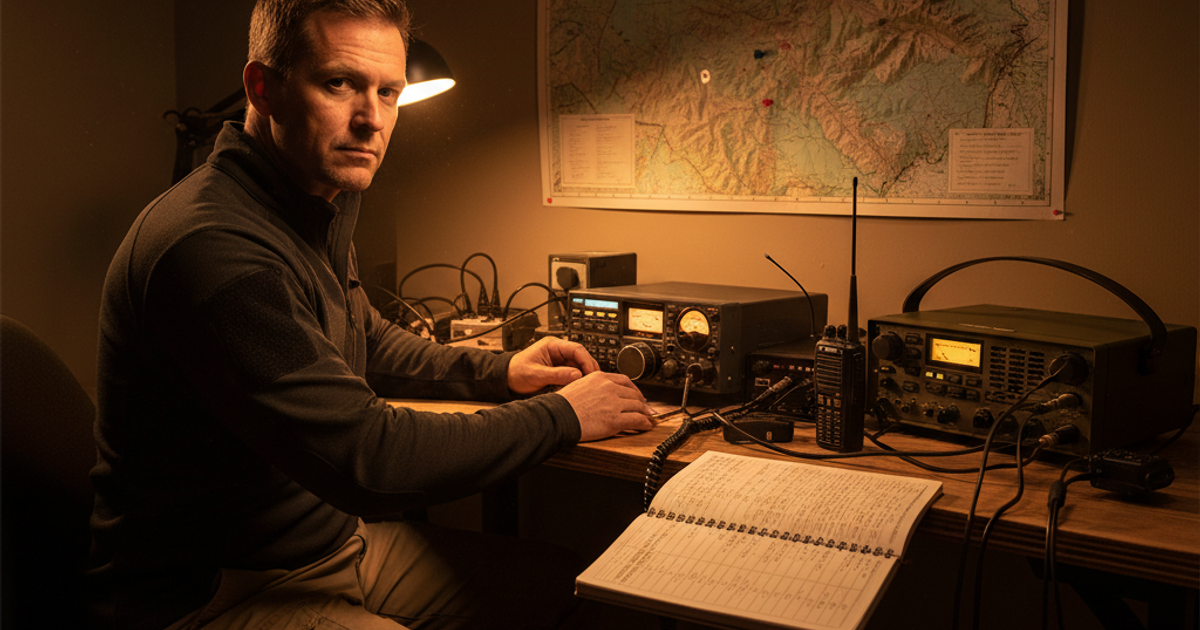
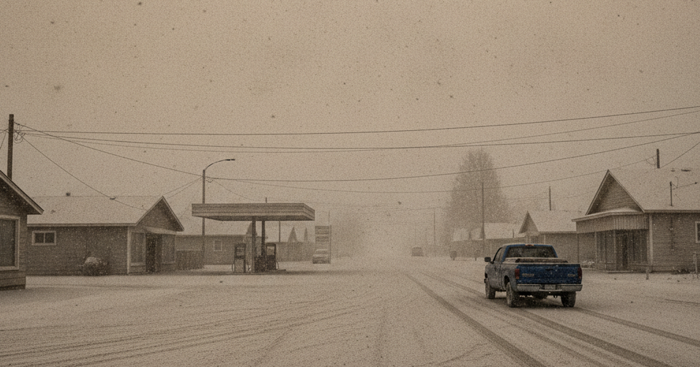
When Hurricane Katrina struck in 2005, cell towers failed within hours. When the 2011 Tōhoku earthquake and tsunami hit Japan, 90% of cellular infrastructure in affected areas went dark instantly. During the 2021 Texas winter storm, millions of people lost the ability to communicate with family members for days. The pattern is consistent and undeniable: when disasters strike hardest, cell networks fail first.
The average American has no backup communication plan. They assume 911 will answer, that text messages will go through, that Wi-Fi calling will bridge the gap. These assumptions are dangerous. A serious emergency preparedness mindset demands you build communication redundancy into your system long before you need it — not unlike how you approach building a complete family emergency communication plan for every other threat scenario.
This guide covers every layer of the communication stack — from satellite devices to smoke signals — so that no matter where you live, whether in a high-rise apartment, a suburban neighborhood, or a remote rural homestead, you have a reliable way to send and receive information when the grid goes dark.
What You'll Need
Tools
- Programmable HAM radio (handheld or mobile)
- Signal mirror or polished metal surface
- Antenna (external, for improved HAM radio range)
Supplies
- Baofeng UV-5R HAM radio transceiver
- Midland X-TALKER two-way walkie talkie
- Garmin inReach Mini satellite communicator
- Pre-written message cards (laminated)
- Physical paper maps of your region
Why Cell Networks Fail — and Why That Matters for Every Prepper
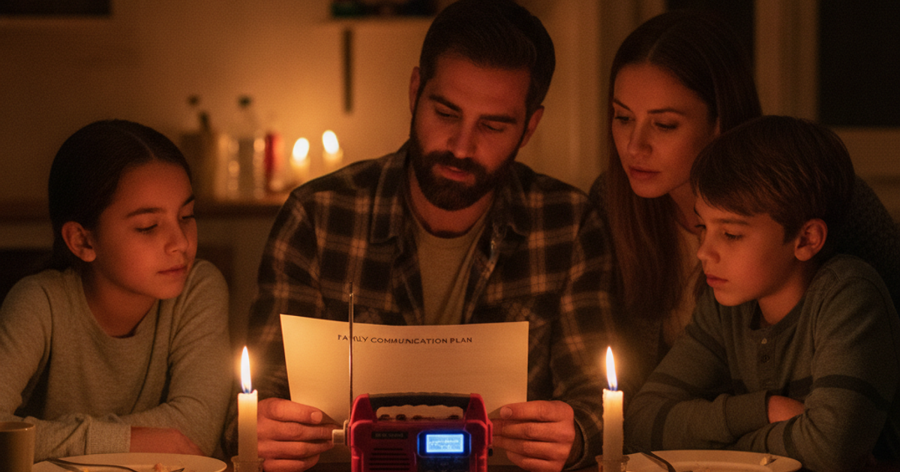
Cell towers rely on commercial power to operate. Most have battery backup rated for only 4–8 hours, with generator backup at a fraction of towers. According to the FCC, during major disasters, over 25% of cell sites in affected areas go offline. In a localized event like a tornado or house fire, this number can hit 100% in your immediate vicinity due to tower damage or network congestion alone — even without a power failure.
This isn't a hypothetical SHTF scenario. It's Tuesday during a bad storm. Your emergency preparedness has to account for reality, not just worst-case fiction. The layered communication system outlined here applies whether you're bugging in at your apartment or managing a bug out bag situation from a rural retreat.
Layer 1 — Satellite Communication Devices for True Off-Grid Reach
At the top of your communication stack sits satellite technology — the only layer that functions completely independent of any terrestrial infrastructure. These devices use Low Earth Orbit (LEO) or geostationary satellites to send GPS coordinates, text messages, and SOS signals anywhere on the planet.
The Garmin inReach Mini satellite communicator is one of the most capable and compact devices in this category. It connects to the Iridium satellite network — which provides true global coverage — and allows two-way text messaging, GPS tracking, and SOS alerts with a monitored response center. This is the device that works in the middle of a remote canyon or on the 20th floor of an urban high-rise with a clear sky view. A subscription plan is required, but the cost is modest compared to the peace of mind it delivers.
For a more budget-conscious satellite option, the SPOT Gen4 satellite GPS messenger offers one-way messaging, GPS tracking, and SOS capability at a lower monthly cost. It's an excellent addition to a bug out bag or vehicle emergency kit for anyone who doesn't need two-way messaging but wants to confirm their safe arrival or trigger an SOS signal when nothing else works.
Layer 2 — HAM Radio for Regional Emergency Communication Networks
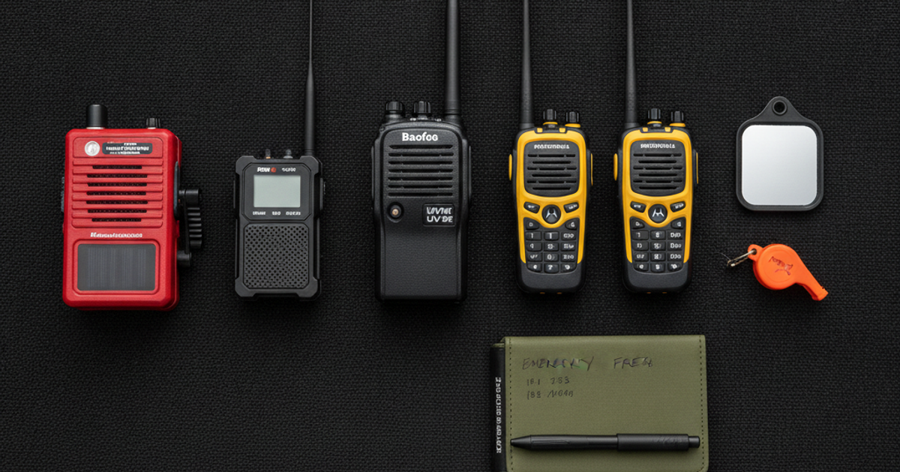
HAM (amateur) radio is the gold standard of off grid communication for serious preppers. Licensed HAM operators have access to a vast spectrum of frequencies, can communicate across hundreds or even thousands of miles under the right conditions, and can tap into a nationwide network of emergency repeaters maintained by organizations like ARRL and ARES.
Getting your Technician license — the entry-level HAM license — requires passing a 35-question multiple choice exam with no Morse code requirement. Most people pass with 2–3 weeks of study using free resources like HamStudy.org. This license unlocks VHF and UHF frequencies used by most local emergency nets.
For budget-minded preppers, the Baofeng UV-5R HAM radio transceiver is a popular starting point. It's a dual-band VHF/UHF handheld radio that can be programmed to monitor NOAA weather channels, FRS/GMRS frequencies, and local repeaters for under $30. It's not the most durable radio on the market, but as a first HAM radio for learning and SHTF communications, it's hard to beat the value.
For those who want professional-grade capability, the Kenwood TH-D74A handheld HAM radio is a tri-band radio with built-in APRS (Automatic Packet Reporting System), D-STAR digital capability, and Bluetooth. APRS is particularly valuable for emergency communication — it allows your radio to beacon your GPS position and exchange data messages across a network of digipeaters without requiring anyone to manually relay your message. For a deeper dive into getting your HAM license and building a network, check out our guide to HAM radio for preppers.
Layer 3 — FRS/GMRS Two-Way Radios for Short-Range Family and Team Comms
For communication within your immediate group — family members in different parts of a building, a neighborhood mutual aid team, or a patrol around your property — FRS (Family Radio Service) and GMRS (General Mobile Radio Service) radios are your workhorses. FRS requires no license; GMRS requires a simple $35 FCC license that covers your entire household for 10 years.
The Midland X-TALKER two-way walkie talkie is a reliable, weather-resistant option with a range of up to 38 miles in ideal conditions (expect 1–3 miles in dense urban environments and up to 5 miles in open suburban or rural areas). These radios are simple enough for children to operate, rechargeable, and robust enough for serious field use. Keep a pair in your go-bag and distribute radios to every adult in your household as part of your core survival gear.
GMRS radios run on the same frequencies as FRS but at higher power levels, dramatically increasing range. With a GMRS license, you can also use repeaters — community-maintained relay stations that can extend your range to 50+ miles even in urban terrain.
Layer 4 — Mesh Network Radios for Off-Grid Digital Communication

Mesh networking is one of the most important — and underutilized — tools in the modern prepper's communication toolkit. A mesh network creates a decentralized radio network where each node relays messages to the next, with no central server or tower required. The goTenna Mesh network radio device pairs with your smartphone via Bluetooth to send encrypted text messages and GPS locations over a mesh network. Every additional goTenna device in range extends the network's reach — making this ideal for a community of preppers or a neighborhood watch group.
For a deeper technical look at building a prepper mesh network, our dedicated guide on prepper mesh radio networks covers hardware options, node placement strategy, and integration with HAM radio systems.
Layer 5 — Emergency Weather Alert Radios for One-Way Information Reception
Communication isn't just about transmitting — it's about receiving accurate, actionable information. The Midland WR300 emergency weather alert radio receives NOAA Weather Radio broadcasts 24/7 and triggers automatically when a weather or civil emergency alert is issued for your county. NOAA's Weather Radio All Hazards network transmits not just severe weather alerts, but also AMBER alerts, national security alerts, and chemical or radiological emergency warnings. This radio should be in every home — apartment, suburban house, or rural cabin — and kept charged or plugged in at all times. It's passive emergency preparedness: you don't have to do anything for it to save your life.
Layer 6 — Analog and Visual Signaling Devices for the Deepest Backup
When every electronic device has failed — batteries dead, satellite subscription lapsed, mesh network too sparse — you fall back to the oldest communication tools in human history. Analog signaling devices require no power, no license, and no infrastructure. They just work.
A signal mirror is perhaps the most underrated item in any survival kit. Under direct sunlight, a quality mirror can reflect a beam of light visible up to 10 miles away — far beyond the range of any FRS radio. The UST signal mirror emergency signaling kit includes a retroreflective aiming system that lets you direct the reflection accurately toward a target even when you can't see them clearly. This belongs in every bug out bag, vehicle kit, and workplace emergency kit.
Beyond mirrors, smoke signals, ground-to-air symbols (visible to rescue aircraft), a loud whistle, and physical written messages left at pre-agreed locations (called "dead drops") round out your lowest-tech communication layer. Learn the international ground-to-air rescue signal code: a large "X" means you need medical assistance, "V" means you need help, and an arrow points the direction you're traveling.
For more on analog signaling techniques, our guide to signaling for rescue using mirrors, whistles, and smoke goes deep on every method.
Step-by-Step Instructions
Step 1: Assess Your Current Communication Gaps and Threat Environment
Before buying any equipment, map out your realistic scenarios. Are you in a dense urban area where line-of-sight radio range will be limited? A suburb where a neighborhood net would work well? A rural area miles from the nearest repeater? Your environment determines which layers deserve the most investment. Write down the three most likely emergencies for your area — severe weather, earthquake, civil unrest — and identify which communication layers would survive each one.
Step 2: Establish a Pre-Agreed Family Communication Protocol
Your technology is useless if your family doesn't know how to use it or when. Create a written communication plan that includes: a designated out-of-area contact everyone can report status to, pre-set check-in times (e.g., every 6 hours), pre-arranged rally points if you can't reach each other, and a code word system for urgent versus non-urgent messages. Laminate this plan and keep a copy in every bug out bag, vehicle, and at your home meeting point.
Step 3: Get Your HAM Technician License and Program Your Radio
Study for your Technician license using HamStudy.org or the ARRL study guide — most people are ready to test within two to three weeks. Once licensed, program your radio with local repeater frequencies (find them at repeaterbook.com), NOAA weather channels, and GMRS calling frequencies. Pre-programming removes the cognitive load of finding frequencies in a high-stress situation.
Step 4: Build and Test Your Short-Range Team Radio Network
Distribute FRS/GMRS radios to every adult household member and key neighbors in your mutual aid group. Conduct a monthly radio check — actually key up and confirm two-way communication. Test inside buildings, in vehicles, and at your maximum expected range. Document dead zones in your area so you can plan around them during an actual emergency.
Step 5: Configure Your Mesh Network and Satellite Devices
Set up your goTenna Mesh devices with pre-loaded contacts, including all household members and your mutual aid group. Register your satellite communicator, activate your subscription, and program your check-in contacts. Test the satellite device from your home location to confirm sky visibility is sufficient for reliable operation. Store these devices charged and in a location every family member knows.
Step 6: Position Your Emergency Weather Radio and Monitor NOAA Frequencies
Place your NOAA weather alert radio in a central location where it will wake sleeping household members. Program it with your county's FIPS code so you only receive relevant local alerts, not distant ones. Test the alert function monthly. Keep a battery backup in the unit at all times in case of power outage — many alerts come in the middle of the night during storms when the grid is already stressed.
Step 7: Practice Analog Signaling Techniques With Your Group
At least twice a year, practice non-electronic communication with your household and mutual aid group. Run a drill where all electronic devices are prohibited — communicate using only written notes, pre-arranged signals, and physical rally points. This reveals gaps in your analog plan you won't discover any other way. Practice using your signal mirror outdoors on a clear day so you can aim it accurately under pressure.
Step 8: Protect All Electronic Communication Gear Against EMP and Moisture
Store backup radios and communication devices in a sealed, moisture-proof container. Consider a basic Faraday cage — a metal ammunition can lined with cardboard works well — for your backup HAM radio and satellite communicator. This protects against both moisture damage and the electromagnetic pulse risk discussed in our guide to EMP survival and grid-down preparedness. Label your storage containers clearly so anyone in your group can access them in an emergency.
Recommended Gear Summary
To build a complete layered communication system, you'll want to work through each tier systematically. Start with the basics — a Midland WR300 emergency weather alert radio for passive monitoring and a pair of Midland X-TALKER walkie talkies for household comms — then build upward. Add a Baofeng UV-5R while you study for your HAM license, upgrade to a Kenwood TH-D74A when you're ready for serious APRS capability, and integrate goTenna Mesh devices for your neighborhood network. At the top of the stack, a Garmin inReach Mini or SPOT Gen4 ensures you can always reach someone, anywhere. And never leave home without a UST signal mirror kit in your pack — when batteries die, the sun still shines.
You can browse more curated survival gear recommendations on our recommended survival gear and equipment page.
Frequently Asked Questions
Do I need a license to use a HAM radio in an emergency?
Technically, anyone may transmit on HAM frequencies without a license to protect life or safety under FCC Part 97.405. However, you must be a licensed operator to transmit under normal conditions, and without regular practice you won't be able to use the radio effectively under stress. Getting your Technician license takes a few weeks of study and dramatically increases your capability — it's one of the highest-value investments any prepper can make. The license also allows you to legally program and use higher-powered GMRS radios that cover your entire family.
What's the best emergency communication option for someone living in an apartment?
Apartment dwellers have excellent options at every tier. A NOAA weather alert radio is plug-and-play. FRS/GMRS radios work well within a building and across a parking lot. A goTenna Mesh device paired with your smartphone provides encrypted off-grid texting to others in your network within a mile or two, extending further with more nodes. And a satellite communicator like the Garmin inReach Mini works from any rooftop, balcony, or window with sky visibility — the ultimate backup that requires no neighborhood infrastructure at all. The key is layering multiple tools rather than depending on any single device.
How far do two-way radios actually work in a real emergency situation?
Manufacturer range claims — often 25 to 50 miles — are achieved in ideal, line-of-sight conditions over flat open water or plains. In urban environments with buildings, expect 0.5 to 2 miles. In dense forest or hilly suburban terrain, 1 to 3 miles. In open rural areas, 3 to 5 miles for FRS and up to 20+ miles for GMRS with a repeater. Height dramatically improves range — a radio on a rooftop or hilltop can reach 3–5 times farther than one at street level. For urban survival scenarios, plan your communication around realistic ranges and use HAM repeaters to bridge longer distances.
Affiliate Disclosure: SHTFPlan.net participates in the Amazon Services LLC Associates Program. Some links are affiliate links — we may earn a small commission at no extra cost to you.