When Cell Networks Fail: How to Build a Family Emergency Communication Plan
When cell towers go down, most families have no backup plan. Here's how to build a layered communication strategy that keeps your people connected when SHTF.
When disaster strikes, the first casualty is often your ability to communicate. Cell networks collapse under the weight of millions of simultaneous calls, towers lose power within hours, and the digital lifeline you rely on every day simply vanishes. According to FEMA, cellular networks failed or became severely congested in nearly every major disaster of the past two decades — from Hurricane Katrina to the 2017 wildfires in California to the February 2021 Texas grid failure. If your emergency preparedness plan depends entirely on your smartphone, you don't have a plan. You have a wish.
A layered family emergency communication plan is one of the most critical — and most overlooked — elements of serious prepper readiness. It doesn't matter whether you live in a high-rise apartment, a suburban neighborhood, or a rural homestead: when the grid goes down, you need pre-established ways to find each other, share information, and coordinate action. This guide walks you through building exactly that.
Why Cell Networks Fail First in a Grid-Down or SHTF Scenario
Most cellular towers have battery backup rated for only 4 to 8 hours. Generator-equipped towers may last 24 to 72 hours, but fuel resupply becomes impossible during widespread disasters. Beyond power failure, sheer call volume overwhelms networks within minutes of a major event. The FCC documented that during 9/11, over 90% of calls in lower Manhattan failed to connect due to network congestion alone.
Text messages often get through when voice calls don't, because they use far less bandwidth. For this reason, your plan should never assume voice calls will work. Assume nothing digital will function and build upward from there.
Step One: Establish Clear Rally Points Before You Need Them
The foundation of any family emergency communication plan isn't technology — it's geography. Every member of your household, including children, needs to know at least two pre-designated rally points by heart.
- Primary rally point: A location close to home, such as a neighbor's driveway, a specific street corner, or the front of your apartment building. This is where you meet if you need to evacuate immediately and communication is impossible.
- Secondary rally point: A location further away — ideally outside your immediate neighborhood — in case the primary is inaccessible. A library, a church, a relative's home, or a community center works well.
- Out-of-area contact: Designate a single trusted person who lives in a different city or region. During localized disasters, long-distance calls often succeed when local ones don't. Every family member should memorize this person's phone number — written on paper in their bug out bag and committed to memory.
For urban preppers living in apartments, rally points require extra planning. Elevators will be offline, stairwells may be crowded, and your building may be cordoned off by first responders. Establish meeting points that account for these realities — and walk the routes with your family in advance so they're not navigating under stress for the first time.
Step Two: Build Your Radio Communication Layers
Two-way radios are the backbone of grid-down family communication. Unlike cell phones, they require no infrastructure, no towers, and no subscriptions. For a deep dive into radio selection, we've covered this extensively — but here's how the layers break down in practice.
Layer One: FRS/GMRS Family Radios for Short-Range Communication
Family Radio Service (FRS) and General Mobile Radio Service (GMRS) radios are the most accessible entry point. They require no license for FRS operation, are inexpensive, and can be handed to every member of your group — including teenagers and older children. The Midland T71 VP3 two-way radio family pack is a strong choice here, offering up to 38 miles of range in open terrain, NOAA weather alerts, and a waterproof design that holds up in field conditions. Pack one in every family member's survival kit or bug out bag so no one is left without a communication device during a separation event.
If you want Bluetooth integration for hands-free use — useful while driving, working, or maintaining situational awareness during an urban evacuation — the Motorola T800 two-way radio with Bluetooth pairs with a smartphone app for expanded features while still functioning as a standalone radio when the network is down. It's a solid option for preppers who want versatility without sacrificing core off-grid capability.
Layer Two: Ham Radio for Extended Range and Information Gathering
For serious preppers, a ham radio license opens up an entirely different tier of communication capability. Licensed amateur radio operators can access repeater networks that dramatically extend range, connect with regional emergency communication nets, and even pass messages across the country through linked systems. The BaoFeng UV-5R ham radio transceiver is one of the most popular entry-level dual-band radios in the prepper community — affordable, compact, and capable of both transmitting and receiving on VHF/UHF frequencies. Pair it with a Technician Class license, which requires only a 35-question multiple-choice exam, and you unlock a communication layer that most people will never have access to during a SHTF scenario.
For a comprehensive look at building a ham radio network, see our guide on HAM Radio for Preppers: How to Build a Reliable Emergency Communication Network.
Layer Three: Emergency Weather Radio for One-Way Information Intake
Communication isn't only about transmitting — it's about receiving reliable information when every other source has gone dark. A dedicated NOAA weather alert radio keeps you informed about storm warnings, evacuation orders, and emergency broadcasts even when the internet and cell networks are offline. The Midland ER310 emergency weather alert radio includes a hand crank and solar charging panel, a built-in flashlight, and the ability to charge small devices via USB — making it a multi-functional piece of emergency gear that belongs in every survival kit, whether you're sheltering in place in an apartment or bugging out to a rural location.
Layer Four: Satellite Communication for When Nothing Else Works
When regional infrastructure is completely destroyed — as seen after major hurricanes, earthquakes, or an EMP event — even ham radio repeaters may be offline. Satellite communicators bypass terrestrial infrastructure entirely, connecting directly to orbital satellites regardless of local conditions. The Garmin inReach Mini satellite communicator allows two-way text messaging, GPS tracking, and SOS signaling from anywhere on Earth with a clear view of the sky. It requires a subscription plan, but for families with members who may be separated across significant distances during a regional disaster, it represents the highest-reliability communication option available to civilians.
Step Three: Create a Written Communication Protocol
Technology is only as useful as the human systems built around it. Your family needs a written protocol — printed on paper, laminated if possible, and stored in each person's emergency preparedness kit — that covers the following:
- Check-in schedule: Establish specific times each day when all family members attempt contact. For example, 7:00 AM, 12:00 PM, and 6:00 PM. This prevents radios from being keyed constantly and preserves battery life.
- Channel assignments: Designate a primary and backup channel for your FRS/GMRS radios. Include CTCSS/DCS privacy codes if your radios support them to reduce interference from other users on the same channel.
- Code words: Simple pre-agreed phrases can convey complex information quickly. "Green light" might mean "I'm safe, stay in place." "Red flag" might mean "Evacuate immediately to secondary rally point." Keep it simple enough for children to remember.
- Out-of-area contact protocol: Everyone knows to call or text the designated out-of-area contact first, leave a status message, and check for messages from that contact before trying to reach other family members directly.
Step Four: Practice and Maintain Your Plan
A communication plan that exists only on paper is worth almost nothing under stress. Run a quarterly drill where your family practices using the radios, navigates to rally points, and executes the check-in schedule without using cell phones. This is especially important for children — teaching kids survival skills and emergency protocols before a crisis is one of the highest-return investments a prepper can make.
Maintain your equipment rigorously. Rotate batteries on a schedule, test radios monthly, and verify that your Garmin inReach subscription is active. Radios stored in a drawer for two years with dead batteries are survival gear in name only.
Your communication plan also intersects with broader preparedness across the board — make sure your household is equally solid on comprehensive family emergency planning that covers shelter, water, and food alongside communication.
Communication and OPSEC: What You Broadcast Matters
Radio transmissions can be monitored by anyone with a scanner. In a prolonged grid-down scenario, broadcasting your location, group size, or supply status over an open channel is a serious operational security risk. Keep transmissions brief, use your pre-agreed code words, and avoid revealing sensitive information. For more on protecting your preparedness information, review the principles covered in our article on OPSEC for Preppers.
What You'll Need
- Hand-crank or battery-powered emergency radio (NOAA Weather Radio capable)
- Family Radios Service (FRS) or General Mobile Radio Service (GMRS) two-way radios
- Laminated emergency contact cards for each family member
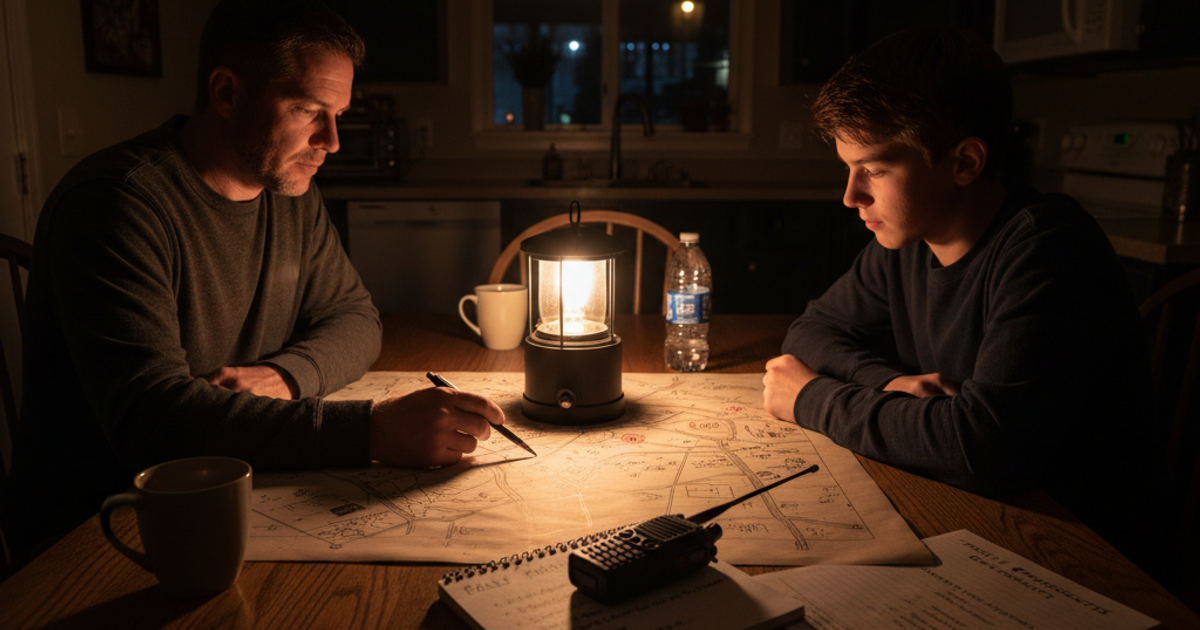
- Physical maps of your local area and evacuation routes
- Whistle for each family member
- Waterproof document holder for your communication plan
- Backup power sources (batteries, solar chargers, power banks)
Step-by-Step Instructions
Step 1: Designate Primary and Secondary Rally Points
Choose two physical meeting locations where family members will gather if communication fails. Your primary rally point should be your home or a nearby landmark within walking distance, such as a specific park, school, or community center. The secondary rally point should be outside your immediate neighborhood in case local evacuation is necessary, ideally 5-10 miles away at a relative's home, church, or recognizable public location. Write down exact addresses and ensure every family member can navigate to both locations without GPS.
Step 2: Establish Communication Check-In Times
Set specific times each day when family members will attempt to make contact or arrive at rally points. For example, establish check-in windows at 9:00 AM, 2:00 PM, and 7:00 PM daily. This prevents family members from wandering aimlessly or waiting indefinitely at meeting points. If someone doesn't arrive during the designated 30-minute window, family members should proceed to the secondary location or follow predetermined contingency protocols.
Step 3: Create an Out-of-State Contact Person
Select a trusted friend or relative who lives at least 100 miles away to serve as your family's communication hub. During regional disasters, long-distance lines often remain operational when local networks fail, and an out-of-state contact won't be affected by the same emergency. Provide this person with your complete family communication plan, rally point addresses, and contact information for all family members. Each family member should memorize this person's phone number and address.
Step 4: Assign Communication Roles and Equipment
Distribute two-way radios to family members and assign each person a specific channel and call sign. Program your radios to privacy codes to reduce interference and test them regularly from various locations your family frequents. Ensure everyone knows how to operate the equipment, change batteries, and understands basic radio etiquette. Keep a master list of who has which radio and what channel/code combination each family member will monitor.
Step 5: Map Alternative Communication Methods
Identify low-tech communication options for leaving messages when direct contact isn't possible. Establish a specific location at your home where family members can leave physical notes (such as under a particular rock, in a mailbox, or taped to a specific window). Teach children and elderly family members simple visual signals, such as placing a specific colored cloth in a window to indicate "safe" or "relocated." Document these alternative methods in writing and review them quarterly.
Step 6: Practice Your Communication Plan
Conduct quarterly drills where family members practice the entire communication protocol without using cell phones. Simulate different scenarios such as "home is inaccessible" or "school is on lockdown" and have family members navigate to rally points and use alternative communication methods. Time how long it takes each person to reach designated locations and identify gaps in your plan. After each drill, gather feedback and update your plan based on lessons learned.
Step 7: Document and Distribute Your Complete Plan
Create laminated wallet-sized cards containing all critical information: rally point addresses with coordinates, check-in times, out-of-state contact details, radio channels, and alternative communication methods. Each family member should carry this card at all times in their wallet, purse, or school bag. Store additional copies in your vehicle glove compartments, emergency kits, and at your workplace. Review and update the plan annually or whenever family circumstances change, such as new jobs, schools, or residences.
Frequently Asked Questions
What two-way radio should I buy for family emergency communication?
For most families, a quality FRS/GMRS radio like the Midland T71 VP3 family pack is the best starting point. It requires no license for FRS frequencies, is easy for all family members to use, and provides reliable short-range communication up to several miles in realistic terrain. If you want extended range and are willing to obtain a Technician Class amateur radio license, adding a BaoFeng UV-5R for each adult in your group significantly expands your capability. Ideally, you build both layers into your plan.
How do I communicate with family members who are far away during a disaster when cell networks are down?
The most reliable method for long-distance communication during a regional grid-down event is a satellite communicator like the Garmin inReach Mini, which operates independently of all terrestrial infrastructure. For medium-distance communication, licensed ham radio operators can use repeater networks and HF frequencies to pass messages hundreds or thousands of miles. Additionally, designating an out-of-area contact person — someone in a different city who can relay messages between separated family members — is a low-tech strategy that has proven effective in virtually every major disaster.
Do I need a license to use a two-way radio for emergency communication?
FRS radios (Family Radio Service) do not require a license and are legal for anyone to operate. GMRS radios require an FCC license, which costs $35 and covers your entire immediate family for 10 years — no exam required. Ham radio requires passing a written exam but unlocks far more powerful communication capabilities. During a declared emergency, FCC rules generally permit unlicensed individuals to use any available frequency to call for help, but your day-to-day preparedness should not rely on that exception. Get licensed and know your equipment before you need it.
Affiliate Disclosure: SHTF Plan participates in the Amazon Services LLC Associates Program. Some links are affiliate links — we may earn a small commission at no extra cost to you.