Can Your EV Power Your House? How to Use Electric and Hybrid Vehicles for Emergency Backup Power
Your electric or hybrid vehicle may hold more usable energy than ten portable generators' worth of fuel. Here's how to safely tap that battery to run your home when the power goes out.
When the grid goes down, most preppers think first about generators, fuel cans, and solar panels. Meanwhile, a 60 to 130 kilowatt-hour battery is parked in the driveway. A fully charged Ford F-150 Lightning with the extended-range pack holds roughly 131 kWh of usable energy. The average American home consumes about 29 kWh per day according to U.S. Energy Information Administration data — meaning that truck alone could theoretically carry a household for three to four days, and well over a week if you ration loads down to refrigeration, lighting, and communications.
That matters more every year. Climate Central's analysis of federal outage data found weather-related power outages rose 78% in the 2011–2021 decade compared to 2000–2010. Texas, California, Louisiana, and the Northeast have all seen multi-day blackouts that killed people. If you already own an electric or hybrid vehicle, you own an emergency power asset — but only if you understand how to safely get electricity out of it and into your house.
Why Your EV Is the Biggest Battery You Already Own
Compare the numbers. A premium portable power station holds 1–3.6 kWh. A DIY lithium battery bank might reach 10–15 kWh for several thousand dollars. A mid-range EV holds 60–100 kWh of lithium-ion storage that you already paid for, already maintain, and already keep charged. Even a Toyota Prius hybrid carries a traction battery plus an onboard gasoline engine that can act as a whisper-quiet, fuel-efficient generator burning roughly 0.15–0.2 gallons per hour under light load — far better than a conventional 5,000-watt generator chugging through half a gallon an hour.
This works for apartment dwellers too. You can't install a whole-home transfer switch in a rented unit, but you can run an extension cord from a vehicle outlet in the parking garage (gas and hybrid vehicles must be outside, never in an enclosed space) to keep a refrigerator, CPAP, and phones alive.
Understanding V2L, V2H, and V2G Bidirectional Charging
Vehicle-to-Load (V2L)
The simplest form. Hyundai Ioniq 5, Kia EV6, Ford F-150 Lightning, Chevy Silverado EV, and Rivian trucks include 120V (and sometimes 240V) outlets built into the vehicle. The Lightning's Pro Power Onboard delivers up to 9.6 kW — more than most portable generators. Hyundai/Kia V2L adapters deliver about 1.9 kW. Plug in directly, no electrician required.
Vehicle-to-Home (V2H)
True V2H uses a bidirectional charger and a critical-loads panel or automatic transfer switch to backfeed your house wiring. Ford's Charge Station Pro plus the Home Integration System, GM Energy's V2H bundle, and third-party hardware like the Fermata Energy bidirectional EV charger (which pioneered CHAdeMO-based discharge with the Nissan LEAF) make this possible. Expect $3,000–$7,000 installed, plus a licensed electrician and a permit.
Vehicle-to-Grid (V2G)
V2G sells power back to the utility. Interesting for your electric bill, irrelevant during SHTF. Ignore it for preparedness planning.
What You'll Need
Tools
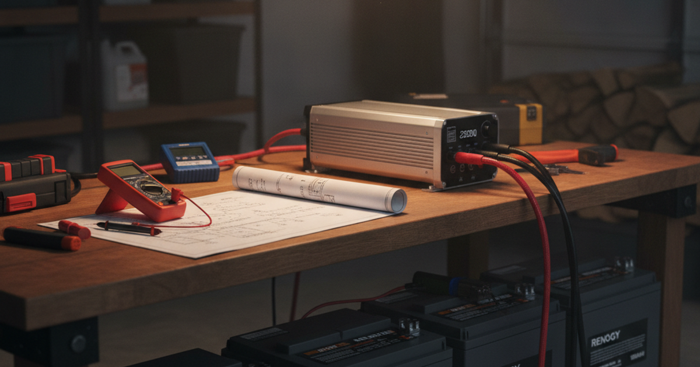
- Multimeter (to verify voltage and confirm circuits are dead)
- Clamp ammeter for measuring actual load draw
- Socket set and wire crimpers for inverter cable terminals
- Kill-A-Watt style plug-in energy meter
Supplies
- Reliance Controls 30-amp manual transfer switch
- Generac transfer switch kit with inlet box
- Renogy 3000W pure sine wave inverter or similar
- Heavy-gauge 12/3 outdoor extension cords (50 ft minimum)
- Battery-powered carbon monoxide alarm
How to Power Your House With a Hybrid or Non-Bidirectional EV
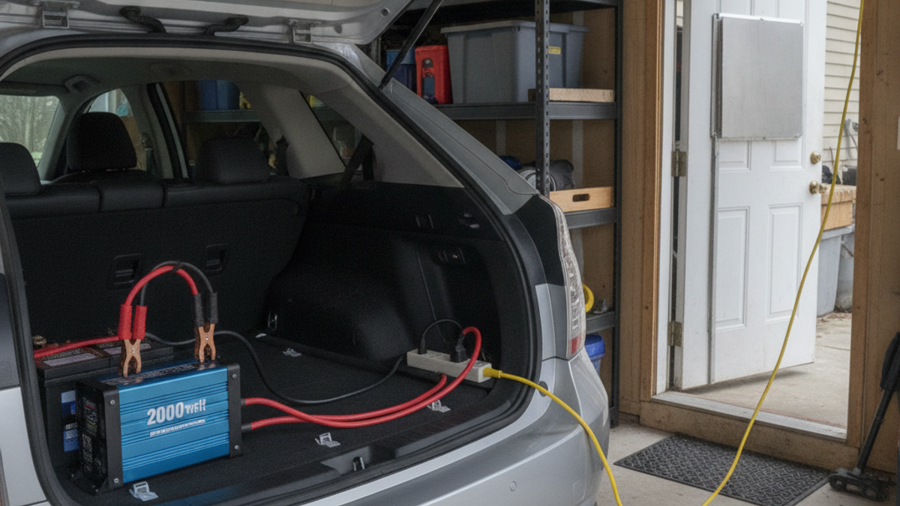
Most vehicles on the road don't support V2H. The workaround is a pure sine wave inverter connected to the 12V auxiliary battery. In a hybrid like a Prius, RAV4 Hybrid, or Escape Hybrid, the DC-DC converter continuously recharges that 12V battery from the high-voltage traction pack, and the gasoline engine cycles on automatically as needed. Japanese households did exactly this after the 2011 Tōhoku earthquake, running essentials off Priuses for days.
Practical limits matter. A hybrid's DC-DC converter typically supplies 100–120 amps at ~13.8V — about 1,400–1,650 watts continuous. A Renogy 3000W pure sine wave inverter handles surge loads like a refrigerator compressor starting, but don't plan on drawing 3,000 watts continuously. For more modest needs, a Krieger 2000-watt inverter with battery cables is a solid middle ground, and a compact BESTEK 300W cigarette-lighter inverter belongs in every vehicle emergency kit for phones, radios, and laptops. If you want a deeper dive on sizing, read our guide to choosing the right power inverter for home, vehicle, and off-grid use.
Critical rule: anything over about 400 watts must connect directly to the battery terminals with properly fused, heavy-gauge cable — never through the cigarette lighter socket, which is typically fused at 10–15 amps.
Transfer Switches and Load Management
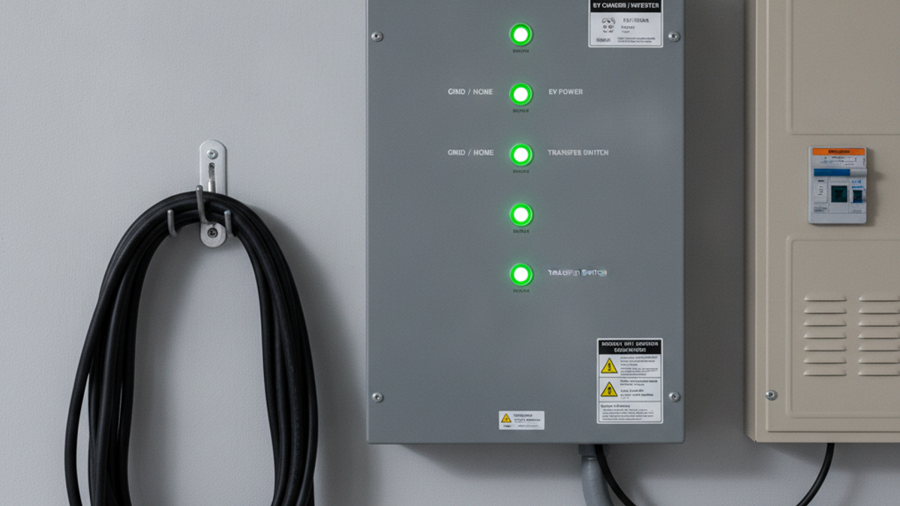
Never use a double-male "suicide cord" to backfeed an outlet. It energizes your service drop, can electrocute a lineworker, and will void your insurance. A manual transfer switch isolates your house from the grid and lets you power hardwired circuits — furnace blower, well pump, refrigerator — through a labeled subpanel. A Generac transfer switch kit with exterior inlet box gives you a weatherproof connection point so no cords run through a cracked window. The same logic applies to conventional backup — see our breakdown of whole-house standby generators for long-term emergency power.
Prioritize loads ruthlessly. Refrigeration (150W average), LED lighting (50W), a chest freezer (100W average), modem/router (20W), and phone charging total under 400 watts. Electric heat, central AC, and resistance water heaters will drain an EV pack in hours. Well pumps draw 1,000–2,500 watts with high surge — fine for a Lightning, impossible for a Prius inverter.
Step-by-Step Instructions
Step 1: Audit your vehicle's actual output capability
Check your owner's manual for V2L outlet wattage, bidirectional charging support, and usable battery capacity. Write the numbers on an index card and tape it inside your electrical panel door. A Kia EV6 gives 1.9 kW; a Silverado EV gives 10.2 kW. That difference determines your entire plan.
Step 2: Calculate your critical load list
Use a plug-in watt meter to measure each appliance over 24 hours. Add up daily kWh for only the devices you truly need. Divide your usable battery capacity by that number to get your runtime in days, then subtract 20% for inverter losses and reserve driving range.
Step 3: Install a manual transfer switch or inlet box
Hire a licensed electrician unless you are genuinely qualified. A 30-amp, six-to-ten circuit manual transfer switch typically costs $300–$600 installed and satisfies NEC 702 requirements. Label every circuit clearly so a family member can operate it in the dark.
Step 4: Wire and fuse your inverter correctly
Mount the inverter in a ventilated location, use cable sized for the full load (typically 2/0 AWG for a 3,000W unit), and install an ANL or Class T fuse within 18 inches of the battery positive terminal. Verify polarity twice with a multimeter before energizing.
Step 5: Test the whole system before you need it
Run a full dress rehearsal on a Saturday. Kill the main breaker, start the vehicle, flip the transfer switch, and live on vehicle power for four hours. Note what fails, what trips, and how much battery you actually consumed.
Step 6: Establish CO and refueling safety protocols
Any vehicle with a combustion engine must run outdoors, at least 20 feet from doors and windows, never in an attached garage. The CPSC attributes roughly 85 deaths per year to portable generator carbon monoxide poisoning; the same physics apply to an idling hybrid.
Step 7: Plan your recharge path
An EV that powers your house for three days is a brick on day four unless you can refill it. Identify a solar array, a nearby town with power, or a working DC fast charger. Our guide to solar panel selection covers sizing a system capable of meaningfully recharging a vehicle.
Safety Rules You Cannot Skip
- Never backfeed without a transfer switch. It is illegal and lethal.
- Reserve 20–30% battery for evacuation. Power outages and wildfires travel together.
- Watch cold weather. Lithium packs lose 20–40% usable capacity below freezing, and the vehicle will spend energy conditioning the battery.
- Avoid flooded vehicles. A submerged EV is a fire and shock hazard. Do not attempt to draw power from it.
- Pure sine wave only for medical devices, CPAPs, and modern electronics.
Recommended Gear
If you'd rather not touch your vehicle's electrical system at all, a high-capacity power station bridges the gap. The EcoFlow DELTA Pro offers 3.6 kWh expandable to 25 kWh and can accept input from an EV's V2L outlet, effectively turning your car into a slow generator that tops off a buffer battery overnight. The lighter Jackery Explorer 1000 is the realistic choice for apartment preppers who need to run a fridge, lights, and devices without hardwiring anything. Pair either with our rundown of blackout battery banks and portable power options.
Frequently Asked Questions
Can any electric car power a house during an outage?
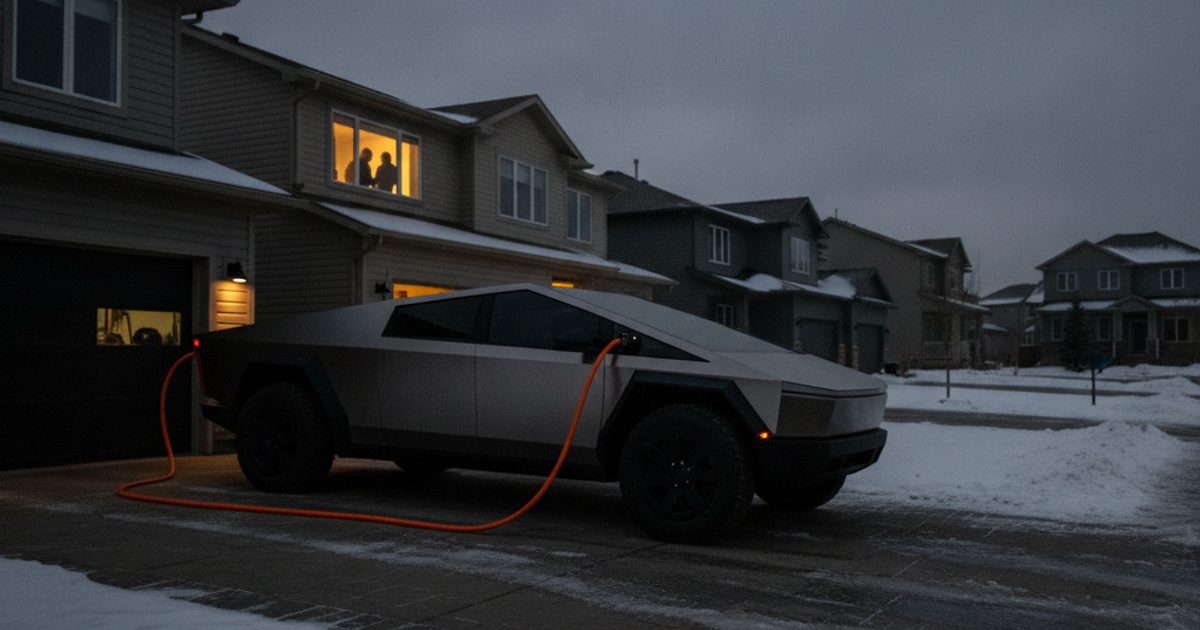
No. Only vehicles with bidirectional capability — the Ford F-150 Lightning, Chevy Silverado EV, Nissan LEAF (with CHAdeMO hardware), Kia EV6, Hyundai Ioniq 5/6, and select others — can feed a home. Tesla added Powershare on the Cybertruck, but most Teslas cannot discharge to a house. For non-bidirectional EVs, a 12V inverter is a low-wattage workaround at best.
How long can an EV power my home in a blackout?
A 75 kWh pack running a 500-watt critical load list (refrigerator, LEDs, router, phone charging) lasts roughly five to six days accounting for conversion losses. The same pack running central air conditioning or electric heat lasts eight to twelve hours. Load discipline — not battery size — is the deciding variable.
Is it safe to idle a hybrid in my garage to run an inverter?
Absolutely not. Even if the engine only cycles intermittently, carbon monoxide accumulates to lethal concentrations in enclosed spaces within minutes. Park outside, at least 20 feet from any opening, and keep a battery-powered CO alarm running inside the house regardless.
Affiliate Disclosure: SHTFPlan.net participates in the Amazon Services LLC Associates Program. Some links are affiliate links — we may earn a small commission at no extra cost to you.