Hazmat Emergency: How to Survive a Chemical Spill or Train Derailment in Your Neighborhood
Tank cars derail, pipelines rupture, and plants vent toxic clouds with almost no warning. Here's how to decide between sealing your home and running — and how to do either one correctly.
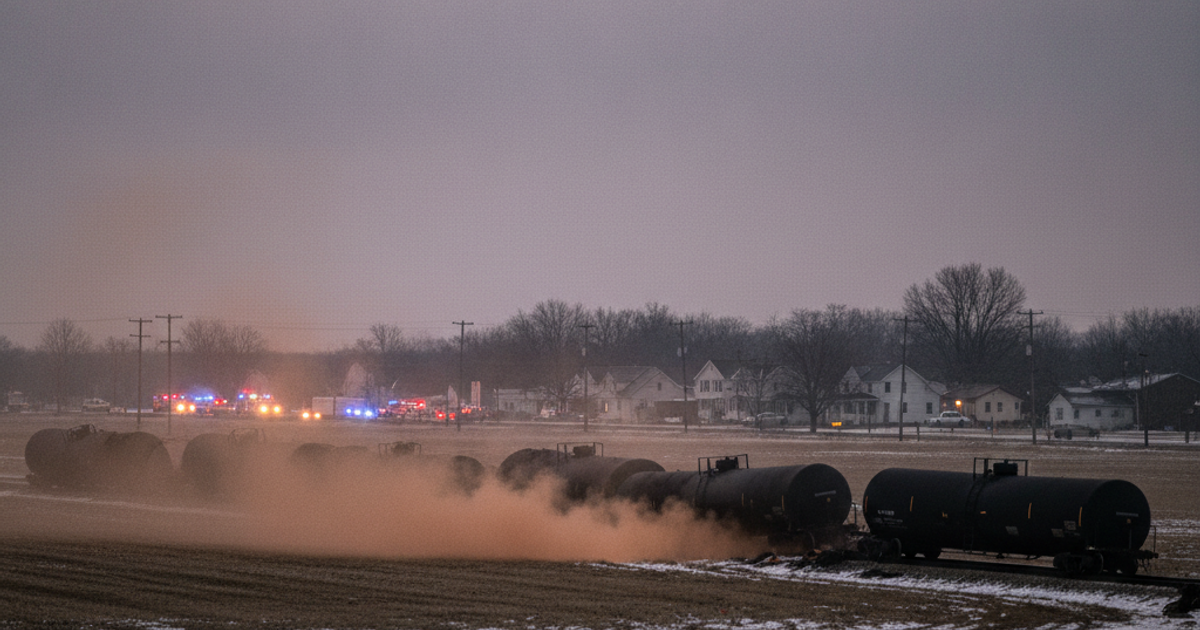
On February 3, 2023, 38 cars of a Norfolk Southern freight train jumped the tracks in East Palestine, Ohio. Eleven of them carried hazardous materials, including vinyl chloride — a colorless gas that causes liver cancer and burns the respiratory tract. Within days, roughly 2,000 residents were under evacuation orders, and a controlled burn sent a black plume over the Ohio-Pennsylvania line. Most of those people had no plan, no respirator, and no idea which way the wind was blowing.
That incident was not an anomaly. The Federal Railroad Administration logs more than 1,000 train derailments annually in the United States, and the Pipeline and Hazardous Materials Safety Administration (PHMSA) records roughly 20,000 hazmat incidents per year across all transport modes. Add in fixed facilities — chemical plants, water treatment stations storing chlorine, fertilizer depots holding anhydrous ammonia — and the EPA estimates that over 150 million Americans live within the vulnerability zone of at least one high-risk chemical facility. If you live near a rail line, an interstate, a river port, or a farm co-op, you are in the game whether you signed up or not.
Hazmat emergencies reward one thing above all: speed of correct decision-making. You will typically have between 5 and 30 minutes to decide whether to seal up or get out, and the wrong choice can be fatal. Here's how to make the right one.
What You'll Need
Tools
- Full-face respirator (3M 6800)
- HEPA air purifier
- Battery-powered NOAA weather radio with SAME alerts
- Scissors or utility knife
Supplies
- Multi-gas/vapor P100 cartridges
- Heavy-duty plastic sheeting (4-6 mil)
- Heavy-duty duct tape
- Weather stripping foam tape
- Pre-cut towels for door gaps, bottled water, printed Emergency Response Guidebook
How to Tell the Difference Between a Shelter-in-Place and an Evacuation
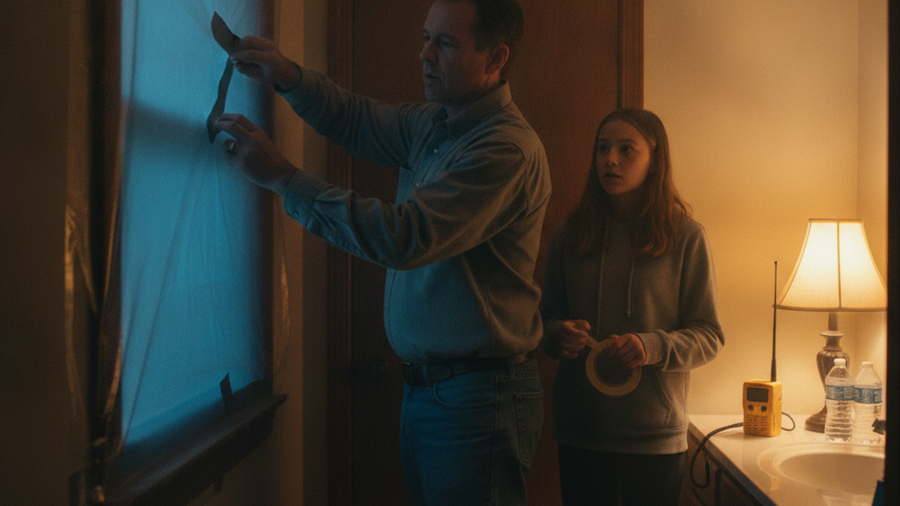
The single most important variable is your position relative to the release and the wind. Gas plumes travel downwind in a cone. If you are upwind or crosswind, your home is a fortress. If you are directly downwind within a mile or two, you may be sealing yourself inside a box that is slowly filling with poison.
The DOT Emergency Response Guidebook (ERG) — a free PDF every prepper should print — gives initial isolation distances of 100 to 1,000 feet and downwind protective action distances that can reach seven miles for a large nighttime chlorine release. Nighttime is worse because stable air keeps the plume concentrated near the ground instead of dispersing it.
Practical rule set:
- Shelter in place if the release is short-duration, you're not immediately adjacent, or roads are already clogged. Sealing works for hours, not days.
- Evacuate if you can see or smell the product, if you're within half a mile of a burning tank car (BLEVE risk — a boiling liquid expanding vapor explosion can throw tank fragments 3,000 feet), or if officials order it.
- Move crosswind first, then upwind. Never drive parallel to the plume's path hoping to outrun it.
Rural readers have an advantage — open escape routes and distance from fixed facilities — but a disadvantage too: volunteer fire departments may take 20+ minutes to arrive, and well water downstream of a spill can be contaminated for months. Urban and apartment dwellers face the opposite problem. You can't outrun anything on foot in gridlock, but modern mid-rise buildings with shared HVAC can be shut down and sealed effectively if you act fast. Review our guide on urban evacuation routes before you need them.
Why Most Chemical Clouds Mean You Go Up, Not Down
Forget the tornado reflex. Chlorine, anhydrous ammonia (which actually rises in some conditions), vinyl chloride, and most industrial gases are heavier than air and pool in low ground — basements, storm cellars, drainage ditches. For a chemical event, choose an interior room on an upper floor with the fewest windows and doors. A second-floor bathroom or walk-in closet is often ideal.
FEMA guidance suggests roughly 10 square feet of floor space per person provides enough air for about five hours in a sealed room. A 10x12 bathroom will support four people comfortably for that window — long enough for most plumes to pass.
Respirators: What Actually Filters Industrial Chemicals
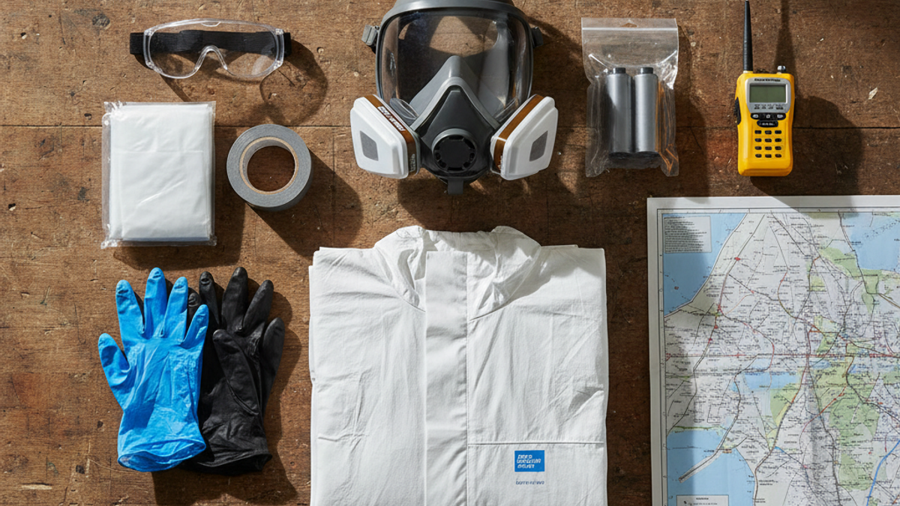
An N95 does nothing against vapors. It traps particulates only. That said, a 3M 8511 N95 respirator is still worth having in every vehicle and bug out bag for smoke, ash, and post-incident cleanup dust.
For gas and vapor, you need a cartridge rated for the hazard. A 3M 60926 multi-gas/vapor P100 cartridge covers organic vapors, chlorine, hydrogen chloride, ammonia, methylamine, formaldehyde, and sulfur dioxide — a reasonable cross-section of what rolls through American rail yards. Pair it with a full-face mask, because many of these agents attack the eyes before the lungs. If you only need particulate protection during cleanup, swap in a 3M 2097 P100 filter, which is lighter and cheaper to replace.
Know the hard limit: air-purifying respirators do not create oxygen. In an oxygen-deficient or IDLH (immediately dangerous to life and health) atmosphere, only self-contained breathing apparatus works. Your respirator is an escape tool, not a license to walk toward the wreck. For a broader framework on chemical, biological, and radiological threats, see our CBRN preparedness plan.
Step-by-Step Instructions
Step 1: Identify the hazard and the wind direction
Look for the four-digit UN placard number on the tank car or truck — binoculars from a safe distance, never up close. Cross-reference it in the ERG. Simultaneously, determine wind direction using a flag, smoke, or your weather app. Write down both before you do anything else.
Step 2: Shut down all air exchange immediately
Turn off HVAC, furnace, window AC units, bathroom and kitchen exhaust fans, and clothes dryers. Close the fireplace damper. In an apartment, kill the bathroom fan — it's a direct conduit to a shared shaft. This single action buys you more protection than everything else combined.
Step 3: Select and move to your sealed safe room
Pick an interior upper-floor room with minimal openings. Bring water, phone, charger, radio, medications, pets, and a bucket with a lid for sanitation. Do a headcount and call anyone missing before you seal.
Step 4: Seal every gap with plastic and tape
Cover windows, vents, and outlets with pre-cut 4-6 mil plastic sheeting, taping all four edges down with heavy-duty duct tape. Pre-cutting sheets to size and labeling them by room during a calm weekend turns a 40-minute scramble into a 6-minute job. Jam damp towels under the door and run weather stripping foam tape around the frame for a tighter seal than tape alone.
Step 5: Run filtration and monitor official channels
Plug in a HEPA air purifier to scrub particulates and aerosols from the room air. HEPA won't remove true gases without a carbon stage, but many releases involve aerosolized droplets and combustion particles where it helps significantly. Keep a NOAA radio on and monitor your county emergency management feed.
Step 6: Decontaminate before you re-enter living space
If anyone was outside during the release, remove clothing outdoors or in a garage — cutting shirts off rather than pulling them over the head — bag it in plastic, and shower with soap and lukewarm water for at least 10 minutes. Flush eyes for 15 minutes. Cold water closes pores less effectively; hot water increases absorption.
Step 7: Ventilate aggressively once the all-clear sounds
Sealed rooms accumulate CO2 and any contaminant that leaked in. When officials declare the area clear, open everything, restart the HVAC with a fresh filter, and run fans for several hours. Don't drink well water or eat garden produce until testing confirms it's safe.
Recommended Gear
Build your hazmat module as a separate, grab-ready bin: one full-face respirator per adult with spare cartridges, a roll of heavy-duty plastic sheeting, two rolls of tape, nitrile gloves, and printed ERG pages. Store it in the safe room itself, not the basement. Our full recommended survival gear list covers the rest of the kit.
Frequently Asked Questions
How long can you safely shelter in place during a chemical spill?
Most sealed-room guidance tops out at five to eight hours depending on room volume and occupancy. Carbon dioxide buildup becomes the limiting factor. Fortunately, the vast majority of transportation hazmat plumes pass or disperse within two to four hours. If authorities extend a shelter order past that, they will typically instruct you to ventilate briefly or evacuate under escort.
Will an N95 mask protect me from a train derailment chemical release?
No. An N95 is a particulate filter and offers zero protection against chlorine, ammonia, vinyl chloride, or other vapors. It is useful for smoke, soot, and cleanup dust only. For vapor protection you need a half- or full-face respirator with multi-gas cartridges, properly fit-tested and sealed against bare skin — facial hair breaks the seal.
How far downwind do I need to evacuate from a hazmat spill?
The DOT Emergency Response Guidebook recommends anywhere from 0.1 miles to 7 miles downwind depending on the chemical, spill size, and time of day. As a default when you have no information, move at least one mile crosswind and then continue upwind. Distance perpendicular to the wind is worth more than distance along it.
Affiliate Disclosure: SHTFPlan.net participates in the Amazon Services LLC Associates Program. Some links are affiliate links — we may earn a small commission at no extra cost to you.