Is Your Home Ready for a Home Invasion? How to Build a Safe Room That Actually Works
A locked bedroom door won't stop a determined intruder. Here's how to build a real safe room that buys you time, keeps your family protected, and gives you options.
According to the FBI, a burglary occurs in the United States every 30 seconds. More troubling: a significant percentage of those incidents are home invasions — crimes where the attacker enters knowing someone is home. Unlike a simple break-in, a home invasion puts you and your family in direct physical danger. Your response time is measured in seconds, not minutes, and law enforcement is rarely close enough to intervene before the situation turns violent.
A properly designed safe room — sometimes called a panic room — gives your family a defensible, fortified space to shelter-in-place while you communicate with authorities, arm yourself if necessary, and wait out the threat. This isn't just for rural homesteaders with land and resources. Whether you live in a high-rise apartment, a suburban split-level, or a remote off-grid cabin, you can build a functional safe room that actually works when SHTF.
This guide covers everything: location selection, door and wall reinforcement, communications, weapons storage, power, and your family shelter-in-place plan. If you're serious about emergency preparedness and urban survival, this is a project that belongs at the top of your list.
What You'll Need
Tools
- Power drill and bit set
- Circular saw or reciprocating saw
- Stud finder
- Hammer and pry bar
- Level
Supplies
- Door Armor MAX complete door reinforcement kit
- Buddybar door security bar barricade
- Hornady RAPiD safe biometric gun safe
- Motorola T800 two-way walkie talkie family radio
- 3-inch security screws and steel strike plate
- Plywood sheeting or ballistic-resistant panel inserts
Choosing the Right Room: Location Is Everything
The most important decision you'll make is which room becomes your safe room. You're looking for a space that satisfies several criteria simultaneously: it must be defensible, reachable quickly from your sleeping area, and capable of being reinforced without a structural renovation.
For most homeowners and suburban preppers, the master bedroom is the ideal choice. You spend roughly a third of your life there unconscious — which is exactly when you're most vulnerable. A bedroom-based safe room means your family doesn't have to traverse a dark hallway while a threat is active inside the home.
For apartment dwellers, the calculus is different. You may not be able to modify doors or walls without violating your lease. In that case, focus on your most interior room — a bathroom or closet — and concentrate on portable, non-destructive reinforcement products. Even a renter can dramatically improve their position with the right tools.
Rural preppers on larger properties have more flexibility. A dedicated panic room built into a basement, or a hardened interior room in an outbuilding used as a home office, can serve dual duty for SHTF scenarios ranging from home invasions to civil unrest to severe weather events. For more on layering your home's defenses, read our guide on Reinforcing Doors and Windows: How to Harden Your Home's Weakest Entry Points Before SHTF.
How to Reinforce Your Safe Room Door Against Forced Entry
The door is your last line of defense. The average interior door — the kind that separates your bedroom from a hallway — is hollow-core wood set into a standard frame with a flimsy strike plate held in by half-inch screws. A determined attacker can breach it in under ten seconds with a single kick. That is not acceptable for a safe room.
Your reinforcement strategy needs to address three failure points: the door itself, the frame, and the hardware.
The door: Replace hollow-core doors with solid-core wood doors (minimum 1¾ inch thickness) or steel-clad doors. If you're renting or on a budget, a solid-core door can be sourced inexpensively at a salvage yard and fitted without full replacement of the frame.
The frame: Standard wood door frames split under kick force because the strike plate only anchors into soft wood trim. The Door Armor MAX complete door reinforcement kit addresses this systemically with steel reinforcement for the door edge, hinge side, and strike zone, using 3-inch screws that anchor into the structural studs behind the trim — not just the trim itself. Independent tests have shown reinforced doors can withstand hundreds of pounds of kick force, compared to under 100 pounds for a standard door.
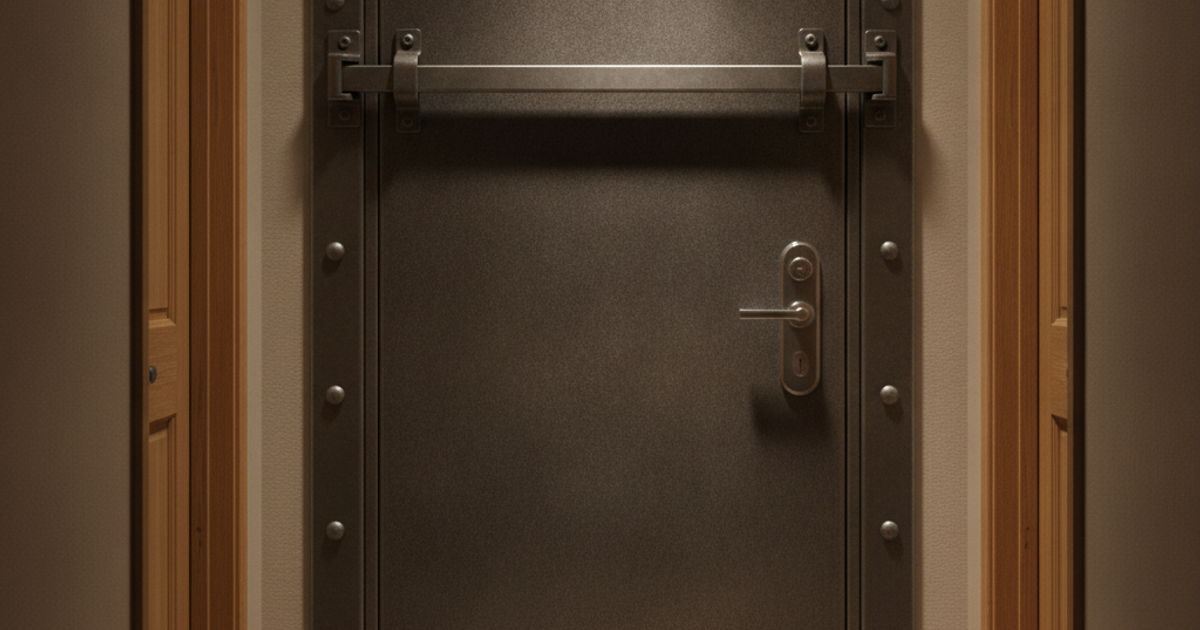
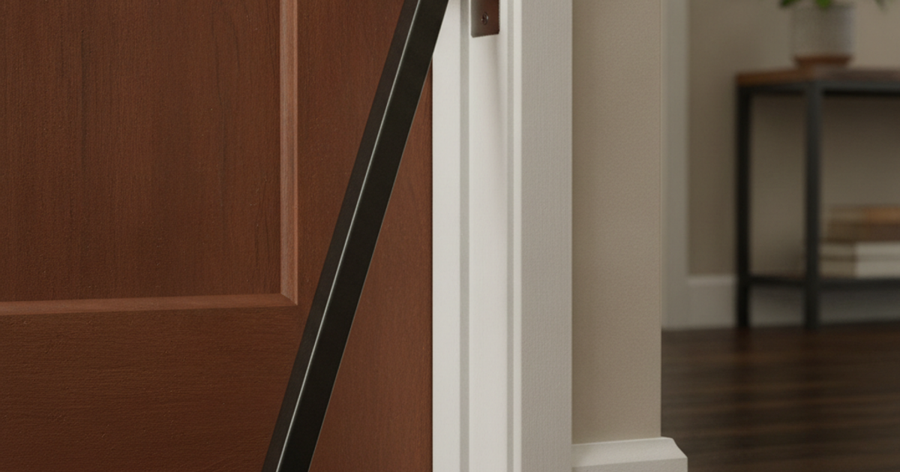
Secondary barricade: Even a reinforced door can fail if the attacker has time and tools. Add a Buddybar door security bar barricade as a secondary layer. This floor-braced bar transfers lateral force directly into the floor joists, making the door functionally immovable without mechanical tools. It's also completely portable and renter-friendly — you can take it with you when you travel and use it in hotel rooms.
Communications Inside Your Safe Room
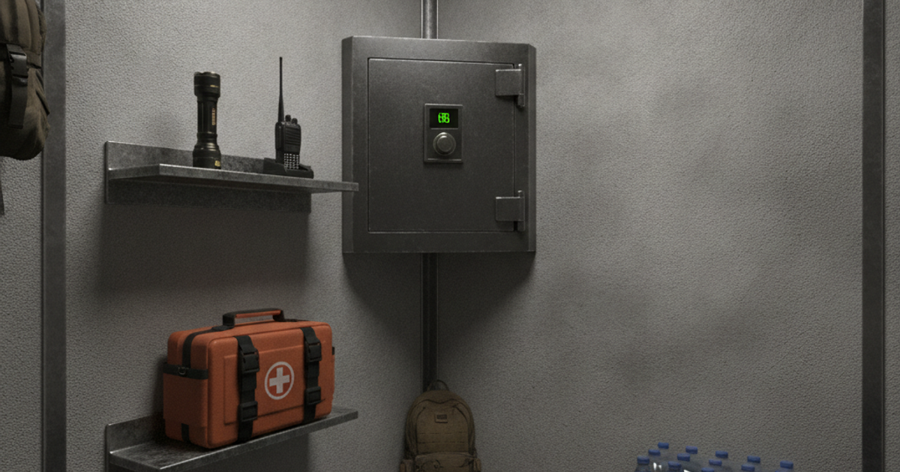
Situational awareness doesn't stop once you're inside the safe room. In fact, it becomes more critical. You need to know what's happening outside your door, communicate with family members who may be elsewhere in the home, and reach emergency services — even if your primary cell phone fails or the intruder cuts your power.
Build a layered communication system into your safe room:
- Cell phone with backup battery: Keep a fully charged phone in the safe room or charge it there nightly. Program 911 and local non-emergency police numbers into the contacts.
- Police scanner: The Uniden BCD536HP police scanner radio lets you monitor local law enforcement frequencies in real time. If you've called 911, you can track response progress. In a broader SHTF scenario, it's an invaluable intelligence tool for understanding what's happening in your neighborhood before you open that door.
- Family radio: If your children's bedrooms are on a different floor or wing of the house, a set of Motorola T800 two-way walkie talkie family radios allows you to coordinate movement before and during an incident. These are also indispensable for your broader family emergency communication plan. For more on building redundant comms, see our article on When Cell Networks Fail: How to Build a Family Emergency Communication Plan.
Surveillance: Knowing What's Outside Before You Open the Door
One of the most dangerous moments in a home invasion scenario is the transition — opening your safe room door before you know the threat has passed. A camera system eliminates that blind spot.
Install a Ring Indoor Cam security camera system at key chokepoints — the hallway outside the safe room door, the main entry points, and the stairs if applicable. The camera feeds to your smartphone, meaning you can monitor activity throughout the home without cracking the door. Even in a power outage, a battery-backed camera system buys you critical intelligence. Pair this with the perimeter alarm systems discussed in our guide on detecting intruders before they reach your door.
Weapons Storage: Fast Access Without Compromising Safety
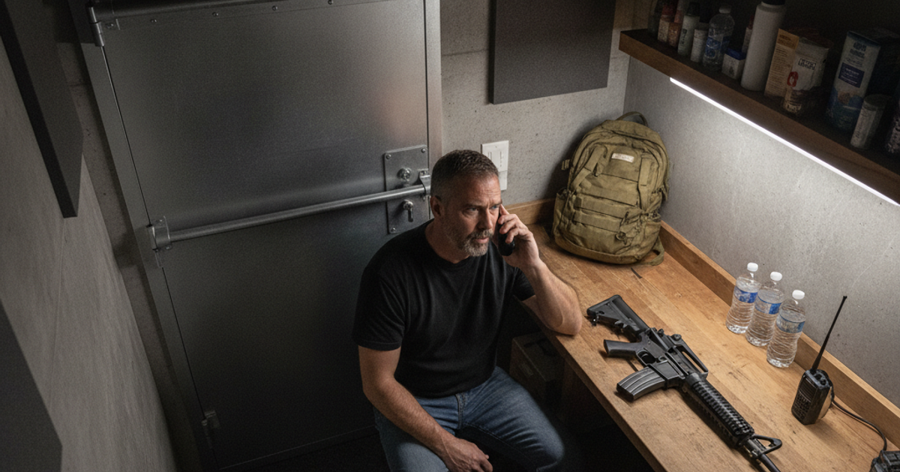
A safe room is not just a hiding place — it's a defensive position. If you own firearms, your defensive weapon needs to be accessible to you and inaccessible to an unauthorized user, including children. Those two requirements seem contradictory until you use the right technology.
The Hornady RAPiD safe biometric gun safe uses RFID and biometric access to open in under a second — faster than a combination lock under stress, and fully child-resistant. Mount it inside a closet or under a nightstand within arm's reach of your sleeping position. Pair your handgun with a weapon-mounted light such as the Streamlight ProTac Rail Mount flashlight, which allows you to identify threats in low-light conditions without managing a separate handheld light. For a deeper discussion on choosing the right defensive firearm, see our comprehensive guide on Shotgun vs. Rifle vs. Handgun: How to Choose the Right Long Gun for Home Defense When SHTF.
Non-firearms options matter too, especially for apartment dwellers in restrictive jurisdictions. A solid pepper spray canister, a tactical flashlight with a strike bezel, or a quality fixed-blade knife can all be stored in the safe room as defensive tools.
Power, Lighting, and Supplies Inside the Safe Room
Your safe room needs to function independently if the attacker cuts power or your shelter-in-place extends for hours. Stock it with the following minimum supplies:
- Battery-powered or rechargeable lighting — at minimum a headlamp and a lantern
- Water — at least one gallon per person stored in the room, rotated every six months
- Basic first aid kit — including a tourniquet and hemostatic gauze if you have any firearms in the room
- Charged backup battery bank — for phones and radios
- Medication — a 72-hour supply of any critical prescriptions
- Dust mask and eye protection — useful if a fire or chemical hazard develops outside
To protect your electronics and communication gear from power surges or grid instability, install a Jasco UL Listed whole home surge protector outlet on the safe room's wall outlet. A surge event during a crisis — from a storm, electrical fault, or grid instability — can wipe out the electronics you're depending on to call for help and monitor the situation.
Your Family Shelter-in-Place Plan
Hardware is only half the equation. The other half is rehearsal. Every member of your household needs to know the plan cold — including children old enough to understand the concept. Research on crisis decision-making consistently shows that people revert to trained behaviors under acute stress. If your family has never practiced getting to the safe room, they won't do it efficiently when it matters.
Your plan should specify:
- The trigger: What sound, signal, or event initiates movement to the safe room (e.g., breaking glass, a specific code word, the perimeter alarm).
- The rally point: Which room is the designated safe room, and what the secondary option is if the primary is inaccessible.
- Movement protocol: Who goes first, how children are escorted, and what path to take.
- Communication roles: Who calls 911, who monitors the radio, who manages the door.
- The all-clear: How you confirm the threat is neutralized before exiting — ideally verbal confirmation from law enforcement, not just silence.
Practice this drill at least twice a year, including a nighttime drill. Threat recognition and situational awareness are habits that require repetition. See our related article on Shelter-in-Place Without Losing Your Mind: How to Survive Weeks of Home Confinement When SHTF for extended shelter-in-place planning.
Step-by-Step Instructions
Step 1: Select and Designate Your Safe Room Location
Walk your home and evaluate interior rooms for proximity to sleeping areas, wall construction, and reinforcement potential. Choose the room that places the fewest barriers between your family's sleeping positions and the defensive space. Mark it clearly in your family emergency plan and ensure every household member knows which room it is.
Step 2: Upgrade the Door to a Solid-Core or Steel-Clad Unit
Remove the existing hollow-core door and replace it with a minimum 1¾-inch solid-core wood door or a steel-clad door. Verify the door frame is square before hanging the new door. If you're renting, focus instead on portable barricade products that don't require permanent modification.
Step 3: Install a Door Reinforcement Kit and Strike Plate
Fit the Door Armor MAX reinforcement kit to the door edge, hinge points, and strike zone, driving 3-inch screws through the trim and into the structural studs behind the frame. Replace the existing strike plate with a heavy-gauge steel version anchored with the same long screws. Test the door by applying significant shoulder force to verify it holds.
Step 4: Add a Floor-Braced Door Barricade
Position the Buddybar door security bar under the door handle and angle it to the floor according to manufacturer instructions, ensuring the floor cup seats firmly. Test the adjustment so the bar is tight but can be removed quickly from inside. Practice setting and releasing it in the dark to simulate a nighttime emergency.
Step 5: Install Surveillance Cameras at Key Positions
Mount a Ring Indoor Cam or equivalent in the hallway directly outside the safe room door and at any other critical chokepoint — stairwell landings, main entry hall, or back hallway. Run the camera app on your dedicated safe room phone or tablet and test that the feed is clear and responsive before relying on it.
Step 6: Secure and Stage Your Defensive Firearm
Mount the Hornady RAPiD biometric safe in a fixed, accessible position inside the safe room — inside a closet at arm's reach or bolted under a nightstand. Register all authorized fingerprints and test RFID access. Ensure your defensive firearm is unloaded during setup, then load and store it according to your household's safety protocols once the safe is installed and tested.
Step 7: Stock the Room with Communications and Supplies
Store your police scanner, family radios, backup battery bank, first aid kit, water supply, and medications inside the safe room in a dedicated bag or bin. Charge all electronics weekly and rotate water and perishable supplies every six months. Label the bin clearly so any family member can access it without assistance.
Step 8: Conduct and Document Your Family Drill
Run your first full-family shelter-in-place drill, starting from sleeping positions and simulating a nighttime alarm. Time the drill, identify bottlenecks, and debrief every participant — including children — on what went well and what needs improvement. Repeat the drill every six months and after any change to household composition or room layout.
Frequently Asked Questions
Can I build a safe room in an apartment?
Yes, and it's more achievable than most renters realize. You can't modify door frames or install permanent hardware without your landlord's approval, but you can use a portable door barricade like the Buddybar, keep a charged backup phone and family radios in a designated room, and establish a clear shelter-in-place plan using your most interior room. Focus on what you can control: communications, supplies, and a practiced family plan. When you move, the equipment moves with you.
What's the most important thing to put in a home safe room?
If you had to pick one item beyond the reinforced door itself, it's a reliable communication device — specifically a charged phone with 911 already dialed and a backup battery to keep it running. Without communication, you're isolated with no way to call for help or monitor the situation. Everything else — weapons, lights, water — matters less if you can't reach emergency services or coordinate with family members in other parts of the home.
How long does a safe room door need to hold against a home invasion?
National average law enforcement response times in urban areas are roughly 7–11 minutes; in suburban and rural areas, that figure climbs significantly — sometimes to 20–30 minutes or longer. Your door needs to hold for the duration of that response, plus the time it takes for officers to clear the scene. A properly reinforced door with a floor barricade can withstand sustained forced entry attempts well beyond that window, which is why layered reinforcement — not just a deadbolt — is non-negotiable for a functional safe room.
Affiliate Disclosure: SHTFPlan.net participates in the Amazon Services LLC Associates Program. Some links are affiliate links — we may earn a small commission at no extra cost to you.