
Perimeter Alarms and Trip Wires: How to Detect Intruders Before They Reach Your Door
When SHTF and 911 is not coming, your first line of defense is detecting threats before they reach your home. Here's how to set up a layered perimeter alarm system.
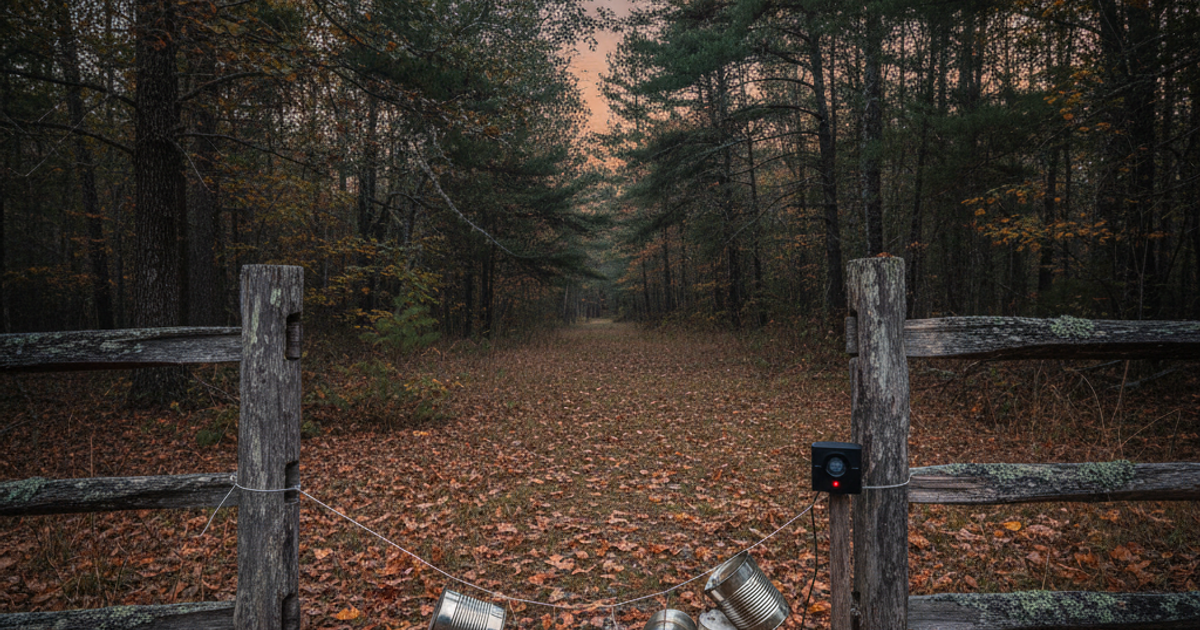
When the grid goes down and emergency services are no longer a phone call away, your home becomes your fortress — and every fortress needs an early warning system. Situational awareness doesn't begin at your front door; it begins at the outermost edge of your property, your street, or even your building hallway. The goal of perimeter security isn't just to stop a threat — it's to detect one early enough that you have time to respond, reposition, and protect your family.
According to the FBI's Uniform Crime Reporting data, burglaries account for hundreds of thousands of home invasions annually even in stable times. In a SHTF scenario — whether that's a prolonged power outage, civil unrest, economic collapse, or natural disaster — that number would multiply dramatically as desperate people make desperate decisions. The best outcome in any confrontation is one you saw coming and prepared for. That preparation starts with building a layered perimeter alarm system.
This guide covers both low-tech and electronic solutions, and it's designed for urban survival, suburban, and rural environments alike. Whether you're defending a homestead with acres of tree line or a third-floor apartment with one hallway entrance, the principles are the same: detect early, alert quietly or loudly as needed, and buy yourself time.
Perimeter security works hand-in-hand with other home hardening measures — if you haven't already, read our guide on Reinforcing Doors and Windows: How to Harden Your Home's Weakest Entry Points Before SHTF to build out your full defensive posture. For those in apartments or tight urban spaces, check out Apartment Prepping: How to Build a Serious Emergency Stockpile in a Small Space for strategies tailored to your environment.
Why Early Warning Changes Everything in a Collapse Scenario
The biggest mistake preppers make in home defense planning is focusing entirely on the point of breach — reinforced doors, firearms, safe rooms — while neglecting the outer layer. Early warning gives you something no amount of armor can: time. Time to wake up, arm yourself, move family members to a safe room, call for help on a radio, or even slip out a secondary exit.
Security professionals use a concept called "defense in depth," meaning threats are slowed and detected through multiple layers before reaching the core. Your perimeter alarm system is the first and most critical layer of that defense. In a grid-down scenario, electronic systems may be unavailable or unreliable, which is why the best approach combines both mechanical/analog methods and battery-powered or solar wireless systems.
Also consider the psychological deterrent value. Most opportunistic threats — and most threats in a collapse scenario are opportunistic — will bypass a location that appears difficult to approach undetected. Visible cameras, signage, and even the sound of a triggered alarm can redirect threats toward softer targets.
What You'll Need
Tools
- Wire cutters and strippers
- Zip ties and paracord
- Hand drill or screwdriver
- Multimeter (for testing electrical connections)
Supplies
- Guardline wireless driveway alarm sensor
- Covert alert trip wire alarm perimeter security sensor
- Monofilament fishing line (30–50 lb test)
- Small bells or tin cans with pebbles (low-tech audible alerts)
- Spare AA/AAA batteries in bulk
- Zip ties, stakes, and anchoring hardware
Understanding Layered Perimeter Defense for SHTF Scenarios
Think of your perimeter in three concentric rings. The outer ring is the boundary of your property or the approach routes to your building — driveways, paths, alleys, treelines. The middle ring covers your yard, parking area, or the floor hallway outside your unit. The inner ring is your immediate structure — doors, windows, and entry points. Your alarm systems should be positioned to trigger detection as far out in those rings as possible.
For rural and suburban preppers with land, the outer ring might extend 100 to 300 feet or more from the home. The Dakota Alert DCMA-2500 wireless motion detector is a favorite in the prepper community for exactly this purpose — it has an impressive detection range of up to 2,500 feet and transmits a wireless alert to an indoor receiver, making it ideal for monitoring driveways, gates, or forest trails without running any wire.
For urban and apartment dwellers, your outer ring may be a hallway, stairwell, or alley. Compact, discreet sensors matter more than long-range systems in these environments.
Electronic Perimeter Alarm Systems: Wireless and Battery-Powered Options
Modern wireless perimeter alarms have made professional-grade early warning accessible to everyday emergency preparedness planners. These systems use passive infrared (PIR) or magnetic sensors to detect motion or movement, then transmit an alert to an indoor chime or alarm unit. Most run on standard batteries, making them grid-independent out of the box.
The Chamberlain CWOPA7 wireless motion alert outdoor sensor is a well-regarded option for suburban use. It's weatherproof, easy to mount, and pairs with an indoor receiver that chimes when the sensor is triggered — no smartphone app, no Wi-Fi required. That independence from the internet is critical in a grid-down situation.
For a comprehensive kit approach, the Skylink SC-100 wireless alarm perimeter sensor kit provides multiple sensors in a single package, allowing you to cover several approach vectors simultaneously. Multiple zones mean you can tell roughly where a threat is coming from before it arrives — invaluable for planning your defensive response.
The Wsdcam wireless perimeter alarm outdoor motion sensor is another strong option, particularly valued for its loud built-in siren capability — useful when you want an audible deterrent rather than just a silent alert. In some scenarios, a loud alarm alone will cause a threat to retreat.
Trip Wire Alarms: Low-Tech, High-Reliability Early Warning
Electronic systems fail. Batteries die. In a long-term off grid collapse, your most reliable tools are often the simplest. Trip wire alarms bridge the gap between pure electronics and pure analog, offering a mechanical trigger that requires no power source to function — though many activate a battery-powered audible alert when tripped.
The concept is straightforward: a thin wire or line is strung between two anchors at ankle height across an approach path. When the line is disturbed, it triggers either a noise-making device or an electronic alarm. These systems are extremely difficult to detect in low-light conditions and require no power to maintain their "armed" state.
The Mace Security International personal alarm trip wire is a compact, affordable option that emits a piercing 120dB alarm when the trip line is pulled. These can be deployed along fence lines, garden paths, stairwells, or even inside a structure to cover interior corridors. At under $20 each, buying several to create overlapping coverage is a realistic budget option for most preppers.
Similarly, the Covert alert trip wire alarm perimeter security sensor is purpose-built for exactly this type of application, offering a weatherproof, low-profile design that can be strung discreetly across trails, gates, and property lines. The covert nature of these devices is a key advantage — an intruder who doesn't know an alarm is present can't disable it.
Primitive and DIY Perimeter Alarms: No Budget Required
Not every solution requires a purchase. Experienced preppers know that resourcefulness is a core survival skill. Simple, effective alarm systems can be built from common materials:
- Can-and-pebble strings: Fill empty aluminum cans with small rocks and tie them to fishing line or paracord strung across approach paths. Any disturbance creates audible rattling.
- Glass bottle paths: Laying broken glass or even intact glass bottles across a dark pathway creates audible crunching and slows movement — a classic technique used in conflict zones worldwide.
- Twig snapping zones: Scattering dry sticks and leaves across an approach path amplifies the sound of footsteps, especially useful at night.
- Bell systems: Bells tied to fence wire or strung between posts will ring with any physical contact. Simple, reliable, zero batteries needed.
- Fishing line perimeters: High-test monofilament strung at ankle height is nearly invisible and can trigger attached cans, bells, or commercial alarm devices.
These methods are particularly valuable as a backup to electronic systems, or in scenarios where electronic devices might be compromised. The grey man approach to survival — as outlined in our guide on Gray Man Methodology in a Societal Breakdown — emphasizes low-visibility solutions that don't advertise your preparedness level to neighbors or passersby. Primitive alarm systems fit this philosophy perfectly.
Camera and Visual Surveillance as Perimeter Tools
Cameras don't stop threats, but they extend your visual perimeter dramatically. In a short-term emergency with partial power, a camera system can alert you to threats you'd otherwise never know about until they're at your door. Solar-powered options extend this capability into long-term grid-down scenarios.
A solar powered outdoor motion sensor alarm Blink camera offers a practical combination of video surveillance and motion alerting without dependence on the grid. Solar charging keeps the unit operational indefinitely in most climates, and motion-triggered recording conserves storage. Position these to cover driveway approaches, gate areas, and any blind corners around your structure. For a deeper dive into camera-based perimeter tools, see our article on Surveillance on a Budget: How to Set Up a Home Security Camera System for SHTF.
Step-by-Step Instructions
Step 1: Map Your Property and Identify All Approach Vectors
Walk the perimeter of your property or building and identify every realistic path someone could use to approach your structure — driveways, footpaths, alleys, gaps in fencing, and stairwells. Mark these on a hand-drawn sketch. Prioritize approaches that offer concealment or darkness, as these are most likely to be exploited. Most residential properties have 3–6 viable approach vectors that need coverage.
Step 2: Define Your Detection Zones Using the Three-Ring Model
Divide your approaches into outer, middle, and inner zones. Assign each zone a detection method based on range and available resources — electronic wireless sensors for outer zones, trip wire alarms for middle zones, and door/window sensors or mechanical alarms for the inner ring. Layer your systems so a threat triggers at least two independent alarms before reaching your door.
Step 3: Install Wireless Motion Sensors at Key Approach Points
Mount your primary wireless sensors — such as the Guardline or Dakota Alert units — at the outermost detection points, typically 50–300 feet from the structure depending on your property size. Position sensors at knee-to-waist height to capture human movement, angled slightly downward. Ensure the receiver unit is placed in your primary sleeping or shelter area so you'll hear it at night. Test range and sensitivity before finalizing placement.
Step 4: Deploy Trip Wire Alarms Across Secondary Approach Paths
Stretch monofilament or trip wire alarm lines across footpaths, gaps in hedges, or alley entrances at ankle height — typically 6–10 inches off the ground. Attach your commercial trip wire alarm device or DIY can-and-pebble system to the line. Ensure the line is taut but not visibly obvious; test each line by walking through it yourself before relying on it. Mark lines on your property sketch so family members don't trigger them accidentally.
Step 5: Set Up DIY Audible Backup Alarms Using Primitive Methods
As a backup to electronic systems, install can-and-pebble lines or bell systems along any approach paths not covered by electronics. Use 30–50 lb monofilament fishing line for near-invisibility, and hang multiple noisemakers per line to maximize sound. These require zero maintenance, zero power, and are highly reliable — they don't care about battery levels or signal interference.
Step 6: Establish a Nighttime Monitoring Routine and Alert Response Plan
A perimeter alarm is only useful if someone is awake to hear it and responds effectively. Create a written alert response plan: who checks the monitors, who moves children to the safe room, who takes which defensive position. In a multi-person household, assign watch rotations during high-risk periods. Your response must be practiced, not improvised at 2 a.m. under stress.
Step 7: Test All Systems Weekly and Rotate Battery Supplies
Schedule a weekly test of every electronic sensor and alarm. Walk each trip line and approach path. Replace batteries on a rotating schedule — don't wait for low-battery warnings. Keep a reserve stock of AA and AAA batteries as part of your broader emergency preparedness supplies. Document each test with a date so you can track sensor reliability over time.
Step 8: Conduct a Full Perimeter Walk After Any Security Event
Any time an alarm triggers — whether a confirmed threat, a false positive from an animal, or an accidental trigger — walk and inspect the full perimeter in daylight. Look for signs of tampering, deliberate probe attempts, or displaced sensors. Reset all trip lines. Threats frequently test a location before committing to an approach, so a single alert event deserves a full post-incident assessment.
Recommended Gear for SHTF Perimeter Security
Building a robust perimeter alarm system doesn't require a massive budget. Start with one or two reliable wireless sensor systems and layer in trip wire and DIY options over time. The most important factor isn't the cost of your gear — it's having multiple redundant layers that function without grid power.
For a solid electronic foundation, the Guardline wireless driveway alarm sensor is one of the most highly reviewed systems available for home perimeter use, offering long wireless range and reliable PIR detection even in adverse weather. Pair it with the Wsdcam wireless perimeter alarm outdoor motion sensor for secondary coverage zones, and you've covered your major electronic needs at a reasonable cost.
For situational awareness beyond your immediate perimeter, strong interpersonal skills and neighbor relationships matter enormously. Consider building a mutual aid network with trusted neighbors — a topic we cover in depth in our guide on Neighborhood Mutual Aid Networks: How to Build a Community Survival Team Before SHTF. Neighbors who are watching for each other multiply your effective detection range without any hardware investment.
Frequently Asked Questions
What is the best perimeter alarm system for a rural homestead with no grid power?
For rural, off-grid settings, the best approach combines long-range wireless motion detectors like the Dakota Alert DCMA-2500 (which can detect movement up to 2,500 feet away and transmit to an indoor receiver) with solar-powered camera systems and mechanical trip wire alarms as backup. The wireless detectors run on standard batteries that can be recharged via solar, making them fully grid-independent. Always layer electronic systems with low-tech mechanical options — fishing line, cans, and bells — so you maintain detection capability even if batteries fail.
How can apartment dwellers set up a perimeter alarm without modifying the building?
Apartment preppers have more options than they might think. Compact door and window entry alarms require no installation beyond a peel-and-stick mount. Small trip wire alarms can be deployed just inside your front door or across interior thresholds without any permanent modification. Wireless motion sensors placed in the hallway outside your unit (where legal and permissible by your lease) can alert you to movement before anyone reaches your door. Pair these with a door reinforcement bar and a budget safe room and you've built a meaningful layered defense even without property access.
Do trip wire alarms actually work, or are they just for movies?
Trip wire alarm systems are genuinely effective early warning tools used by military personnel, hunters, and security professionals worldwide. Commercial units like the Mace Security International trip wire alarm emit 120dB alerts — loud enough to wake a household and deter most threats. The key advantages are simplicity, reliability, and near-zero detectability in low-light conditions. They work best as one layer in a multi-layer system, not as a standalone solution. Animals can trigger them, so placement matters — use them primarily on human-width approach paths rather than open fields or areas with wildlife traffic.
Affiliate Disclosure: SHTFPlan.net participates in the Amazon Services LLC Associates Program. Some links are affiliate links — we may earn a small commission at no extra cost to you.