Survival Group Vetting: How to Recruit, Screen, and Lead a Prepper Team Before SHTF
A survival group multiplies your capability — or becomes your biggest liability. Learn how to recruit, background-check, and lead a prepper team before the crisis arrives.
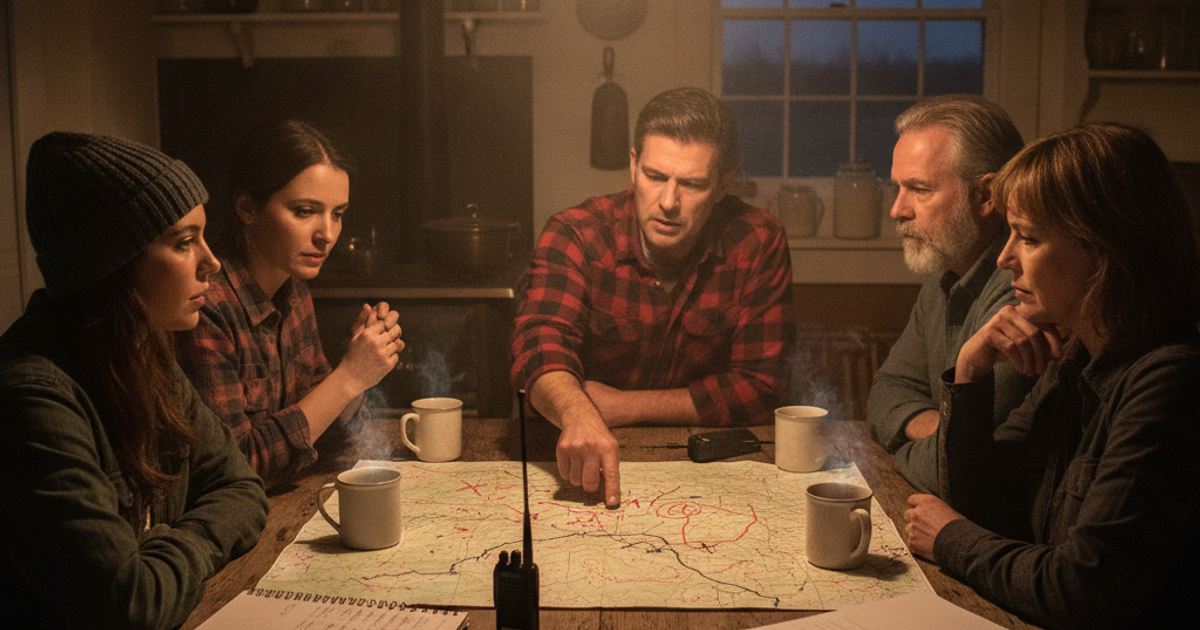
The lone wolf dies. That's not a slogan — it's arithmetic. A single family cannot maintain a 24-hour security watch, treat its own casualties, grow its own food, repair its own equipment, and sleep. FEMA's own National Household Survey data consistently shows that fewer than half of American households have an emergency plan, which means in any given crisis, the overwhelming majority of your neighbors will be improvising. The people who do best in prolonged disasters aren't the ones with the biggest stockpile — they're the ones embedded in a functioning group. Research from disaster sociologists at the University of Delaware's Disaster Research Center has repeatedly documented that spontaneous mutual aid, not official rescue, saves the majority of lives in the first 72 hours after a catastrophic event.
But a badly built survival group is worse than no group at all. Bring in the wrong person and you've handed a stranger your address, your inventory, and your family's vulnerabilities. This guide covers how to recruit, screen, organize, and lead a mutual assistance group (MAG) — whether you're in a sixth-floor apartment, a cul-de-sac, or on forty acres.
What You'll Need
Tools
- Baofeng UV-5R two-way radio (one per household, programmed identically)
- Midland GXT1000VP4 GMRS radios for license-light short-range comms
- Cross-cut paper shredder for destroying rosters and drafts
- Folding camp table for planning sessions and field command posts
Supplies
- All-weather notebooks for logs, watch reports, and rosters
- Pressurized space pens that write wet, cold, or upside down
- Locking storage box for group documents and member records
- Topographic maps of your operating area, one set per household
How to Recruit Survival Group Members Without Blowing Your OPSEC
The cardinal rule: recruit from people you already know in real life. Online prepper forums are reconnaissance platforms for people who want what you have. Start with the concentric-circle method — family first, then long-term friends, then neighbors, then members of existing organizations you belong to (church, volunteer fire department, CERT class, shooting club, community garden, HOA).
CERT (Community Emergency Response Team) training is the single best recruiting ground in America. It's free, FEMA-sponsored, available in most counties, and it self-selects for people who show up. You will learn who completes the coursework and who quits in week two — that's screening data you didn't have to collect yourself.
Never lead with your stockpile. Lead with a shared, low-threat problem: "The grid went down for three days last winter — want to put together a neighborhood phone tree and a generator plan?" That framing recruits normal people. Review our guidance on why sharing your preparedness plans online makes you a target before you say a word in a group chat.
Group Size and Composition
Military and anthropological research converges on a useful number: roughly 8 to 12 adults is the maximum size a group can sustain on trust alone without formal bureaucracy. Below six, you can't staff a continuous watch. Above fifteen, factions form. Target 4 to 8 households.
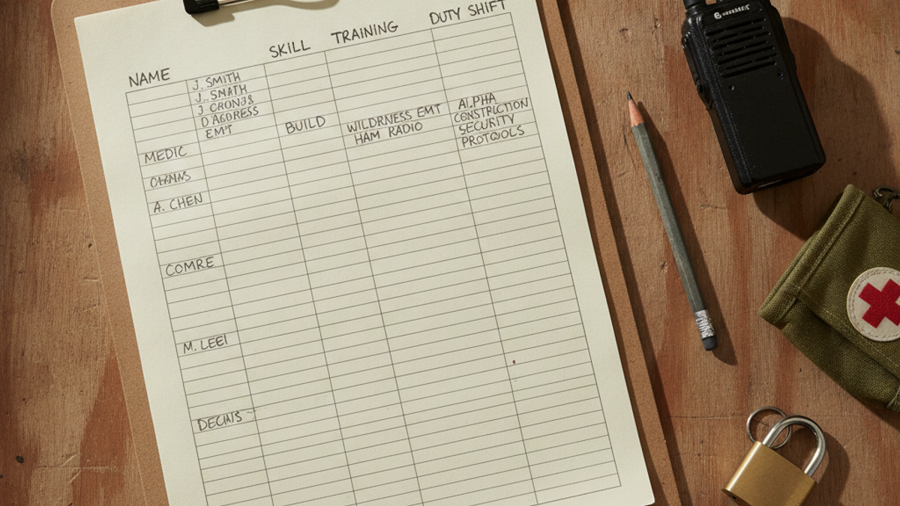
Prioritize skills over gear. Every group needs: medical (nurse, EMT, paramedic, veterinarian), mechanical/electrical, agriculture or food preservation, communications, security, and logistics. A dentist, a welder, and a midwife are each worth more than another guy with a rifle.
How to Screen Prepper Group Candidates Before You Let Them In
Vetting is where most groups fail. Be systematic:
- Long runway. Minimum six months of social contact before any operational discussion. Time exposes character.
- Background check. Run a paid public-records check. You are looking for violent felonies, fraud convictions, and restraining orders — not old DUIs.
- Financial stability. People in acute financial distress are statistically more vulnerable to desperation decisions and often cannot fund their own share of supplies.
- Substance abuse and untreated mental illness. These are disqualifying for armed roles, full stop. Handle it compassionately but handle it.
- Spouse buy-in. A member whose partner thinks the whole thing is foolish will leak information and will not show up. Interview the household, not the individual.
- Stress observation. Take candidates camping in bad weather. Do a 10-mile ruck. Run a 48-hour no-power weekend. Watch who complains, who quits, and who takes care of others.
Document the process but protect the documents. Keep rosters, contact sheets, and medical information in a locking box, and shred every draft. A paper roster in a recycling bin is a complete target package.
Assigning Roles, Rules, and Leadership That Survives Contact
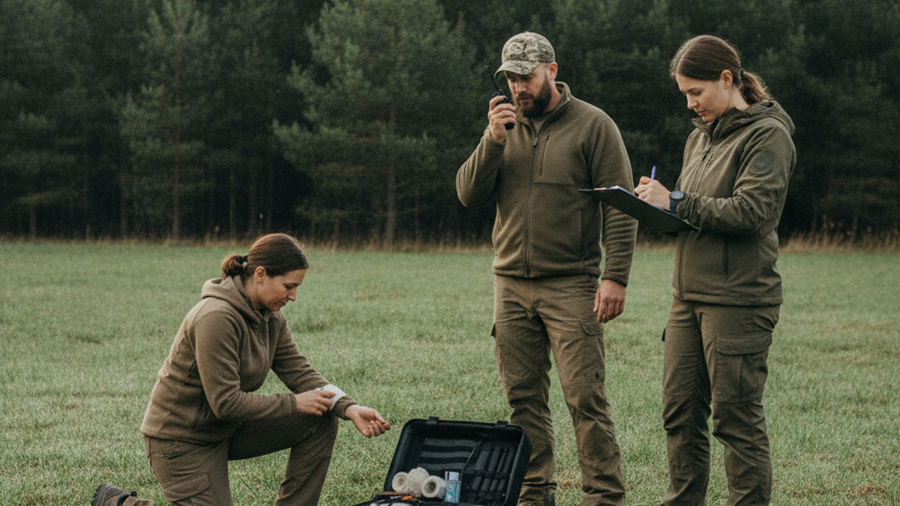
Write a one-page charter before the first crisis. It should cover: purpose, membership requirements, decision-making process, dues or supply contributions, dispute resolution, grounds for expulsion, and rules of engagement for the use of force. Groups that skip this step argue about it in the dark with the power out.
Core Roles
- Coordinator/Leader — final decision authority in emergencies; elected, with a defined term.
- Medical Lead — manages the group trauma kit and triage protocol.
- Security Lead — builds the rotating security watch schedule and trains everyone on it.
- Comms Lead — programs radios, maintains the frequency plan, runs weekly radio checks.
- Logistics/Quartermaster — tracks shared inventory, rotation, and resupply.
- Intelligence/Recon — monitors local conditions and runs neighborhood threat monitoring.
Leadership in a crisis should be decisive but accountable. Use consensus for planning and single-point command for emergencies — announce which mode you're in. Every role needs a trained backup, because someone will be sick, injured, or absent when it matters.
Step-by-Step Instructions
Step 1: Define your group's mission and geography
Write down what the group is actually for — mutual defense, resource sharing, medical support, or all three — and draw a boundary on a map. Urban groups should think in blocks and stairwells; rural groups in road networks and chokepoints. If members live more than 30 minutes apart in a grid-down scenario, they cannot support each other.
Step 2: Build a recruiting shortlist from existing relationships
List every adult you know personally and rate them on three axes: trustworthiness, useful skill, and proximity. Take CERT or a wilderness first aid course to expand the pool. Approach no more than two candidates at a time so you can give each a proper vetting runway.
Step 3: Screen candidates with a written process
Use the same questionnaire, background check, and reference call for everyone — consistency prevents favoritism and catches inconsistencies. Interview the whole household. Require a unanimous or supermajority vote of existing members before admission.
Step 4: Draft and sign a group charter
Put rules, roles, contributions, and expulsion criteria on paper and have every adult sign. Include a confidentiality clause and a plain-language rules-of-engagement section. Store signed copies in a locking box and shred all working drafts.
Step 5: Establish a layered communications plan
Assign primary, alternate, contingency, and emergency (PACE) channels. Program every handheld identically, set a daily check-in time, and distribute a printed frequency card. Pair radios with your layered emergency communication plan so the group can function without cell towers.
Step 6: Assign roles and cross-train backups
Match roles to demonstrated competence, not enthusiasm. Then pair each role holder with an understudy and require them to teach one skill session per quarter. A group where only one person can run the generator or suture a wound is one injury away from collapse.
Step 7: Run quarterly drills under realistic conditions
Schedule at minimum a half-day exercise every three months: a no-power weekend, a mass-casualty medical scenario, a bug-out convoy run, or a full night of rotating watch. Debrief honestly afterward and log the findings in your all-weather notebook.
Step 8: Audit security and OPSEC twice a year
Review who knows what, who has keys, and which documents exist. Remove inactive members from distribution lists immediately. Verify that no member is posting group activity, locations, or photos to social media.
Group OPSEC: The Weakest Member Sets Your Security Level
Compartmentalize. Not every member needs to know every cache location, every member's address, or the full inventory. Use the need-to-know standard. Avoid group names, logos, patches, and matching gear — all of which turn a quiet network into an advertisement. Apply gray man principles at the group level, not just the individual level.
Establish a duress word and a simple authentication challenge for radio traffic. Assume unencrypted radio is monitored, because it is. And be ruthless about the exit process: when someone leaves the group, change meeting locations, rekey anything they had access to, and update the plan.
Frequently Asked Questions
How many people should be in a survival group?
Four to eight households — roughly 8 to 15 adults — is the practical sweet spot. That's enough to staff a 24-hour security rotation with three to four people per shift while still allowing everyone adequate sleep, and small enough that decisions don't require formal bureaucracy. Larger groups need written governance; smaller ones burn out fast.
Can I build a survival group if I live in an apartment?
Absolutely, and in some ways urban groups are easier to form because proximity is built in. Focus on same-building or same-block members, shared stairwell security, water and sanitation coordination, and a group evacuation plan. Pair the group with solid small-space stockpiling strategy so no single unit carries the whole load.
What do I do about a group member who won't follow the rules?
Address it immediately and privately first, then formally if it continues. Your charter should spell out a three-stage process: verbal warning, written warning with a correction period, and removal by vote. Tolerating a disruptive member destroys group cohesion faster than any outside threat, and the longer you wait the more damage you absorb.
Recommended Gear
For a working group, redundancy matters more than brand prestige. Stock spare batteries for every handheld, keep a laminated frequency card in each kit, and maintain a printed map set — paper never loses signal. Browse our full recommended survival gear and equipment list for group-level kit recommendations.
Affiliate Disclosure: SHTFPlan.net participates in the Amazon Services LLC Associates Program. Some links are affiliate links — we may earn a small commission at no extra cost to you.