Apartment Prepping: How to Build a Serious Emergency Stockpile in a Small Space
Living in an apartment doesn't mean you can't prep. Here's how to build a real emergency stockpile when space is your biggest enemy.
According to FEMA, nearly 40% of Americans live in apartments or condominiums — and most of them have done almost nothing to prepare for a serious emergency. The assumption that emergency preparedness is only for people with basements, garages, and half an acre of land has left tens of millions of urban dwellers dangerously exposed. The reality is that apartment prepping is entirely achievable, and in many cases, a well-organized small-space stockpile is more efficient than a cluttered rural homestead. You don't need a root cellar. You need a system.
Whether you're in a 400-square-foot studio in Chicago, a two-bedroom apartment in Phoenix, or a small rental home in the suburbs, this guide will walk you through building a serious emergency preparedness stockpile in limited space — without alerting your neighbors, violating your lease, or going broke.
What You'll Need
Supplies
- Augason Farms 30 day emergency food supply bucket
- WaterBOB bathtub emergency water storage bladder
- Wise Company freeze dried food pouches variety pack
- Platypus Platy collapsible water bottles
- IRIS USA weathertight stackable storage boxes
- Mylar bags and oxygen absorbers for long-term food storage
Why Apartment Preppers Are More Vulnerable Than They Realize
Urban dwellers face a unique set of vulnerabilities during a crisis. Supply chain disruptions, power outages, water pressure failures, and civil unrest hit cities first and hardest. During Hurricane Katrina, tens of thousands of city residents had no food, water, or plan within 72 hours. During COVID-19, urban grocery stores were emptied within hours of panic buying. The prepper community often frames SHTF scenarios as rural problems, but history consistently shows that urban populations bear the brunt of supply shocks.
The good news: apartments are actually excellent for certain aspects of emergency preparedness. They're typically more energy-efficient to heat, easier to secure room by room, and located near population centers where mutual aid networks can form quickly. The challenge is purely logistical — space, concealment, and access. All three are solvable.
The Hidden Storage System: Making Every Square Foot Count
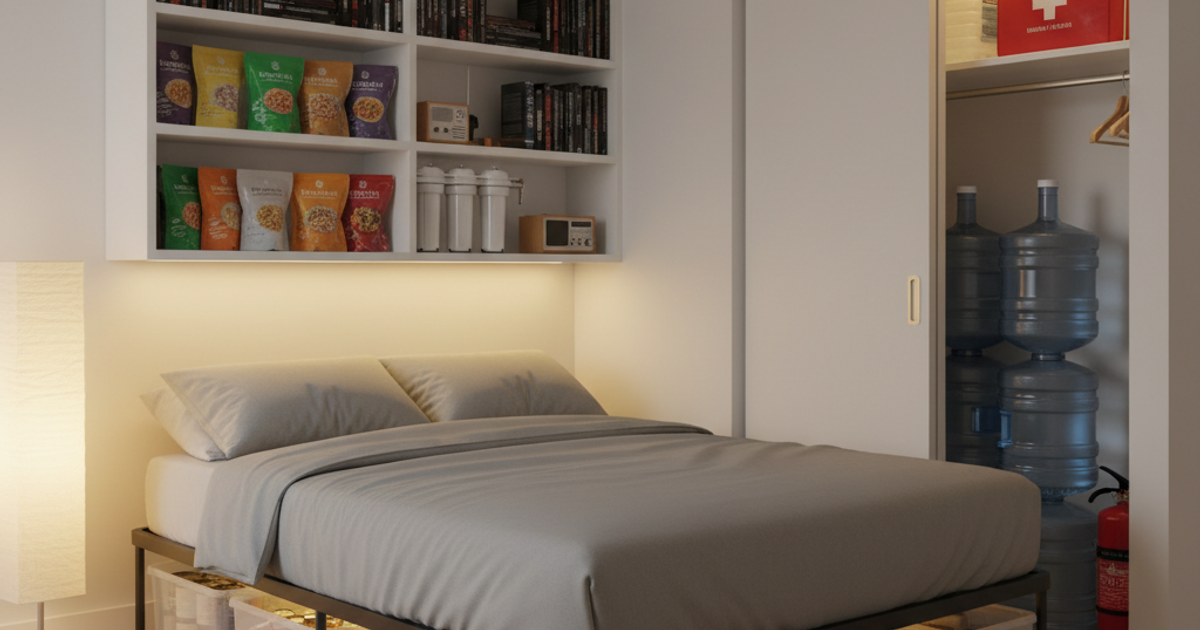
The average apartment has far more usable storage space than its occupants recognize. The key is thinking vertically and thinking inside furniture. Beds are the single largest untapped storage zone in most apartments. A standard queen bed frame has roughly 30–40 cubic feet of space beneath it — enough to store months of freeze-dried food pouches, water containers, and critical survival gear. Use low-profile rolling storage bins or vacuum-sealed bags to maximize this space without attracting attention.
Closets are another underutilized resource. Most people stack things haphazardly on the floor or on a single shelf. Install a second or third shelf near the ceiling to create dedicated emergency supply zones that remain out of daily sight. The top shelf of a bedroom closet, behind seasonal clothes, is an ideal location for your primary emergency food storage cache.
Furniture with hidden storage — ottomans, storage benches, hollow bed frames — serve dual purposes and maintain the visual neutrality of your space. This is a core principle of the grey man approach to prepping: your apartment should not look like a prepper's apartment. For more on why that matters, read our guide on OPSEC for Preppers: How to Keep Your Stockpile and Plans Secret When SHTF.
Emergency Food Storage for Small Spaces: Calorie Density Is Everything
When square footage is limited, calorie density becomes your primary metric. Forget cases of canned soup that weigh 40 pounds and deliver 1,200 calories. Focus on foods that deliver maximum calories per cubic inch of storage space.
The priority list for apartment food storage:
- Freeze-dried entrees and meals (25-year shelf life, lightweight, compact)
- White rice and dried beans in mylar bags (dirt cheap, calorie-dense, 25+ year shelf life)
- Hard tack, crackers, and emergency ration bars
- Peanut butter (high fat, high protein, no refrigeration needed)
- Honey (indefinite shelf life, caloric, medicinal uses)
- Instant oats, protein powder, and multivitamins
The Augason Farms 30 day emergency food supply bucket is one of the most space-efficient food storage solutions available for apartment preppers. A single stackable bucket provides a full month of calories for one adult in a container about the size of a small trash can — it slides under a bed, fits in a closet corner, or stacks in a kitchen cabinet. It's a practical foundation for any urban survival food plan.
For variety and long-term morale — which matters more than most preppers admit — Wise Company freeze dried food pouches are an excellent complement. Individual pouches can be slipped into backpacks, stored in office drawers, tucked into a vehicle emergency kit, or distributed across multiple locations in your home. They're also light enough to grab and go if you need to execute a bug out quickly. For a deeper dive into building a food supply that goes beyond 30 days, check out our comprehensive guide on Long-Term Food Stockpile: How to Build a Supply That Actually Keeps You Alive.
Water Storage in an Apartment: Solving the Hardest Problem
Water is where most apartment preppers fail. FEMA recommends one gallon per person per day, minimum — and that's for drinking only. Factor in sanitation, cooking, and basic hygiene and you're looking at 3–5 gallons per person per day for comfortable survival. Storing even a two-week supply for two people means 60–140 gallons. That's a serious logistical challenge in a small apartment.
The smartest solution for urban preppers is the WaterBOB bathtub emergency water storage bladder. When a crisis is imminent — hurricane, infrastructure failure, civil unrest — you fill this food-grade bladder in your bathtub and it holds up to 100 gallons of clean municipal water. It stores flat when not in use, costs almost nothing in terms of space, and can be filled within minutes of a warning. Every apartment prepper should own at least one.
For everyday distributed water storage, Platypus Platy collapsible water bottles are ideal for small spaces. They roll flat when empty and take up virtually no room, yet can hold significant water volume when filled. Keep several under your bed alongside your food cache. This also feeds directly into your bug out bag strategy — collapsible bottles weigh almost nothing and take up minimal pack space while providing critical water capacity on the move. For detailed guidance on water purification if municipal water becomes unsafe, see our article on Making Any Water Safe to Drink: How to Purify Every Water Source When SHTF.
Organized, Accessible, and Hidden: The Container Strategy
Disorganized stockpiles are dangerous stockpiles. When stress is high and time is short, you need to be able to put your hands on any item in your emergency supply within 60 seconds. The solution is standardized, labeled, weathertight containers organized by category.
IRIS USA weathertight stackable storage boxes are the apartment prepper's best friend. They stack cleanly, seal against moisture and pests, come in consistent sizes that maximize shelf and floor space, and look like ordinary household storage to anyone who glances at them. Use one box per category: food, water purification, first aid, documents and cash, tools and light sources. Stack them in your closet, slide them under your bed, or arrange them as a room divider with a tablecloth on top. Function and camouflage, simultaneously.
Step-by-Step Instructions
Step 1: Audit Your Space and Map Every Storage Zone
Walk through your apartment with a notepad and catalog every unused or underused storage location: under beds, top closet shelves, cabinet corners, hollow furniture, spaces behind doors. Measure each zone in cubic feet. This gives you a concrete storage budget to work with rather than guessing. Most apartments have 40–80 cubic feet of hidden storage that's never been used.
Step 2: Calculate Your Minimum Survival Requirements
Determine how many people you're prepping for and set a target timeframe — start with 72 hours, then work toward 30 days. Calculate calories needed (roughly 2,000 per adult per day), water volume (minimum 1 gallon per person per day for drinking, 3 gallons for full needs), and medication or special supply requirements. Write these numbers down — they drive every purchasing decision that follows.
Step 3: Build Your Water Reserve First
Water is your most critical and most difficult resource to store. Purchase a WaterBOB bladder and keep it ready to deploy at the first sign of a municipal water threat. Supplement with filled 2-liter soda bottles (food-grade, free, stackable), collapsible bottles, and at least one quality water filter or purification tablets. Store water in multiple locations rather than one centralized cache.
Step 4: Stock Your Emergency Food Supply by Calorie Density
Begin with a foundation of calorie-dense, long-shelf-life foods: freeze-dried buckets, mylar-bagged rice and beans, emergency ration bars. Rotate in canned goods that match your normal diet to maintain morale and avoid digestive shock. Store food in weathertight containers organized by meal type and clearly labeled with expiration dates. Practice first-in, first-out rotation monthly.
Step 5: Organize Supplies Into Standardized Labeled Containers
Sort all emergency supplies into dedicated weathertight containers by category — food, water, medical, tools, documents. Label every container on the top and side. Stack food containers together in your most accessible hidden zone. Keep your medical and first aid container in the same location you'd access in a power outage — muscle memory matters when it's dark and you're stressed.
Step 6: Assemble a Grab-and-Go Bug Out Bag
Even if your plan is to shelter in place, a packed bug out bag is non-negotiable for apartment dwellers. You may have no choice but to evacuate quickly. Pack a 72-hour supply of food, water, first aid, important documents, cash, a change of clothes, and basic survival gear into a backpack kept near your door. Review and refresh it every six months. Our Complete 72-Hour Bug Out Bag Checklist for Urban Survival is an excellent resource for ensuring you've covered every essential category.
Step 7: Secure Critical Documents and Financial Resources
Store copies of all critical documents — ID, passport, insurance policies, medical records, bank account information — in a waterproof bag inside your grab-and-go kit. Keep a small cash reserve (minimum $200–$500 in small bills) in the same location. During grid-down events, ATMs and card readers fail immediately. Physical cash and barter goods become your financial system.
Step 8: Test and Rotate Your Stockpile Every Six Months
A stockpile that's never been tested is a liability. Every six months, do a 72-hour simulation: eat only from your emergency food supply, use your stored water, and navigate your apartment in low-light conditions using only your stored tools and lights. This reveals gaps, expired items, and logistical problems before a real emergency exposes them at the worst possible moment.
OPSEC and the Grey Man Principle: Don't Advertise Your Stockpile
In a prolonged crisis, a well-stocked apartment in an urban building becomes a target. Situational awareness and operational security are not optional for urban preppers — they're as important as the stockpile itself. Don't discuss your preparations with neighbors, and don't leave obvious clues: boxes of emergency food in plain sight during a move, conversations about your "three-month supply" in hallways, or social media posts about your prepping activities. The grey man principle applies directly here: blend in, say nothing, and give no one a reason to identify you as a resource to be taken. For more on practicing urban survival without drawing attention, see our article on Top 10 Tips for Using Gray Man Methodology in a Societal Breakdown.
Frequently Asked Questions
How much emergency food should an apartment prepper store?
Start with a minimum of 72 hours — the baseline recommended by FEMA — and work toward a 30-day supply as your storage space and budget allow. A single adult needs roughly 2,000 calories per day, meaning a 30-day food cache requires approximately 60,000 calories. One Augason Farms 30-day bucket occupies roughly the same space as a small suitcase and meets this requirement for one person. For a family of four, plan for four times the storage volume and prioritize the most calorie-dense, lowest-volume foods available.
How do I store enough water for an emergency in a small apartment?
The most efficient approach is a layered water strategy. Keep a WaterBOB bathtub bladder ready to fill at the first sign of a water emergency — it holds up to 100 gallons and stores flat when not in use. Supplement with filled 2-liter soda bottles distributed under beds and in closets. Add collapsible bottles for portability and a quality water filter or purification tablets as your backup purification method. You don't need to store all your water pre-filled — having the capacity to fill and store rapidly when a warning is issued is often more practical in a small space.
Can I get evicted for keeping a prepper stockpile in my apartment?
In most cases, no — storing food and water is not a lease violation. However, a few important caveats apply. Storing large quantities of flammable materials (propane, gasoline, kerosene) in apartments is typically prohibited by lease agreements and fire codes. Structural load limits apply to upper-floor units — a 500-pound cache of canned goods concentrated in one spot can be a problem in older buildings. Distributed storage throughout the apartment avoids both issues. Store only non-flammable supplies indoors, keep fuel storage for vehicles or outdoor spaces, and ensure your storage footprint is spread across multiple zones rather than concentrated in one room.
Affiliate Disclosure: SHTFPlan.net participates in the Amazon Services LLC Associates Program. Some links are affiliate links — we may earn a small commission at no extra cost to you.