Fat Is Fuel: How to Stockpile Cooking Oils, Lard, and Tallow for Long-Term Food Storage
Fats deliver more than twice the calories of grain per pound, yet most stockpiles ignore them. Here's how to choose, store, render, and rotate cooking oils before shelves go empty.
Walk through any prepper's pantry and you'll find the same things stacked to the ceiling: rice, beans, wheat, pasta, sugar, salt. What you almost never find is enough fat. That's a dangerous oversight. Carbohydrates and protein deliver roughly 4 calories per gram, but fat delivers 9 — more than double. In a grid-down scenario where you're chopping wood, hauling water, and walking everywhere, calorie density isn't a luxury, it's survival math.
History proved the point the hard way. During the Arctic and subarctic expeditions of the 19th century, explorers and frontiersmen who subsisted on lean game meat alone developed "rabbit starvation" — protein poisoning marked by diarrhea, weakness, and eventual death despite eating to satiety. The human liver can only process roughly 200 to 300 grams of protein per day. Without fat or carbohydrates to fill the gap, you starve with a full belly. The U.S. Military's cold-weather ration doctrine calls for diets where 30 to 40 percent of calories come from fat for exactly this reason.
Fat also does things nothing else in your stockpile can do. It makes flour edible as pastry and biscuits. It carries fat-soluble vitamins A, D, E, and K into your bloodstream. It fries, seals, preserves, waterproofs, lubricates, and — rendered and poured into a jar with a wick — burns as a lamp. The problem is that fats are also the most fragile thing you can store. They go rancid. Here's how to beat that.
What You'll Need
Tools
- Heavy-bottomed stockpot or slow cooker for rendering
- Fine mesh strainer and cheesecloth
- Wide-mouth canning jars with two-piece lids
- Permanent marker and inventory log or spreadsheet
Supplies
- Organic coconut oil in bulk buckets
- Grass-fed beef tallow
- All-vegetable shortening in steel cans
- Mylar bags with oxygen absorbers
Why Cooking Oils Go Rancid — and How to Slow It Down
Rancidity is oxidation. Oxygen molecules attack the double bonds in unsaturated fatty acid chains, producing aldehydes and ketones that taste like old crayons and, in significant quantities, contribute to inflammation and free-radical damage. Four factors accelerate it: oxygen, light, heat, and metal ions. Every storage decision you make should attack at least one of them.
The single biggest variable is saturation. The more saturated a fat is, the fewer double bonds it has, and the longer it lasts. That's why the fats at the top of the prepper hierarchy are the solid ones:
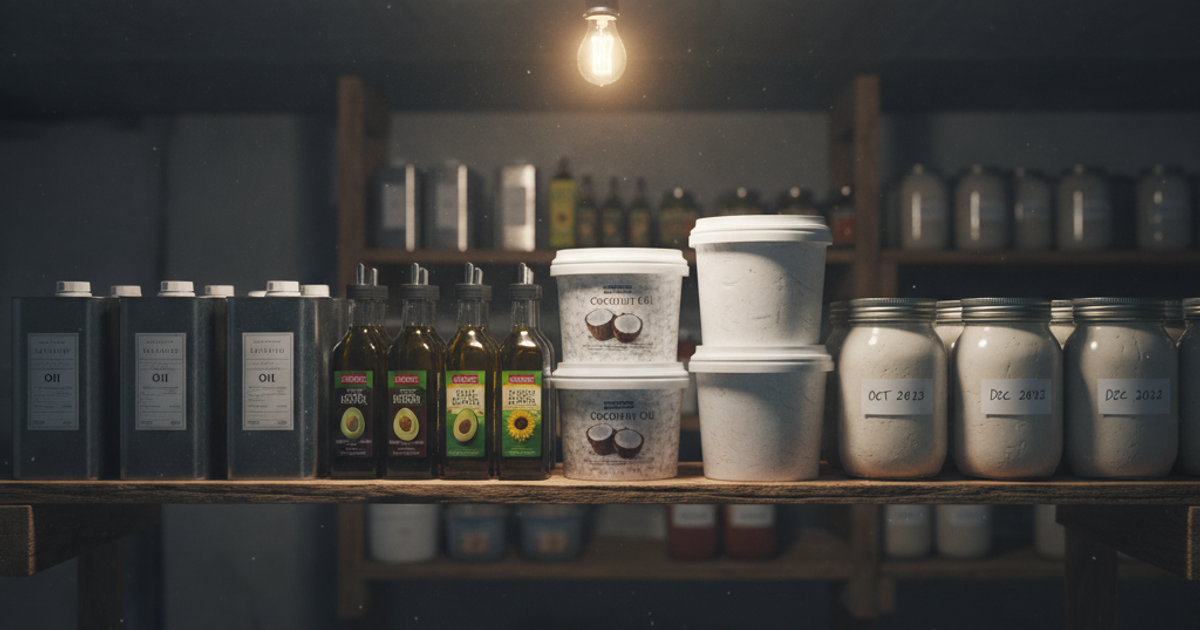
- Coconut oil — roughly 90% saturated. Properly stored, it realistically lasts 3 to 5 years, with many preppers reporting usable product well past that. The undisputed champion of shelf-stable fat.
- Vegetable shortening (hydrogenated) — commercially canned shortening routinely tests good at 5 to 10 years. It's not health food, but it's calories that don't quit.
- Beef tallow and lard — rendered clean and kept cool, 1 to 3 years at room temperature, decades in a freezer, and functionally indefinite if pressure-canned.
- Ghee/clarified butter — water and milk solids removed, 1 to 3 years shelf stable.
- Olive oil — 18 to 24 months from pressing. Buy in tins, not clear glass.
- Canola, soybean, corn, sunflower — 6 to 12 months. These are your rotation fats, not your deep storage.
For pantry storage that genuinely works, Nutiva's organic coconut oil in a bucket gives you a food-grade sealed pail that resists light entirely and can be repacked into smaller jars as you open it. For flavor and high-heat cooking, olive oil sold in metal tins outperforms the same oil in a clear bottle by a wide margin, because light exposure alone can cut olive oil's usable life in half.
How to Store Fats in an Apartment, a Suburb, or on a Homestead
You don't need acreage to stockpile fat — you need a dark, cool, stable spot. Every 18°F increase in storage temperature roughly doubles the rate of oxidation. A closet on an interior wall at 60 to 65°F will preserve oil far better than a cabinet above the stove at 85°F.
Apartment dwellers: use the back of a bedroom closet, under-bed bins, or the bottom shelf of a linen closet. Solid fats stack efficiently and don't leak. Shelf-stable canned lard like Armour Lard and Snow Cap manteca tubs are cheap, dense, and sold at nearly every grocery store — which makes them ideal for quiet, low-profile stockpiling. See our guide to building a serious emergency stockpile in a small space for more layout strategies.
Suburban homes: basements and north-facing crawl spaces are gold. Avoid the garage — summer temperature swings there will destroy oils in a single season.
Rural and off-grid: a root cellar holding 45 to 55°F will extend the life of every fat you own. If you already have one, you're ahead; if you don't, our DIY root cellar build guide is a good starting point.
How to Render Your Own Lard and Tallow at Home
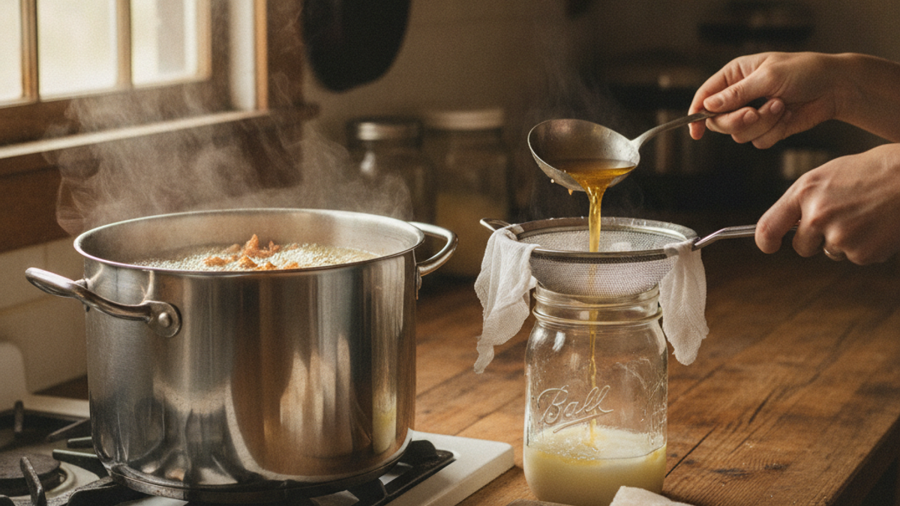
Rendering is simply melting fat out of connective tissue and removing impurities. Those impurities — bits of meat, blood, and water — are what cause rancidity. Clean rendered fat, called "leaf lard" when it comes from pork kidney fat, is nearly white, nearly odorless, and vastly more stable than what you scrape out of a frying pan.
Urban preppers can buy fat trimmings from a butcher counter for pennies per pound, often free for the asking. Rural preppers processing their own animals should read our guide on processing and preserving meat to capture every ounce of fat from a carcass.
Step-by-Step Instructions
Step 1: Source and prepare your raw fat
Ask your butcher for pork fatback or leaf fat (lard) or beef suet from around the kidneys (tallow). Aim for 5 to 10 pounds per batch. Chill the fat until firm, then dice it into half-inch cubes or run it through a meat grinder — smaller pieces render faster and more completely.
Step 2: Render the fat low and slow
Place the fat in a heavy stockpot or slow cooker with a quarter cup of water to prevent scorching. Hold at 225 to 250°F for 3 to 6 hours, stirring occasionally. The water will evaporate and the fat will turn clear and golden. Never let it smoke — overheating damages the fat and shortens shelf life dramatically.
Step 3: Strain out every impurity
Pour the liquid fat through a fine mesh strainer lined with two layers of cheesecloth into clean, dry jars. Strain twice if the fat looks cloudy. The cracklings left behind are edible and excellent — don't waste them. Residual protein and moisture are the number one cause of early rancidity.
Step 4: Seal, label, and date every container
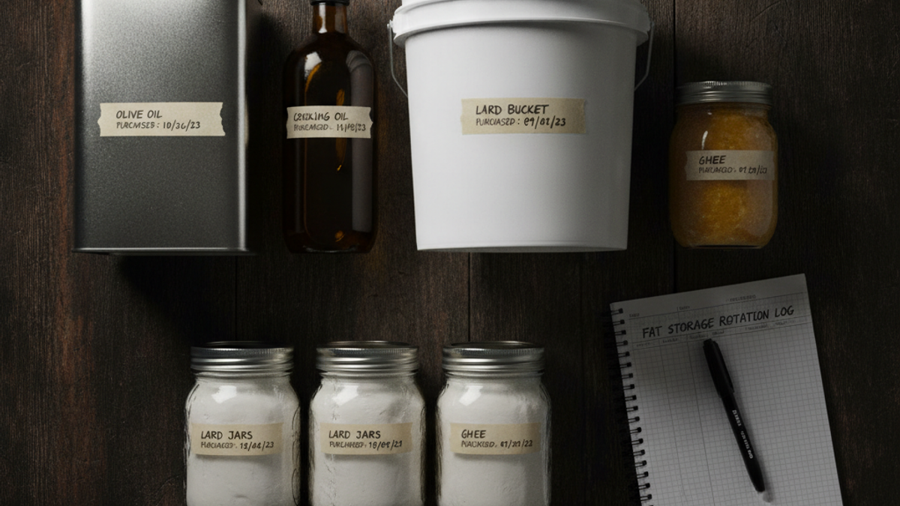
Fill jars to within an inch of the rim, wipe the rims clean, and seal while still warm so the cooling fat pulls a partial vacuum. Write the render date and contents directly on the lid. For bulk buckets and bagged solid fats, over-pack with 5-gallon Mylar bags and oxygen absorbers to strip residual oxygen from the headspace — the same technique detailed in our 25-year food packaging guide.
Step 5: Store cold, dark, and stable
Move sealed containers to your coolest, darkest storage location. Keep them off concrete floors — use a pallet or shelf to prevent moisture wicking and temperature transfer. Never store fat next to cleaning chemicals, gasoline, or kerosene; oils absorb odors readily.
Step 6: Test for rancidity before each use
Open, smell, and taste a small amount. Fresh fat smells clean and neutral. Rancid fat smells like old paint, putty, or crayons and tastes bitter or metallic. Rancid fat won't usually make you acutely sick, but it has lost much of its vitamin content and tastes bad enough to trigger food fatigue — a real morale killer in a long emergency.
Step 7: Rotate on a documented schedule
Adopt first-in, first-out. Cook with your oldest containers weekly and replace them with fresh purchases. A simple spreadsheet or logbook — as outlined in our stockpile inventory management guide — prevents the classic prepper failure of discovering 40 pounds of ruined oil three years too late.
How Much Fat Should You Actually Stockpile?
The LDS Church's long-standing one-year food storage guidance recommends roughly 25 pounds of fats and oils per adult per year. That's a survival minimum built around a mostly grain-based diet. If you're planning for hard physical labor in a grid-down world, budget 35 to 50 pounds per adult per year — closer to a gallon of oil or 4 pounds of solid fat per person per month.
Diversify the types. A stockpile of nothing but coconut oil gets monotonous fast. Balance long-life solids like grass-fed beef tallow and canned vegetable shortening against flavor fats you rotate more aggressively. For baking and morale food, powdered butter in #10 cans stores for up to 10 years unopened and reconstitutes into something that makes a pot of plain rice taste like an actual meal.
Frequently Asked Questions
How long does cooking oil last in long-term food storage?
It depends almost entirely on saturation and storage conditions. Coconut oil and hydrogenated shortening stored cool and dark can last 5 to 10 years. Olive oil runs 18 to 24 months, and polyunsaturated oils like canola, corn, and sunflower typically degrade within 6 to 12 months of opening. Unopened, sealed, and stored below 70°F, expect the high end of each range.
Is it safe to eat lard or oil that has gone rancid?
Rancid fat is generally not acutely toxic, and it won't send you to the hospital the way botulism or salmonella will. However, oxidation destroys vitamins A, D, E, and K, generates free radicals linked to inflammation, and tastes genuinely awful. In a survival scenario, food you refuse to eat is food you don't have. Discard it or repurpose it for soap-making, lamp fuel, or leather conditioning.
Can I store cooking oil in an apartment without a basement or root cellar?
Absolutely. Prioritize solid fats over liquid oils, buy in opaque containers, and pick the coolest interior closet you have — away from exterior walls, windows, radiators, and the kitchen stove. Under-bed storage bins in an air-conditioned bedroom hold remarkably stable temperatures and keep your stockpile out of sight.
Affiliate Disclosure: SHTFPlan.net participates in the Amazon Services LLC Associates Program. Some links are affiliate links — we may earn a small commission at no extra cost to you.