Calorie Math for Survival: How to Ration Emergency Food and Stretch Your Stockpile for 90 Days
Your food stockpile is only as good as the math behind it. Learn how to calculate daily calorie needs, build a rationing plan, and stretch emergency food for 90 days without starving your family.
Most preppers can tell you how many buckets of food they own. Very few can tell you how many calories they own. That distinction is the difference between a stockpile that carries your family through a 90-day crisis and one that quietly runs out on day 47 while everyone wonders where it went.
Food storage is arithmetic before it is anything else. A "one-month supply" advertised on a bucket label may assume 1,200 calories per person per day — barely half of what a working adult burns hauling water, cutting firewood, or walking a defensive patrol. FEMA and the USDA generally plan around 2,000 calories per person per day for sheltering populations, and the Department of Defense builds its MREs around roughly 1,300 calories per meal for soldiers under load. If your emergency food storage math is built on marketing servings instead of real caloric need, your plan has a hole in it.
This guide shows you how to calculate your household's true 90-day caloric requirement, how to ration intelligently, and how to stretch a stockpile whether you're in a 700-square-foot apartment or on 40 acres.
What You'll Need
Tools
- Digital kitchen scale
- Measuring cups and a dedicated ration scoop
- Notebook, spreadsheet, or printed inventory sheet
- Permanent marker for dating and labeling containers
Supplies
- Long-term bulk staples (rice, beans, oats, wheat)
- Shelf-stable cooking fat
- Peanut butter or other calorie-dense spread
- Compressed emergency ration bars
- Multivitamins, salt, and electrolyte powder
How to Calculate Your Family's 90-Day Calorie Requirement
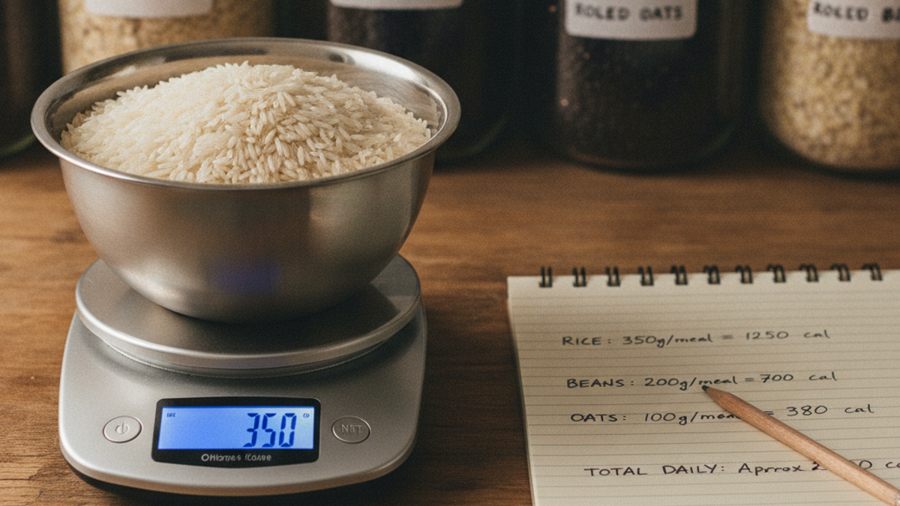
Start with a baseline of 2,000 calories per adult per day for sedentary shelter-in-place conditions. Then adjust upward for reality:
- Moderate activity (hauling water, hand-washing laundry, garden work): 2,400–2,800 calories
- Heavy labor or cold weather (chopping wood, winter without central heat): 3,000–3,600 calories
- Children ages 4–8: 1,200–1,600 calories
- Teens: 2,200–3,200 calories — teenage boys often out-eat adult men
- Pregnant or nursing women: add 300–500 calories
Run the math for a family of four with two adults and two school-age kids: 2,400 + 2,400 + 1,600 + 1,600 = 8,000 calories per day. Over 90 days that's 720,000 calories. That number, not "how many buckets," is your target. For perspective, a 50-pound bag of white rice delivers roughly 80,000 calories. That family would need the caloric equivalent of nine such bags — plus fats, protein, and enough variety to keep people eating.
Cold weather adds a hidden tax. Research from military cold-weather studies shows energy expenditure can rise 25 to 50 percent in sustained cold. If your winter heating plan involves a wood stove and manual fuel gathering, budget accordingly.
Why Calorie Density Beats Volume in Small Spaces
Apartment dwellers and suburban preppers with limited closet space should think in calories per cubic foot. Fats deliver 9 calories per gram versus 4 for carbohydrates and protein — which makes cooking oil the single most space-efficient survival food you can store. A gallon of bulk coconut oil packs roughly 32,000 calories into less space than a gallon of milk, and it's remarkably shelf-stable at room temperature.
Peanut butter is the other heavyweight. Forty-ounce jars of bulk peanut butter run about 6,600 calories each and contribute fat, protein, and morale in one shelf-stable package. Stack a case under a bed and you've added meaningful days to your timeline. For more small-space strategies, see our guide to building a serious stockpile in a small apartment.
Freeze-dried meals occupy the opposite end of the spectrum: light and convenient, but bulky and expensive per calorie. They're excellent as a "no-cook, no-cleanup" layer. A Mountain House 14-day supply makes a solid grab-and-go module that can transfer straight into a vehicle or bug out bag if you're forced to move.
How to Ration Emergency Food Without Starving Your Family
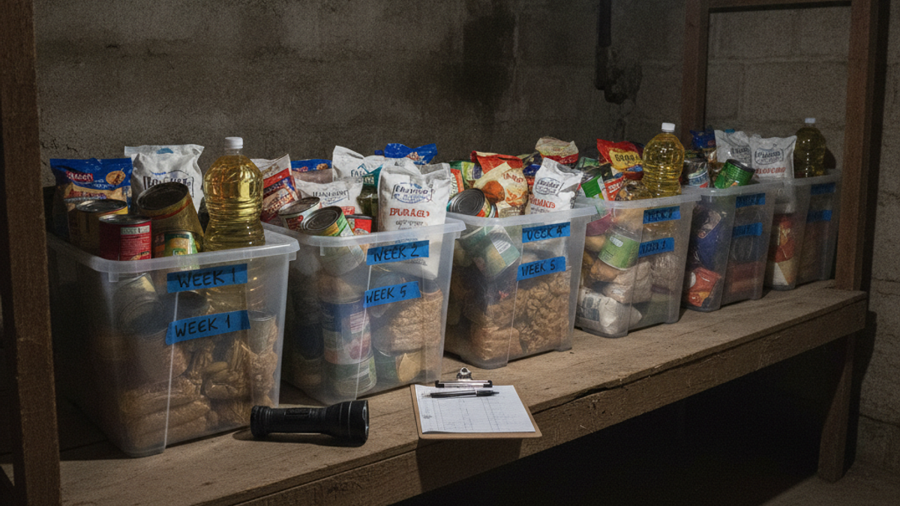
Rationing does not mean everyone eats half. It means deliberate, measured distribution based on need. Three rules govern smart rationing:
- Ration on day one, not day thirty. Mild restriction early — trimming to 1,800 calories while the situation clarifies — buys weeks. Panic cuts on day 30 come after your body has already burned reserves.
- Never ration below 1,200 calories for working adults. Below that, cognitive function, immune response, and decision-making degrade. The Minnesota Starvation Experiment documented profound apathy, irritability, and obsessive food fixation in men held at semi-starvation levels — exactly the mindset you can't afford during a crisis.
- Feed the workers. Whoever is chopping wood, hauling water, or standing watch gets the larger portion. This isn't favoritism; it's operational necessity.
Weigh portions. Eyeballing fails badly under stress — most people overserve by 20 to 30 percent. An accurate digital kitchen scale is one of the cheapest pieces of survival gear you can own, and it turns guesswork into arithmetic.
Step-by-Step Instructions
Step 1: Inventory every calorie you currently own
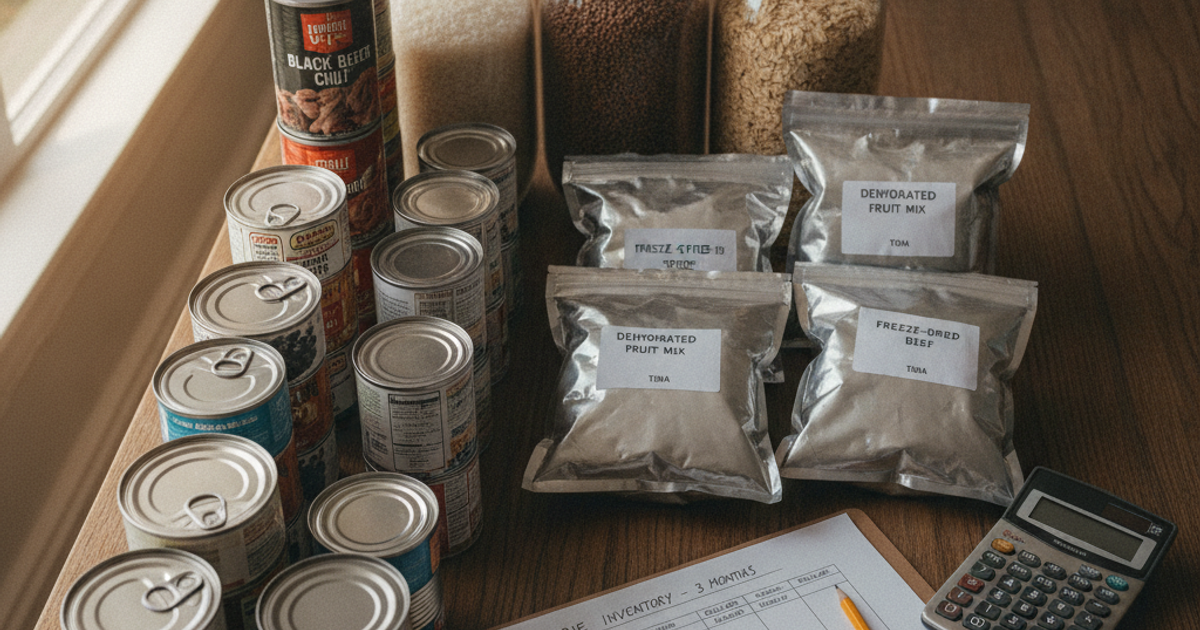
Pull everything — pantry, freezer, buckets, car stash — and log item, quantity, calories per serving, and expiration date. Multiply out the totals. Most households discover they hold 10 to 20 days of real food, not the 30 they assumed. Our guide to stockpile inventory management covers tracking systems that survive real use.
Step 2: Calculate your household's 90-day target
Assign each family member a daily calorie number based on age and expected activity, sum them, and multiply by 90. Write that number on the inside of your pantry door. Every purchase from here forward closes the gap between what you have and what you need.
Step 3: Fill the gap with calorie-dense bulk staples
Rice, beans, oats, pasta, sugar, and oil deliver the most calories per dollar. A 30-day emergency food pail is a fast way to add a known quantity of calories, and a 120-serving bucket adds variety that prevents appetite fatigue. Check the label's stated calories per serving — not servings alone.
Step 4: Repackage bulk goods for long-term storage
Bulk grains in paper sacks are rodent bait. Transfer them into mylar with oxygen absorbers using the method in our guide to 25-year food storage packaging, then place sealed bags inside food-grade buckets or totes.
Step 5: Build a written 90-day ration menu
Plan in seven-day cycles: breakfast, main meal, and a snack, with calorie counts listed for each. A repeating menu prevents improvised overconsumption and makes it obvious when you're ahead or behind schedule.
Step 6: Establish weekly weigh-ins and consumption checks
Every Sunday, recount remaining supplies and compare against plan. If you've burned nine days of food in seven, tighten portions immediately. Track body weight too — losing more than one to two pounds per week means you're cutting too deep.
Step 7: Extend the timeline with fresh inputs
Sprouts and microgreens produce edible greens in 5 to 10 days on a countertop, providing vitamin C that stored grains lack. Our guide to growing sprouts indoors works in apartments, suburbs, and rural homes alike.
Recommended Gear
Two products deserve a spot in every vehicle and evacuation kit. Millennium energy bars pack roughly 400 calories each, require no water or cooking, and tolerate hot car trunks. For a compact backstop, 3,600-calorie ration bricks deliver three days of minimum sustenance in a package the size of a paperback book. Browse more field-tested options on our recommended survival gear page.
Frequently Asked Questions
How many calories per day do you need to survive an emergency?
Plan on 2,000 calories per adult per day as a baseline and 2,400–3,000 if you're doing physical labor or living without heat. Short-term rationing at 1,500 calories is survivable for healthy adults, but sustained intake below 1,200 causes measurable declines in strength, judgment, and immune function.
How long does emergency food last in storage?
Freeze-dried meals in sealed #10 cans last 25 to 30 years. White rice, wheat berries, and beans packed in mylar with oxygen absorbers last 20 to 30 years. Cooking oils last 1 to 3 years, peanut butter about 2 years past its printed date, and canned goods typically 3 to 5 years with good quality retention well beyond.
What's the cheapest way to stockpile 90 days of food?
Bulk staples bought by the 25- or 50-pound bag: white rice, pinto beans, rolled oats, pasta, sugar, and vegetable oil. This combination delivers calories at a fraction of freeze-dried prices. Add multivitamins, salt, and a rotating supply of canned proteins to cover nutritional gaps.
Affiliate Disclosure: SHTFPlan.net participates in the Amazon Services LLC Associates Program. Some links are affiliate links — we may earn a small commission at no extra cost to you.