Night Watch: How to Set Up a Rotating Security Watch Schedule for Your Survival Group
When SHTF, sleeping through a threat could cost you everything. Here's how to build a watch rotation that keeps your group safe without burning everyone out.
When the grid goes down and social order begins to fray, darkness becomes both your greatest vulnerability and your most powerful ally. Historically, most violent crimes and raids occur between the hours of 11 PM and 4 AM — the same window when human alertness naturally bottoms out due to circadian rhythm. For a prepper survival group, whether you're sheltering in a suburban home, an apartment complex, or a rural retreat, failing to maintain organized nighttime security is one of the most dangerous mistakes you can make. A well-designed rotating watch schedule transforms a scattered group of individuals into a disciplined security team capable of detecting and responding to threats around the clock.
This guide will walk you through building, managing, and sustaining a rotating security watch schedule for your SHTF survival group — from the first roster draft to maintaining long-term operational readiness. Whether your group is three family members in a city apartment or twelve people dug in on a rural homestead, the core principles apply. For additional context on threat detection and layered defense, see our guide on situational awareness and detecting threats before they become dangerous.
What You'll Need
Tools
- Celestron SkyMaster night sky binoculars
- Streamlight ProTac tactical flashlight with red filter
- Casio G-Shock military watch with illuminator
- Motorola Talkabout T800 two-way radio
Supplies
- Rite in the Rain weatherproof notebook (tactical)
- Pens or mechanical pencils
- Pre-printed watch schedule templates
- Signal mirror or backup whistle
Why a Rotating Watch Schedule Is Non-Negotiable for SHTF Security
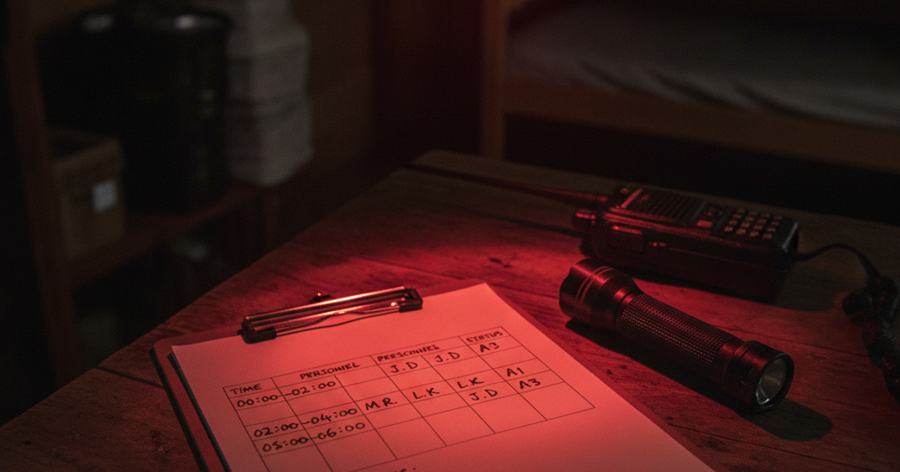
In an extended SHTF scenario, fatigue will be your most persistent enemy. Research from the U.S. Army Research Laboratory confirms that after 24 hours without sleep, cognitive performance degrades to a level equivalent to a 0.10% blood alcohol concentration — legally drunk in every U.S. state. If one person attempts to stand watch all night, every night, they will eventually fail at the worst possible moment. A rotating schedule distributes the burden, keeps everyone sharper, and ensures no single person becomes a liability.
The rotating watch model has been used by military units, frontier settlers, and disaster response teams for centuries because it works. The principle is simple: divide the night into manageable blocks, assign personnel in rotation, and ensure everyone gets enough consolidated sleep to function. The specifics — block length, number of watchers on duty simultaneously, communication protocols — vary based on your group's size, location, and threat environment.
Urban and suburban preppers often assume this kind of security planning doesn't apply to them. That's a dangerous assumption. A four-story apartment building is harder to defend than a farmhouse in many ways: more entry points, shared hallways, elevator shafts, and neighbors who may not be allies. The principles of watch scheduling apply just as strongly in a city context, even if the observation posts and patrol routes look different.
How to Assess Your Group's Actual Security Needs
Before writing a single name on a watch roster, you need to conduct an honest assessment of your group. Start by cataloging everyone's physical fitness, any medical conditions that affect nighttime alertness, and relevant prior training. A 60-year-old with a heart condition should not be pulling 2 AM solo watch shifts in the cold. A military veteran with nighttime operations experience should probably be designing your protocols and training others.
Next, evaluate your location. Rural retreat? Identify your perimeter, natural approach routes, and likely threat vectors. Suburban home? Walk the neighborhood at night and identify sight lines, lighting conditions, and chokepoints. Urban apartment building? Designate observation points near stairwells and windows with clear street views, and identify which neighbors might be trusted to form a neighborhood mutual aid network as a force multiplier.
Calculate how many people you have available for watch duty. As a general rule, you need at least four able-bodied adults to sustain a viable rotating watch schedule over multiple weeks without destroying group cohesion. With fewer than four, you're looking at watch shifts that are dangerously long or sleep rotations that are dangerously short.
Designing the Watch Block Structure
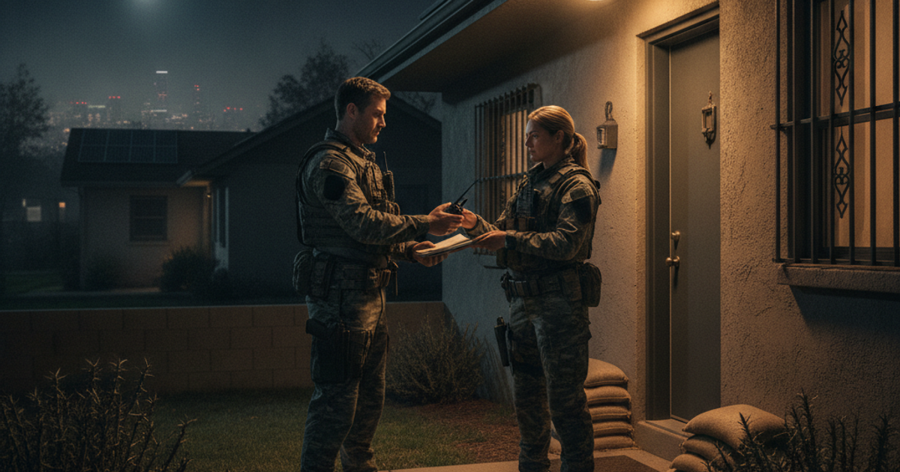
The most field-tested watch block formats used by military and security professionals are the 2-hour and 3-hour models. Two-hour blocks are more mentally sustainable per shift but require more handoffs and can disrupt sleep more frequently. Three-hour blocks allow deeper sleep cycles between duties but are more cognitively demanding toward the end of the shift, especially in the 3–5 AM window when alertness is at its lowest.
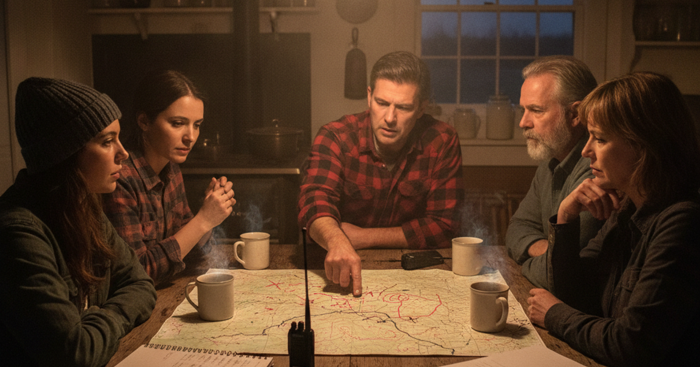
For most survival groups of 4–6 people, a 2-hour block rotation from sunset to sunrise works well. With six people, each person stands one two-hour watch per night, then sleeps the remaining ten hours (minus transition time). With four people, each person stands two two-hour watches, which is more demanding but workable if daytime rest is protected.
Always track shift times precisely. A reliable, battery-backed timepiece is essential — the Casio G-Shock military watch with illuminator is a proven workhorse that can be read in complete darkness without compromising your position. Every watcher on your team should have a working watch; relying on a phone is a poor choice when power is unreliable and screen light can compromise situational awareness.
Observation Tools That Give You the Edge After Dark
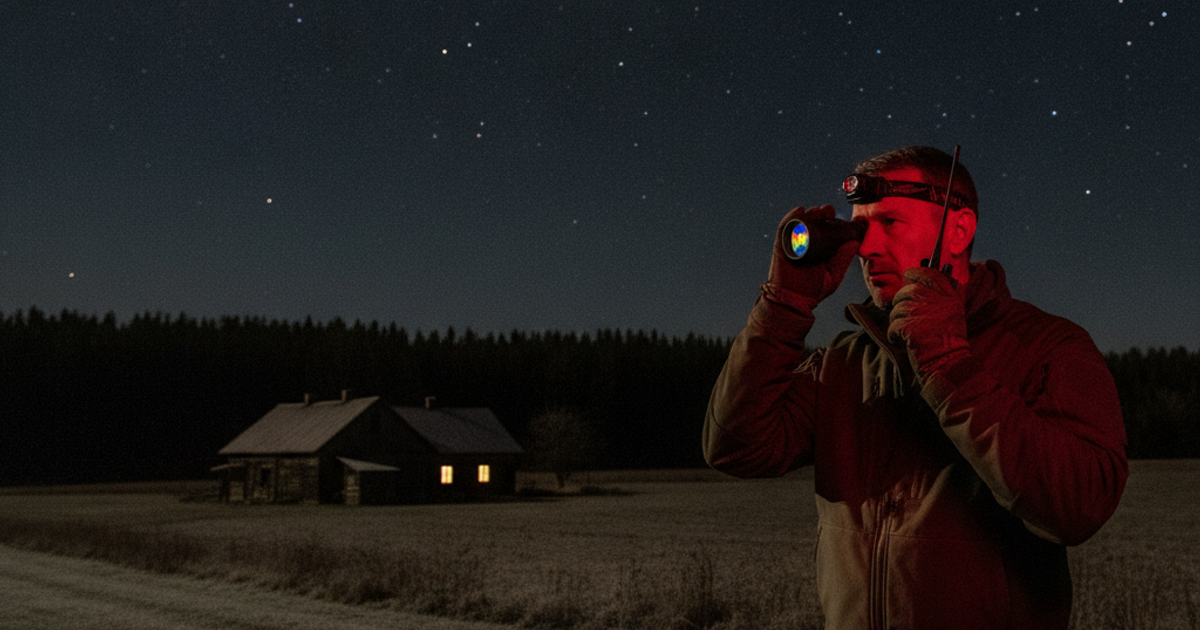
Night watch is only as effective as your ability to actually see what's happening. Unaided eyes in darkness max out at about 100–150 feet of useful threat detection under a clear, moonlit sky. That's not enough. Your team needs optics.
For general perimeter scanning, quality binoculars are the backbone of any watch position. The Vortex Optics Crossfire 10x42 binoculars offer excellent low-light performance for daytime and dusk-to-dark transitions. For dedicated astronomical and low-light conditions, consider keeping a pair of Celestron SkyMaster night sky binoculars at your primary observation post — their large objective lenses gather significantly more light than standard models.
For true night vision capability, the ATN PVS14 night vision monocular is a professional-grade option that provides clear image intensification even on moonless nights. It's a significant investment, but in a prolonged grid-down scenario, the ability to see threats that cannot see you is a decisive tactical advantage. Complement this with a FLIR Scout TK thermal monocular for detecting body heat signatures through brush, around corners, and in conditions where traditional night vision struggles. The combination of thermal and image-intensification optics is what serious security teams use for a reason. For a deeper dive into these technologies, read our article on thermal imaging and night vision for preppers.
For lighting during watch transitions or perimeter checks, avoid white light whenever possible — it destroys your night vision and advertises your position. The Streamlight ProTac tactical flashlight with red filter gives you usable task lighting while preserving dark adaptation and minimizing your light signature.
Communication Protocols During Watch
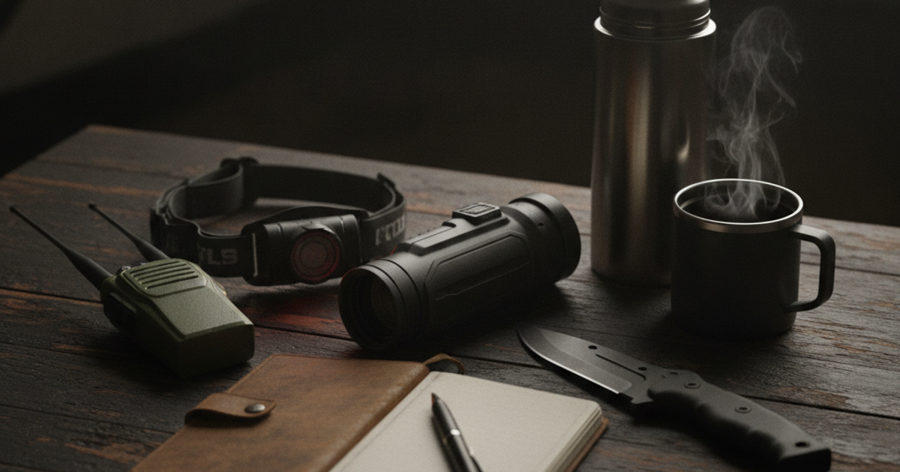
Every watcher needs a reliable way to alert the rest of the group — and to receive updates — without creating noise or light that attracts outside attention. Two-way radios on a designated channel are the standard solution. The Motorola Talkabout T800 two-way radio offers Bluetooth integration, rechargeable batteries, and a solid range that works well across a suburban property or apartment building floor plan. Establish a simple radio check protocol — a brief radio check at the start of each watch shift, with agreed-upon code phrases for threat levels.
Radio discipline is critical. Unnecessary chatter is both a security risk and a battery drain. Develop a simple brevity code: one click means "all clear," two clicks means "movement observed," three clicks means "immediate threat, wake everyone." Write these codes down and post them at every watch position so there is no ambiguity under stress.
The Watch Log: Your Group's Tactical Memory
Every watch shift should produce a written log. This is not optional. The watch log is how your group builds a threat intelligence picture over time — you may not recognize that someone has been surveilling your position until you compare notes from three separate watch shifts over four days. Log time, weather, any observed movement, vehicles, sounds, or anomalies, and the watcher's name. Use a Rite in the Rain weatherproof notebook so entries survive rain, dew, and humid overnight conditions without becoming illegible. Review the log as a group every morning and look for patterns.
Step-by-Step Instructions
Step 1: Assess Your Group's Available Personnel and Physical Capabilities
Inventory every member of your group for watch duty eligibility. Consider age, medical conditions, physical fitness, and prior military or security experience. Assign a watch fitness rating (full duty, limited duty, or support only) to each person so your schedule reflects reality, not wishful thinking.
Step 2: Map Your Observation Posts and Patrol Routes
Walk your location in daylight and again after dark to identify the best observation positions. In a rural setting, this means elevated positions with broad sight lines and covered approach routes. In a suburban or urban setting, identify upper-floor windows, rooftop access points if available, stairwell landings, and doorways with exterior views. Mark each post on a simple hand-drawn map and assign fields of responsibility to each position.
Step 3: Choose Your Watch Block Structure Based on Group Size
Select 2-hour or 3-hour watch blocks based on how many able-bodied adults you have available. Build the rotation so that each person gets at least 6 consecutive hours of sleep within every 24-hour period — ideally more. Post the schedule in a central location where every group member can see it, and ensure everyone understands the rotation at least 48 hours in advance.
Step 4: Establish and Brief the Communication Protocol
Set up your radio channels, establish the brevity code for alerts, and practice it before going live. Designate a quick reaction element — the two people who will respond first if the on-watch person sounds an alarm — and make sure that role rotates so no one is always the one woken at 3 AM. Pair this with your perimeter alarm setup; see our guide on perimeter alarms and trip wires for layered detection strategies.
Step 5: Conduct a Watch Position Handoff Procedure
Incoming watchers should arrive at the post five minutes before the shift change, receive a verbal briefing from the outgoing watcher covering any observations during the previous shift, and visually inspect the post equipment. The outgoing watcher does not leave until the incoming watcher confirms they are ready and equipped. This overlap prevents coverage gaps and ensures continuity of the log.
Step 6: Implement a Watch Log and Morning Debrief Routine
Every watcher logs entries in real time using the weatherproof notebook at the post. At morning standup — ideally at first light — the group leader or security coordinator reviews all watch logs from the previous night, identifies any anomalies, and briefs the group. Patterns that emerge over multiple nights should trigger a security posture reassessment.
Step 7: Rotate the Schedule Weekly to Prevent Fatigue Inequity
The same people should not always pull the 2–4 AM "graveyard" shift, which is physiologically the most difficult window for human alertness. Rotate the schedule weekly so the worst shifts are shared equally across the group. This maintains morale, prevents resentment, and ensures no one degrades faster than others from sleep disruption.
Step 8: Conduct Regular Drills and Schedule Reviews
At least once per week, run a simulated alert drill — have someone trigger the alarm code and time how long it takes for the quick reaction element to reach the post and the rest of the group to reach their designated positions. Review the schedule whenever group composition changes. A schedule built for six people will fail dangerously if two members become sick or injured.
Managing Watch Fatigue Over the Long Term
Short-term SHTF scenarios are manageable under almost any watch structure. It is the extended scenario — two weeks, a month, three months — where watch fatigue becomes a genuine threat to your group's security. Sleep deprivation compounds over time in ways that single nights of rest cannot fully reverse. Group leaders must actively monitor for signs of chronic fatigue: irritability, microsleeps during watch, declining log quality, and missed radio checks.
Build recovery time into your schedule whenever the threat level permits. If you've had three quiet nights with no observed movement, consider standing down to a reduced watch rotation for one night to allow full sleep cycles across the group. Document the decision, post a minimum observer, and return to full rotation at first light. Strategic rest is not a weakness — it is a force multiplier.
Group dynamics during extended watch schedules are also a psychological consideration. The stress of disrupted sleep, combined with confinement and scarcity, creates conflict even among close-knit teams. Structured scheduling, fair rotation, and transparent decision-making about assignments go a long way toward keeping morale functional. For more on managing the psychological dimension of extended crisis scenarios, see our article on surviving the mental toll of psychological breakdown in a crisis.
Frequently Asked Questions
How many people do you need to run a 24/7 rotating security watch?
At a minimum, you need four able-bodied adults to sustain a continuous watch rotation without dangerous sleep deprivation over an extended period. With four people on 2-hour blocks covering a 10-hour night, each person pulls one or two shifts per night and has enough time for a consolidated sleep block. Six or more people is significantly more sustainable for long-term operations. Groups smaller than four should seriously consider consolidating into a larger mutual aid network or accepting that a full 24/7 watch is not feasible, and focusing security efforts on passive perimeter detection instead.
What should a survival watch guard do if they see a threat during their shift?
The immediate priority is to alert the group without revealing your position. Use your agreed-upon radio brevity code — do not shout, do not use white light, and do not engage unilaterally unless an immediate threat to life demands it. Your job as a solo watch is observation and communication, not confrontation. Once the quick reaction element is awake and moving, the watch guard maintains observation and feeds real-time information via radio until the group leader makes tactical decisions. Detailed protocols for what happens after the alert should be planned and rehearsed in advance, not improvised under stress.
Can you set up a watch schedule in an apartment building or urban environment?
Absolutely. Urban watch schedules focus on interior and exterior observation points rather than open-perimeter patrol. Assign watchers to windows overlooking primary street approaches, stairwell landings, and if accessible, rooftop positions. Coordinate with trusted neighbors to extend your coverage network and share watch duties across multiple units, effectively creating a community survival team. Urban watch must also account for acoustic observation — sounds of forced entry, group movement, or vehicles idling without explanation are all significant intelligence in a city environment. Keep the watch log focused on anything that deviates from the pattern of life you've established for your block.
Affiliate Disclosure: SHTFPlan.net participates in the Amazon Services LLC Associates Program. Some links are affiliate links — we may earn a small commission at no extra cost to you.