
Bears, Big Cats, and Feral Dog Packs: How to Survive a Wild Animal Attack When Help Isn't Coming
Predator encounters spike when people are displaced and pets go wild. Learn how to prevent, deter, and survive a wild animal attack — and treat the bite wounds afterward.

Most preparedness planning focuses on people — looters, rioters, home invaders. But in a grid-down, EMS-free environment, the threat that's statistically most likely to put you in the dirt isn't a two-legged predator. It's a four-legged one. Black bears raiding unsecured food caches. Mountain lions following a lone hiker on a resupply run. And the most underestimated threat of all: feral and abandoned dog packs, which multiply fast when owners evacuate, die, or simply stop feeding them.
The CDC estimates 4.5 million dog bites occur annually in the United States, with roughly 800,000 requiring medical attention and 30 to 50 resulting in death — and that's with animal control, police, and emergency rooms fully staffed. Bear and cougar attacks are far rarer (fatal black bear attacks average roughly one per year across North America, and mountain lions have killed fewer than 30 people in the last century), but survivability in those encounters depends almost entirely on whether you know what to do in the first three seconds.
Here's the uncomfortable truth for preppers: in a collapse, every one of these numbers goes up. Garbage service stops, which means bears and coyotes move into suburbs. Livestock goes unprotected. Pets become strays, strays become packs, and packs become hunters. This is as much an urban survival problem as a rural one.
What You'll Need
Tools
- High-lumen tactical flashlight
- Fixed-blade survival knife
- Stun gun with built-in light
- Sturdy walking staff or trekking poles
Supplies
- EPA-registered bear spray (10.2 oz)
- Chest or belt bear spray holster
- Pepper gel for dog deterrence
- Bear-resistant food storage bag
- Bear bells or noisemakers
- Irrigation syringe, povidone-iodine, and sterile gauze
How to Survive a Bear Attack Without a Gun
Species identification drives your entire response. Black bears are the bears most Americans will meet — they range from Florida to Alaska and increasingly raid suburban garbage. Grizzly/brown bears occupy the Northern Rockies, Alaska, and parts of Canada.
For a defensive grizzly encounter — a surprised sow with cubs, a bear on a carcass — play dead. Lie face down, legs spread so you can't be rolled, hands laced behind your neck, pack on. Stay down until the bear is gone. For a black bear, never play dead. Fight. Punch, kick, strike the nose and eyes with anything hard. The same applies to any bear that stalks you, enters your shelter, or attacks at night — that's predatory behavior, and compliance gets you eaten.
Research by wildlife biologist Tom Smith found bear spray stopped undesirable bear behavior in roughly 92% of documented incidents, outperforming firearms in several analyses — largely because a panicked shooter misses. Carry a full-strength 10.2 oz canister like the Counter Assault 10.2 oz, which throws a 30+ foot fog cloud for eight seconds. Spray buried in a backpack is useless, so mount it on a chest holster where you can draw it one-handed in under two seconds.
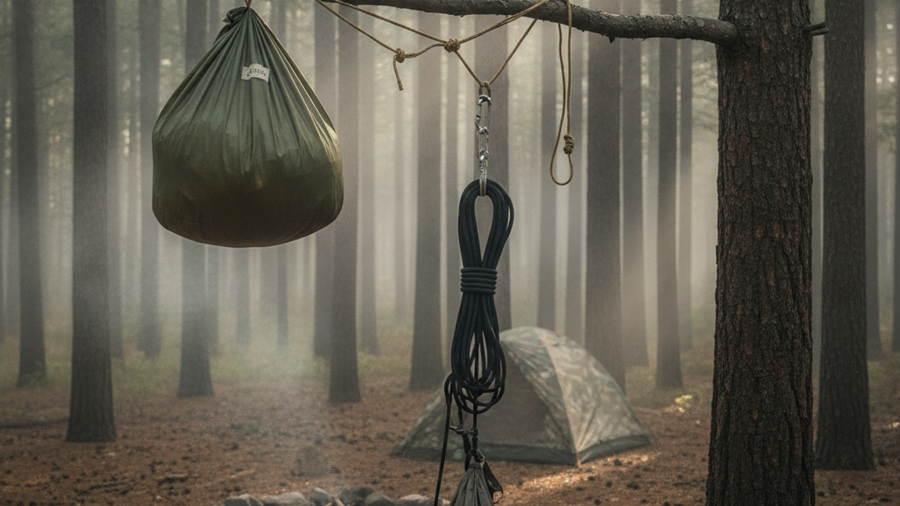
Prevention beats everything. Most bear conflicts are food conflicts. Hang or stash all food, trash, grease, and scented hygiene items in a bear-resistant Ursack at least 100 yards downwind of where you sleep. On trails and around a dark property, bear bells and loud conversation prevent the surprise encounters that cause most maulings.
How to Stop a Mountain Lion Attack in Progress
Cougars are ambush predators that target the neck from behind. If you see one, you've probably already disrupted its plan. Never run — running triggers the chase reflex. Instead, make yourself enormous: open your jacket, raise your pack overhead, shout in a deep voice, and back away slowly while maintaining eye contact. Pick up small children immediately; attack data consistently shows lions prefer targets under 5 feet tall.
If contact is made, fight for your airway. Protect your throat with your forearms, and attack the eyes and nose. Survivors have driven lions off with rocks, pens, jackets, and bare hands. A fixed-blade knife carried on your belt — not folded in a pocket you can't reach with a cat on your back — is a genuine force multiplier here. A 1,000-lumen tactical flashlight also matters: cougars hunt at dawn and dusk, and a blast of white light both identifies eyeshine at distance and disrupts an approach.
How to Defend Against a Feral Dog Pack in the Suburbs
Feral dog packs are the most likely animal threat in an extended grid-down scenario, and the most dangerous because they're coordinated, fearless of humans, and active in daylight. Packs typically use a flanking approach: one dog fronts you while others circle to your rear.
- Break the encirclement. Put your back against a wall, vehicle, fence, or tree so they can only come from one direction.
- Don't run, don't scream, don't turn your back. Face them, stand tall, and move away laterally with slow deliberate steps.
- Deploy chemical deterrent early. Pepper gel is better than spray in wind and indoor spaces because it streams rather than atomizes, and won't blow back on you.
- Feed the lead dog your off arm. If a bite is unavoidable, offer a padded forearm or pack strap rather than your throat or femoral artery, then strike with your dominant hand.
- Use noise and electricity. The crackle of a stun gun alone will scatter most semi-feral dogs before contact — a quiet, non-lethal option for apartment dwellers and anyone who can't legally carry a firearm.
Apartment and suburban residents should also think about perimeter deterrence: secure trash in hard-sided containers, close crawlspaces and under-deck access, remove pet food from balconies and porches, and keep stairwells and courtyards lit. A well-trained dog of your own is the single best early-warning system available — see our guides on training your dog as a survival alarm and choosing a security dog for SHTF.
Step-by-Step Instructions
Step 1: Assess Your Local Predator Profile
Check your state wildlife agency's range maps for black bear, grizzly, and mountain lion presence within 50 miles of your home and bug-out location. Note known den areas, game trails, and greenbelt corridors — predators use riparian areas and utility easements to move through cities. Document seasonal patterns: bears are most aggressive in late summer hyperphagia and early spring.
Step 2: Harden Your Property Against Attractants
Secure garbage in metal bins with locking lids, bring pet food indoors, clean grills after every use, and pick fallen fruit daily. Install motion-activated lighting on all approaches and consider electric fencing for chicken coops, rabbit hutches, and beehives. Clear brush within 30 feet of structures so nothing can stage an ambush from cover.
Step 3: Carry a Layered Deterrent System Daily
Build a tiered response: light and noise first, chemical deterrent second, impact weapon or blade third, firearm last. Mount bear spray or pepper gel where your dominant hand naturally falls — hip, chest rig, or pack shoulder strap — not inside a zipped compartment.
Step 4: Practice Your Draw and Deployment
Buy an inert practice canister and run 20 repetitions: draw, remove safety clip, aim low and slightly downward, burst for two seconds. Do it while walking, while wearing gloves, and while kneeling. Under adrenaline, you will only perform what you have rehearsed.
Step 5: Control the Encounter Before It Becomes an Attack
Stop. Identify the animal. Do not run. Make yourself large for cats and dogs, speak in a calm firm voice for bears, and create distance by backing away on a diagonal. Never position yourself between a mother and offspring, and never approach a carcass or kill site.
Step 6: Fight With Intent If Contact Happens
Protect your throat, face, and femoral arteries. Target eyes, nose, and throat on any attacking animal. Use whatever is in your hands — trekking pole, flashlight bezel, knife, rock. Commit fully; half-measures teach a predator you're prey.
Step 7: Irrigate and Treat the Bite Wound Immediately
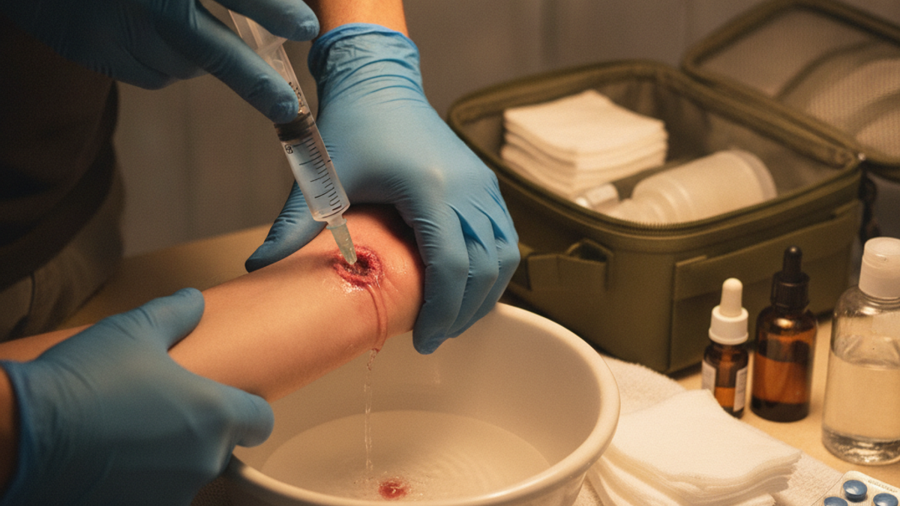
Animal bites are contaminated puncture wounds — infection rates run 10–20% for dog bites and higher for deep punctures. Control bleeding with direct pressure first, then irrigate aggressively with at least a liter of clean, potable water under pressure using an irrigation syringe. Clean around the wound with povidone-iodine, pack loosely with sterile gauze, and leave deep punctures open rather than suturing them shut, which traps bacteria.
Step 8: Monitor for Infection and Rabies Risk
Watch for spreading redness, streaking, swelling, heat, pus, or fever over 48–72 hours. In a grid-down situation, broad-spectrum antibiotics such as amoxicillin-clavulanate are the standard of care for animal bites — something to discuss with your physician while stocking your long-term medical supplies. Rabies remains nearly 100% fatal once symptomatic; any bite from an unknown or behaviorally abnormal mammal is a genuine emergency, and post-exposure prophylaxis is worth extraordinary effort to obtain.
Recommended Gear
A complete animal-defense loadout is cheap compared to most survival gear. Pair a Counter Assault 10.2 oz canister with a quick-draw holster, keep pepper gel in your everyday carry for urban dog encounters, and add a stun gun/flashlight combo for apartment dwellers restricted from carrying weapons. Round it out with bear bells on your pack, an Ursack Major for food security, a Cold Steel Bushman on your belt, and a Streamlight ProTac for identifying eyeshine before an animal closes distance. Sharpening your situational awareness costs nothing and prevents more attacks than all of it combined.
Frequently Asked Questions
Is bear spray or a gun better for stopping a bear attack?
Studies by Brigham Young University's Tom Smith found bear spray stopped aggressive bear behavior in roughly 92% of incidents, while firearms succeeded in 76–84% depending on type. Bear spray requires less precision under extreme stress, works on cats and dogs, is legal nearly everywhere, and doesn't kill the animal. The best answer is both, with spray as the first response.
What should I do if a dog pack surrounds me and I have no weapon?
Get your back to a solid object immediately so they can't flank you, then stand tall, avoid direct staring, and back away slowly without turning. Throw rocks or swing a stick, belt, or jacket to create distance. If knocked down, curl into a ball and protect your throat, neck, and face with your arms until you can regain your feet.
How do I treat an animal bite when there's no hospital?
Stop the bleeding with direct pressure, then flush the wound with at least a liter of clean water under pressure for several minutes. Disinfect around — not deep inside — the wound, dress it loosely, and leave punctures open to drain. Recheck twice daily for signs of infection and begin stockpiled antibiotics if redness spreads or fever develops. Our guide on treating cuts, burns, and infections without a hospital covers wound care in greater depth.
Affiliate Disclosure: SHTFPlan.net participates in the Amazon Services LLC Associates Program. Some links are affiliate links — we may earn a small commission at no extra cost to you.