Tactical Flashlights for Preppers: How to Choose the Best EDC and Survival Light for Any Emergency
Not all flashlights are created equal. Here's how to choose a tactical flashlight that pulls double duty as an EDC tool and a survival lifeline.
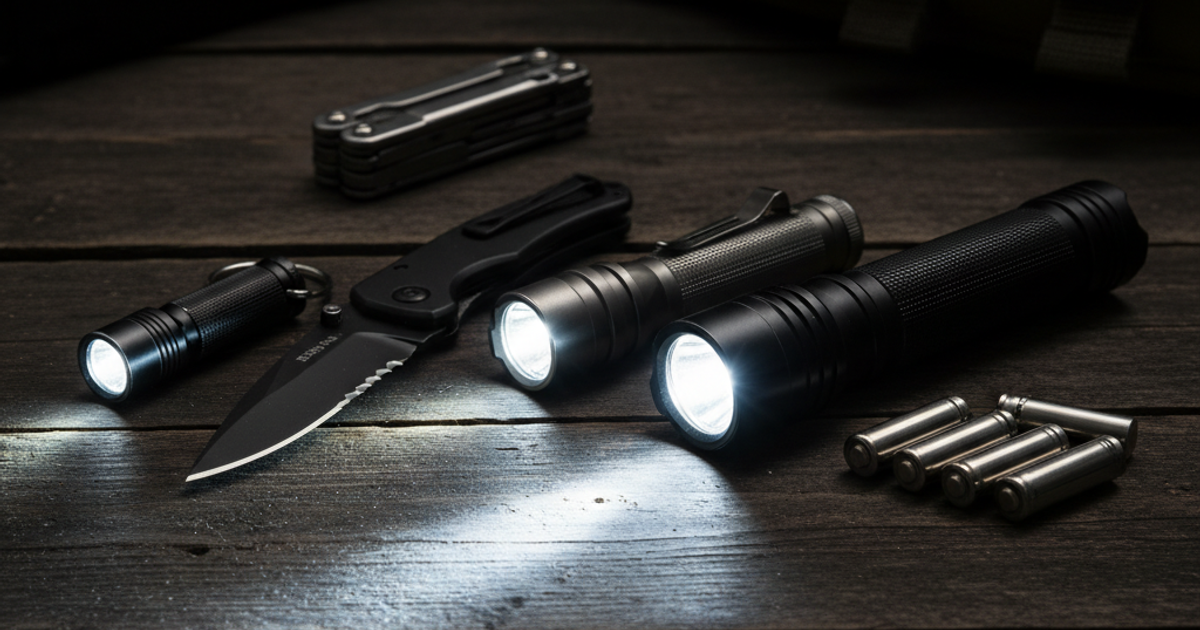
When the power grid fails, a natural disaster strikes, or you find yourself navigating a dangerous situation after dark, the humble flashlight becomes one of the most critical pieces of survival gear you can carry. Yet most preppers dramatically underestimate what a purpose-built tactical flashlight can do — and how much it matters when things go sideways.
A quality tactical flashlight is not the same as the cheap plastic tube collecting dust in your kitchen junk drawer. It is a precision tool engineered for durability, brightness, and in some cases, self-defense. Whether you live in a high-rise apartment in Chicago, a suburb of Atlanta, or on a rural homestead in Montana, a reliable EDC light should be on your body or within arm's reach at all times. According to the U.S. Department of Homeland Security, power outages affect tens of millions of Americans every year — and that number is rising as grid infrastructure ages and extreme weather events become more frequent.
This guide will walk you through everything you need to know to choose the right tactical flashlight for everyday carry, your bug out bag, or your emergency preparedness kit.
Why Tactical Flashlights Belong in Every Prepper's EDC Kit
Standard household flashlights are designed for convenience, not survival. Tactical flashlights are built to military and law enforcement specifications — engineered to perform under stress, in wet conditions, after being dropped, and during extended use. For preppers, this distinction is everything.
A tactical flashlight serves multiple roles in a SHTF scenario:
- Navigation: Moving through a blacked-out building, forest trail, or urban street without light is genuinely dangerous. A high-output light eliminates that risk.
- Signaling: Strobe modes are visible for miles and can attract rescue personnel or signal teammates during a bug out.
- Threat identification: In a home defense or urban survival scenario, identifying a threat before engaging is critical. A powerful beam gives you that split-second advantage.
- Temporary disorientation: A 1,000+ lumen burst directed at an aggressor's eyes in darkness causes temporary flash blindness — a non-lethal defensive tool that complements concealed carry or other self-defense strategies.
- Tool use: Breaking glass, striking in a self-defense situation, and triggering switches with gloved hands are all functions purpose-built tactical lights are designed for.
For more on building a complete EDC loadout, check out our guide on Everyday Carry (EDC) Essentials: What Every Prepper Should Have on Them at All Times.
Understanding Lumens, Beam Distance, and Output Modes
Lumens measure the total amount of light emitted by a flashlight. More lumens is not always better — context matters enormously.
- 20–100 lumens: Adequate for close-up tasks, reading maps, or navigating a familiar space without destroying your night vision.
- 100–500 lumens: Solid general-purpose output for most EDC and emergency scenarios. Enough to light up a room or identify someone 50–75 yards away.
- 500–1,500 lumens: Tactical range. Useful for threat identification at distance, search tasks, and disorienting aggressors in low-light.
- 1,500+ lumens: High-intensity tactical and search-and-rescue territory. These lights generate significant heat and drain batteries quickly on max output.
Beam distance (measured in meters) tells you how far the light throws usable illumination. A floody beam spreads wide — ideal for close-quarters navigation. A throwy beam reaches farther — better for open terrain or scanning at distance. The best tactical lights offer both, often through adjustable focus or multiple beam profiles.
For urban survival applications, a mid-range light in the 500–1,000 lumen range with multiple output modes (low, medium, high, strobe) is ideal. Rural preppers and those building a comprehensive survival kit may want to carry a higher-output light for scanning open terrain and signaling across distance.
The Streamlight ProTac tactical flashlight is one of the most trusted names in law enforcement and military EDC lighting, offering a compact, durable form factor with multiple output modes at a price point accessible to most preppers. It runs on common CR123A or AA batteries depending on the model, which matters when you're thinking about long-term supply logistics.
Battery Types: CR123A, AA, 18650, and What to Stockpile
Battery choice is one of the most overlooked factors in selecting a survival flashlight. In an extended emergency, your ability to resupply batteries could determine how long your light remains useful.
CR123A Lithium Batteries
These are the standard in high-performance tactical lights. They have a 10-year shelf life, perform exceptionally well in cold temperatures (important for winter emergencies), and deliver high energy density. The downside: they're not rechargeable and can be harder to find in smaller stores during a regional emergency. Stockpile at least 20–30 spares per light in your emergency food storage and gear cache.
AA and AAA Batteries
Widely available and inexpensive. Some tactical lights are designed around AA cells specifically to take advantage of this accessibility. Alkaline AA batteries have a shelf life of 5–7 years when stored properly. Lithium AA batteries push that to 20 years and perform better in cold. For a light in your survival kit or bug out bag, AA compatibility is a legitimate advantage.
Rechargeable 18650 Lithium-Ion
The 18650 cell has become the gold standard for high-performance rechargeable tactical lights. A quality 18650-powered light can deliver extraordinary output and be recharged hundreds of times via USB-C. For off grid setups with solar panels or hand-crank generators, rechargeable lights make exceptional long-term sense. The Fenix PD36R rechargeable tactical flashlight is a top-tier example — it outputs up to 1,600 lumens from a single 21700 rechargeable cell, charges via USB-C, and includes a battery life indicator. It's an excellent choice for preppers who prioritize long-term sustainability over disposable battery convenience.
Durability Ratings: What IP67, IP68, and MIL-SPEC Mean
Tactical flashlights use standardized ratings to communicate durability. Understanding these helps you avoid buying a light that fails when you need it most.
- IPX4: Splash resistant from any direction. Adequate for light rain but not submersion.
- IPX7: Submersible to 1 meter for up to 30 minutes. A solid baseline for most survival applications.
- IPX8 / IP68: Submersible beyond 1 meter. Ideal for flood scenarios, river crossings, or working in heavy rain. See our Flood Survival Guide for more on emergency scenarios where waterproof gear becomes critical.
- MIL-STD-810: A U.S. military testing standard that covers impact, temperature extremes, altitude, humidity, and vibration. A light bearing this certification has survived extensive abuse testing.
For preppers in any environment — urban apartment or rural retreat — look for at minimum IPX7 and impact resistance rated to a 1-meter drop. Lights without these ratings have no place in serious emergency preparedness gear.
The Surefire G2X tactical flashlight is built to MIL-SPEC standards with a virtually indestructible Nitrolon polymer body. SureFire is the brand of choice for special operations forces precisely because their lights do not fail under extreme conditions. The G2X is purpose-built with self-defense use in mind — its tail switch enables momentary-on activation for rapid threat illumination, and its aggressive bezel design makes it a formidable last-resort contact tool.
Self-Defense Features: How a Tactical Flashlight Becomes a Force Multiplier
A tactical flashlight's role in self-defense extends well beyond simply seeing in the dark. For preppers focused on situational awareness and threat detection, a properly used tactical light can neutralize or deter a threat before physical contact occurs.
Strobe Mode
Rapid strobe at 10–20Hz causes disorientation, nausea, and temporary vision disruption in an aggressor. Many law enforcement agencies train officers to use strobe as a non-lethal compliance tool. Look for a light with a dedicated strobe mode accessible without cycling through other modes.
Crenellated Bezel
The toothed or serrated edge around the lens of many tactical lights is designed for emergency glass breaking and can serve as a striking surface in a defensive situation. This is not a gimmick — it is a legitimate design feature used by professionals.
Momentary-On Activation
Tail-cap switches with momentary-on capability (press and hold for light, release to extinguish) allow for tactical use without accidentally revealing your position. This is a critical feature for anyone using a flashlight in a grey man or defensive context.
Pairing with a Firearm
Many tactical lights are compatible with weapon rail mounts, allowing them to be attached to a pistol or rifle for low-light target identification. This integration is standard in professional use and increasingly common among prepared civilians. Pair your light selection with your concealed carry planning and training regimen.
Size and Form Factor: EDC vs. Full-Size Tactical Lights
Not every situation calls for the same light. A tiered approach to your flashlight loadout makes sense for serious preppers.
- EDC / Keychain lights (under 3 inches): Always-available backup. Low output, minimal footprint. Good for apartment dwellers and urban environments where carrying a full-size light attracts attention.
- Mid-size EDC lights (3–5 inches): The sweet spot for most preppers. Fits in a pocket or belt holster, delivers meaningful output, and doesn't compromise the grey man profile. The Olight Warrior Mini tactical EDC flashlight delivers 1,500 lumens in a package small enough to clip onto a waistband. Its magnetic charging system and intuitive side switch make it one of the most user-friendly high-output EDC lights available.
- Full-size tactical lights (5+ inches): Home defense, vehicle kits, and bug out bag applications. Higher output, longer runtime, greater throw distance. Keep one in your vehicle emergency kit and one at your bedside.
Top Tactical Flashlight Recommendations for Preppers
After evaluating lumens, battery systems, durability, and self-defense features, here are the lights that belong in a serious prepper's arsenal:
- Budget-Friendly EDC: Streamlight ProTac — Reliable, affordable, proven in the field.
- Best Rechargeable: Fenix PD36R — Ideal for off-grid long-term use with USB-C charging.
- Best for Self-Defense: SureFire G2X — MIL-SPEC construction, trusted by professionals.
- Best Compact EDC: Olight Warrior Mini — Maximum output in minimum space.
- Best High-Output: Nitecore P20iX — A staggering 4,000 lumens in a duty-capable package, ideal for search operations, open terrain scanning, and serious threat deterrence.
For a complete look at the tools that complement a tactical flashlight in a survival loadout, including blades and cutting tools, see our article on Knife Selection for Preppers: How to Choose the Best Survival Knife for Any Scenario.
Building Your Tactical Light Into a Complete Preparedness System
A tactical flashlight does not exist in isolation. It is one node in a broader emergency preparedness network. Pair your light selection with complementary gear:
- A headlamp for hands-free work during power outages, medical emergencies, or camp setup — keep one in your bug out bag alongside your tactical light.
- Backup batteries stored in a waterproof container in your survival kit and vehicle emergency kit.
- A red lens filter or low-output red mode to preserve night vision during extended darkness operations.
- Holster or pocket clip matched to your carry style — a light you don't carry is useless.
For rural preppers and homesteaders, consider staging lights throughout your property: one by every exterior door, one in the barn or shop, one in each vehicle, and one beside every bed. Urban preppers living in apartments should keep a light in a consistent, accessible location — nightstand, go-bag, jacket pocket — and practice finding it in complete darkness.
What You'll Need
- Budget allocation ($30-$200 depending on quality tier)
- Notebook or smartphone for comparing specifications
- Access to product reviews and reputable flashlight retailer websites
- Sample batteries (CR123A, 18650, AA) for size comparison
- Measuring tape or ruler
Step-by-Step Instructions
Step 1: Determine Your Primary Use Case and Carry Method
Identify whether you need an everyday carry (EDC) pocket light, a larger tactical light for home defense, or a multi-purpose survival flashlight for bug-out bags. Consider how you'll carry it—clipped to a pocket, attached to gear, or stored in a vehicle. Your use case will dictate the size, weight, and feature requirements. EDC lights should be compact (3-5 inches), while survival lights can be larger with extended runtime capabilities.
Step 2: Evaluate Lumens and Beam Distance Requirements
Select appropriate brightness levels for your needs, with EDC lights typically ranging from 300-1000 lumens and tactical/survival lights from 1000-3000+ lumens. Understand that higher lumens drain batteries faster, so prioritize lights with multiple output modes. Check the beam distance specification—EDC lights should throw 100-200 meters, while survival lights should reach 200-400+ meters. Remember that candela (beam intensity) matters more than raw lumens for long-distance identification.
Step 3: Choose the Right Battery Type and Power System
Decide between rechargeable 18650 lithium-ion batteries (best value and performance), disposable CR123A batteries (long shelf life for emergency kits), or common AA/AAA batteries (universally available). Rechargeable options save money long-term and perform better, but disposable batteries are crucial for backup emergency lights since they store for 10+ years. Consider lights that accept multiple battery types for maximum flexibility in survival situations.
Step 4: Assess Durability and Weather Resistance Standards
Verify the flashlight has a minimum IPX7 waterproof rating (submersible to 1 meter for 30 minutes) and impact resistance of at least 1 meter drop rating. Look for aircraft-grade aluminum construction with Type III hard anodizing for corrosion and scratch resistance. Check for reinforced bezels, tempered glass lenses, and O-ring seals at all openings. Military-spec (MIL-STD-810) ratings indicate superior durability for harsh environments.
Step 5: Test User Interface and Mode Selection
Choose a user interface that matches your skill level and stress response—simple on/off with mode memory for beginners, or tactical tail switches with mode groups for advanced users. Ensure the light has instant access to maximum output for defensive situations without cycling through multiple modes. Verify that strobe and SOS modes are accessible but not in the primary operation sequence where they could disorient you during emergencies.
Step 6: Verify Brand Reputation and Warranty Coverage
Research manufacturers with proven track records in the flashlight community such as Streamlight, Fenix, Olight, SureFire, or Acebeam. Read long-term user reviews focusing on reliability after months of use, not just initial impressions. Confirm the warranty offers lifetime or minimum 5-year coverage with responsive customer service. Avoid unknown brands making exaggerated claims—if specifications seem too good for the price, they're likely false.
Step 7: Build a Layered Flashlight System
Create redundancy by selecting three lights: a compact EDC light for daily pocket carry (300-600 lumens), a mid-size tactical light for home and vehicle storage (1000-1500 lumens), and a high-output survival light for bug-out bags (1500+ lumens with extended runtime). Ensure each layer uses different battery types so you're not dependent on a single power source. Store backup lights with fresh batteries in multiple locations including your vehicle, office, and emergency kits.
Frequently Asked Questions
What is the best tactical flashlight for everyday carry and emergency preparedness?
The best EDC tactical flashlight balances output, size, battery life, and durability. For most preppers, a mid-size light in the 500–1,500 lumen range with IPX7 water resistance and multiple output modes (including strobe) covers the majority of survival scenarios. The Streamlight ProTac and Olight Warrior Mini are both excellent starting points. If you prioritize long-term sustainability in an off-grid or extended SHTF scenario, a USB-C rechargeable model like the Fenix PD36R is worth the investment.
How many lumens do I need in a tactical flashlight for self-defense?
For close-quarters self-defense applications, 500–1,000 lumens is generally sufficient to cause temporary flash blindness in an aggressor in low-light conditions. Beyond self-defense, output requirements scale with the task: identifying threats at 50+ yards requires 1,000+ lumens, while scanning open terrain or signaling at distance benefits from 2,000 lumens or more. The key is pairing raw output with strobe capability and a momentary-on tail switch for tactical use.
Should I use rechargeable or disposable batteries in my survival flashlight?
Both have a place in a well-rounded preparedness kit. Disposable lithium batteries (CR123A or AA lithium) offer up to 20-year shelf life and consistent cold-weather performance — ideal for lights staged in survival kits and bug out bags that may sit unused for extended periods. Rechargeable 18650 or 21700 cells are better for daily-carry lights used regularly, especially if you have solar charging capability. Many experienced preppers carry one rechargeable EDC light and one disposable-battery backup staged in their emergency preparedness gear.
Affiliate Disclosure: SHTF Plan participates in the Amazon Services LLC Associates Program. Some links are affiliate links — we may earn a small commission at no extra cost to you.