Dew, Fog, and Solar Stills: How to Collect Emergency Drinking Water Where There's No Rain or River
When the taps fail and there's no rain, creek, or well within reach, water still exists in the air, soil, and plants around you. Here's how to pull it out and make it drinkable.
Every preparedness plan starts with the same assumption: when the taps fail, you'll fall back on stored water, then rainwater, then a creek, lake, or well. But what happens when there is no rain in the forecast, no surface water within walking distance, and your stored supply is down to the last few inches? This is the scenario that kills people — and it's far more common than preppers like to admit. The 2011-2017 California drought saw communities in Tulare County go completely dry for months. Across the American Southwest, roughly 40% of the land area is classified as arid or semi-arid, and much of it goes 100+ days without measurable precipitation.
The good news: the atmosphere holds an estimated 3,100 cubic miles of water vapor at any given moment — more than all the world's rivers combined. Even in desert air, that moisture is there. The question is whether you know how to pull it out. Dew collection, fog harvesting, solar stills, and transpiration bags are the four proven techniques for extracting drinking water from air, soil, and plants when there's nothing to dip a bucket into. None of them are magic. Some produce less than a cup a day. But stacked together and run continuously, they can keep a person alive long enough to reach a better option.
What You'll Need
Tools
- Folding shovel or trowel (for digging solar still pits)
- Knife or multi-tool
- Paracord or strong cordage
Supplies
- Clear polyethylene plastic sheeting
- Large clear plastic trash bags
- Clear oven bags (turkey size)
- Wide-mouth collection bottle
- Compact squeeze water filter
- Water purification tablets
How to Collect Dew for Emergency Drinking Water
Dew forms when a surface cools below the dew point of the surrounding air — typically in the two hours before sunrise. Research from the International Organization for Dew Utilization has documented yields of 0.1 to 0.6 liters per square meter per night from engineered condensers in coastal and semi-arid climates. That means a 10x10-foot tarp, properly deployed, can realistically produce a quart to two quarts of water overnight.
The trick is surface selection. You want something thin, non-absorbent, and thermally isolated so it radiates heat to the night sky and drops below ambient temperature. A mylar emergency blanket is nearly perfect for this — it's lightweight enough to live in a bug out bag, and its low thermal mass means it chills fast after sunset. Stake it at a slight angle over a shallow depression, weight the low corner, and let the condensate run into a container.
Rural readers have a second option: dew sponging. Tie absorbent cloth or bandanas around your ankles and walk through tall grass at dawn, then wring the cloth into a bottle. Military survival instructors cite yields of up to a liter per hour in heavy dew. Urban readers should look at car hoods, metal railings, HVAC housings, and painted rooftops — all of them radiate heat efficiently and collect dew by morning.
How to Build a Fog Net That Harvests Water From the Air
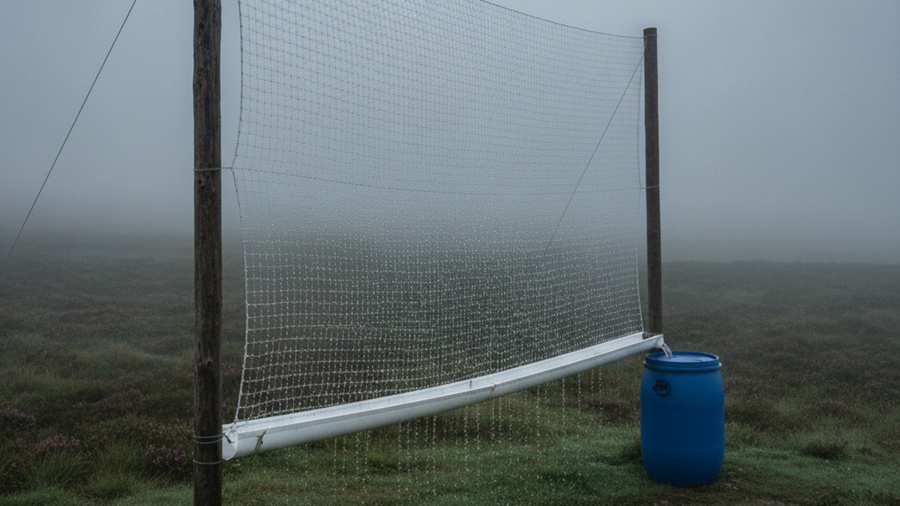
Fog harvesting is the highest-yield atmospheric technique on earth, and almost nobody prepares for it. In Chungungo, Chile, 50 fog collectors supplied an entire village with roughly 15,000 liters per day. The Dar Si Hmad project in Morocco's Anti-Atlas Mountains pulls more than 6,000 liters daily off mesh panels. Average productivity in good fog conditions runs 3 to 10 liters per square meter per day — an order of magnitude more than dew.
A fog net is simply a vertical sheet of fine mesh stretched between two poles, with a gutter at the bottom. Shade cloth, window screen, mosquito netting, or doubled-over Raschel mesh all work. Fog droplets impact the fibers, coalesce, and run down into the trough. Site it perpendicular to the prevailing wind on a ridge, rooftop, or any exposed edge. Coastal fog belts from San Francisco to the Pacific Northwest, plus mountain valleys with morning inversion fog, are prime territory. Apartment dwellers with a balcony facing the right direction can rig a 3x5-foot panel and collect into a bucket — the same mindset behind rooftop and balcony rainwater harvesting, just tuned for days when nothing is falling from the sky.
How to Build a Solar Still That Actually Produces Water
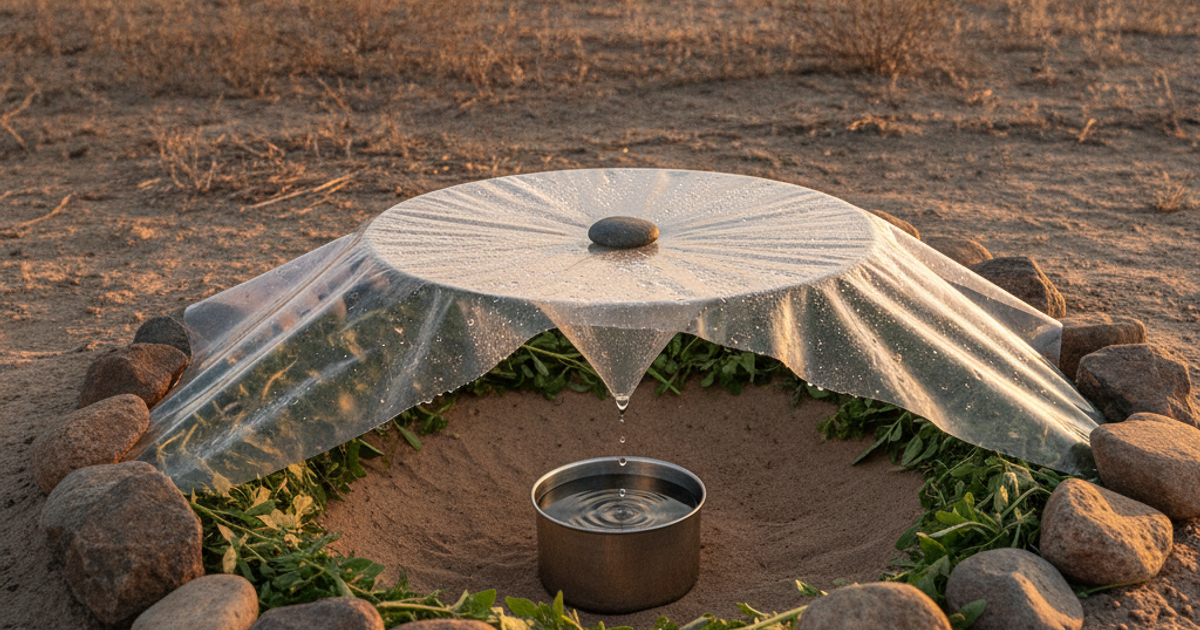
The solar still is the most famous and most overrated technique in survival literature. U.S. Army field testing found belowground stills yield roughly one pint to one quart per day — often less energy returned in water than you burn digging the hole. Build one anyway, but build several, and build them where the soil is damp: a dry streambed, a shaded gully, the low spot in a lawn.
Dig a cone-shaped pit about three feet across and two feet deep. Set a container at the bottom. Line the walls with shredded green vegetation (never oleander, poison ivy, or unknown plants — their toxins vaporize with the water). Stretch clear plastic sheeting over the top, seal the edges with soil, and set a small rock in the center so condensate runs to a drip point above your container. Run a length of surgical tubing from the container to the surface so you can sip without breaking the seal. The same design works on a balcony or rooftop using a plastic tub filled with damp soil, grass clippings, or even urine-soaked rags — the still distills out the salts and solids.
How to Use Transpiration Bags to Pull Water From Trees
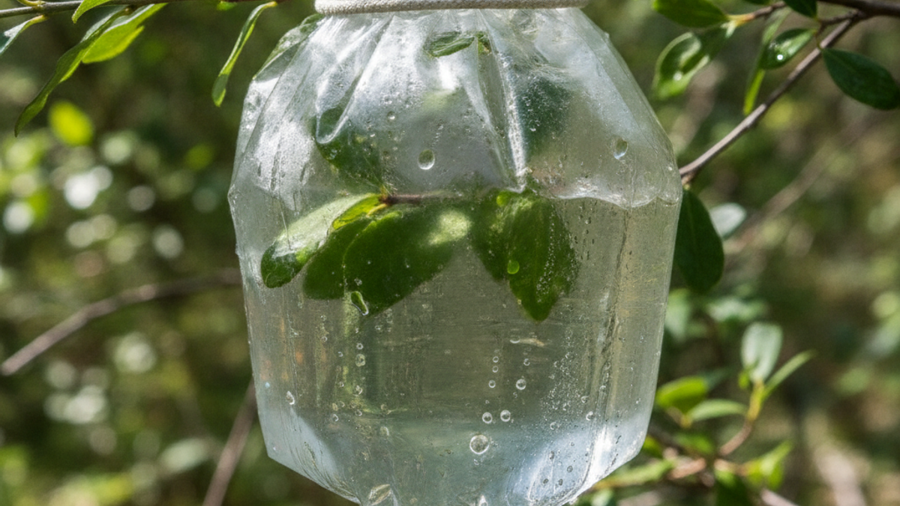
A single mature tree can transpire hundreds of liters of water per day. Capture even a fraction of that and you have the single best effort-to-yield ratio of any technique here. Tie a large clear trash bag over a leafy, sun-exposed branch, cinch it tight at the base, and weight one corner so condensate pools at a low point. Expect 0.25 to 1 liter per bag per day depending on species, sun exposure, and leaf mass.
For smaller branches and bushes, turkey-size oven bags are superior to trash bags: they're crystal clear, heat-resistant, food-safe, and weigh almost nothing in a pack. Stick to non-toxic species — maple, willow, cottonwood, fruit trees, and most conifers are safe. Run ten bags at once and rotate branches daily so you don't kill the limb.
Urban Atmospheric Water Sources Most Preppers Overlook
In the city, the biggest atmospheric water source is mechanical. A window air conditioner in humid conditions can shed 1 to 5 gallons of condensate per day, and commercial rooftop units produce far more. Dehumidifiers pull similar volumes. This water is effectively distilled but contaminated by coil biofilm, metals, and dust — it must be filtered and disinfected before drinking. Also consider water heater tanks, toilet reservoirs, and ice makers as part of a broader emergency water rationing strategy.
Step-by-Step Instructions
Step 1: Assess your microclimate and humidity
Check overnight dew point versus forecast low temperature. If the low drops to or below the dew point, dew will form and dew collection is your highest-value play. Coastal or valley fog in the forecast means prioritize a fog net instead.
Step 2: Deploy dew collection surfaces before sunset
Lay out mylar blankets, plastic sheeting, or tarps on an angle, elevated off the ground on sticks or bricks so air circulates underneath. Place a collection vessel at the low corner. Deploy every surface you own — redundancy beats efficiency.
Step 3: Rig fog nets perpendicular to the wind
Stretch mesh between two uprights on the most wind-exposed spot you can safely access. Angle a gutter, rain-gutter section, or folded tarp beneath the mesh and run it into a sealed container to prevent evaporation losses.
Step 4: Tie transpiration bags on sunny branches by mid-morning
Choose leafy branches in direct sun. Seal the bag opening tight with cordage or tape, weight the lowest corner with a pebble inside the bag, and leave it until late afternoon when yield peaks.
Step 5: Build solar stills in the dampest soil available
Dig in shaded low ground or a dry creek bed. Add vegetation, seal the plastic, center a weight stone, and leave it undisturbed through the heat of the day. Build at least three if you have the sheeting.
Step 6: Consolidate, filter, and disinfect everything you collect
Pool all collected water into a single container, then run it through a filter and treat it chemically. Even distilled condensate picks up dust, plastic residue, and bacteria from collection surfaces.
Step 7: Store and rotate your yield properly
Transfer treated water to sealed, opaque containers and keep them cool. Log daily yields so you know how many collectors you need to meet your consumption rate.
Recommended Gear for Atmospheric Water Collection
Collection is only half the job — storage and treatment finish it. A wide-mouth 32 oz bottle doubles as a measuring vessel so you can track yields precisely, and its mouth is wide enough to catch drips directly. A collapsible soft bottle packs flat when empty, which matters when you're carrying ten collection vessels in a bug out bag. For treatment, a compact squeeze filter rated to 0.1 microns handles bacteria and protozoa, while iodine purification tablets cover viruses and weigh nothing. Pair them with a solid understanding of which purification method fits which scenario, and keep your long-term supply organized with proper emergency water storage containers. Browse more vetted survival gear on our recommended equipment page.
Frequently Asked Questions
How much water can a solar still actually produce in a day?
Realistically one pint to one quart per 24 hours in moist soil, and often less in true desert conditions. Military testing consistently shows that a single still cannot meet daily hydration needs, which is why experienced preppers build multiple stills and combine them with transpiration bags and dew collection rather than relying on any one method.
Is water from dew, fog, and solar stills safe to drink without purification?
No. Solar still and transpiration water is essentially distilled, but it contacts plastic, soil, and plant material on the way to your container. Fog and dew pick up airborne particulates, pollen, bird droppings, and in urban areas, rooftop contaminants and heavy metals. Always filter and chemically treat before drinking.
Can apartment dwellers really collect atmospheric water without a yard?
Yes. A balcony fog net, dew-collecting tarps on a railing or rooftop, a tub-style solar still, and air conditioner condensate can collectively produce meaningful volume. It won't replace stored water, but in a grid-down urban survival scenario, it can extend your supply by days — and days are often all you need.
Affiliate Disclosure: SHTFPlan.net participates in the Amazon Services LLC Associates Program. Some links are affiliate links — we may earn a small commission at no extra cost to you.