Greywater Recycling: How to Reuse Household Water When Every Drop Counts
Laundry, dish, and bath water can be captured and reused for flushing, irrigation, and cleaning. Here's how to build a safe greywater system before your taps run dry.
When the taps run dry — or when the water that comes out of them has to be hauled in by bucket — the math of household survival changes fast. The EPA estimates the average American family uses more than 300 gallons of water per day at home, with roughly 70 percent of that used indoors. Showers account for about 17 percent of indoor use, clothes washers another 17 percent, and bathroom sinks another 15 percent. Add those together and you'll find that roughly half of everything flowing through your plumbing is "greywater" — water that's dirty enough that you wouldn't drink it, but clean enough to do a second job before it disappears down the drain.
In a grid-down or municipal failure scenario, that second job matters enormously. Greywater can flush toilets, irrigate a survival garden, wash tools, mop floors, and soak laundry. Every gallon you reuse is a gallon of your stored drinking water you don't burn on a non-drinking task. For the prepper working from a rationed supply, greywater recycling may be the single highest-leverage water skill there is — and unlike drilling a well or installing a cistern, it costs almost nothing to start.
What Counts as Greywater — and What Absolutely Doesn't
Greywater is wastewater from showers, bathtubs, bathroom sinks, and clothes washers. It typically contains soap, skin cells, hair, lint, and trace body oils. It carries some bacteria, but at levels manageable with basic precautions.
Blackwater is wastewater from toilets and — in most state codes — kitchen sinks and dishwashers. Kitchen water is loaded with grease, food particles, and the fecal bacteria that ride along on raw meat. It goes rancid within hours and should never be stored or applied to edible crops. If your sewer system is down entirely, handle blackwater through a dedicated disposal plan, not a reuse plan. Our guide on managing waste when the sewers stop working covers that side of the equation.
A third category — "dark greywater" — includes water used to wash diapers or clothing soiled with vomit or feces. Treat it as blackwater. No exceptions.
What You'll Need
Tools
- Adjustable wrench and pipe wrench
- Utility knife or PVC cutter
- Cordless drill with hole saw bits
- Submersible utility pump
Supplies
- 50-gallon barrel with screened lid
- 20-gallon lidded utility container
- 25-ft drinking-water-safe hose
- 1/2-inch drip irrigation tubing kit
- Biodegradable, low-sodium, boron-free soap
- Mesh lint screens and nitrile gloves
How Apartment Dwellers Can Recycle Greywater Without Any Plumbing
You don't need a homestead to do this. The single most effective urban survival greywater technique requires nothing but a container: put a bucket in the shower. A standard showerhead flows 2.5 gallons per minute, and most people waste 1 to 3 gallons just waiting for hot water. Catch that pre-warm water in a clean container — it's actually potable-grade — and catch the rest of the shower runoff in a second tub.
A Rubbermaid Commercial 20-gallon Brute container with a lid fits in most tub enclosures, stacks in a closet when not in use, and the lid keeps odors and mosquito larvae out between uses. Pour that water directly into the toilet bowl — not the tank — to force a gravity flush. About 1.6 gallons poured fast into the bowl will clear it completely.
For balcony gardeners and anyone hauling water across a building, a 5-gallon collapsible water container is worth stocking. It stores flat, weighs nothing empty, and makes transporting reclaimed rinse water up a stairwell far easier than sloshing an open bucket. Pair this strategy with rooftop and balcony rainwater harvesting and a small apartment can stretch a municipal outage for weeks.
Laundry-to-Landscape: The Best Greywater System for Suburban and Rural Preppers
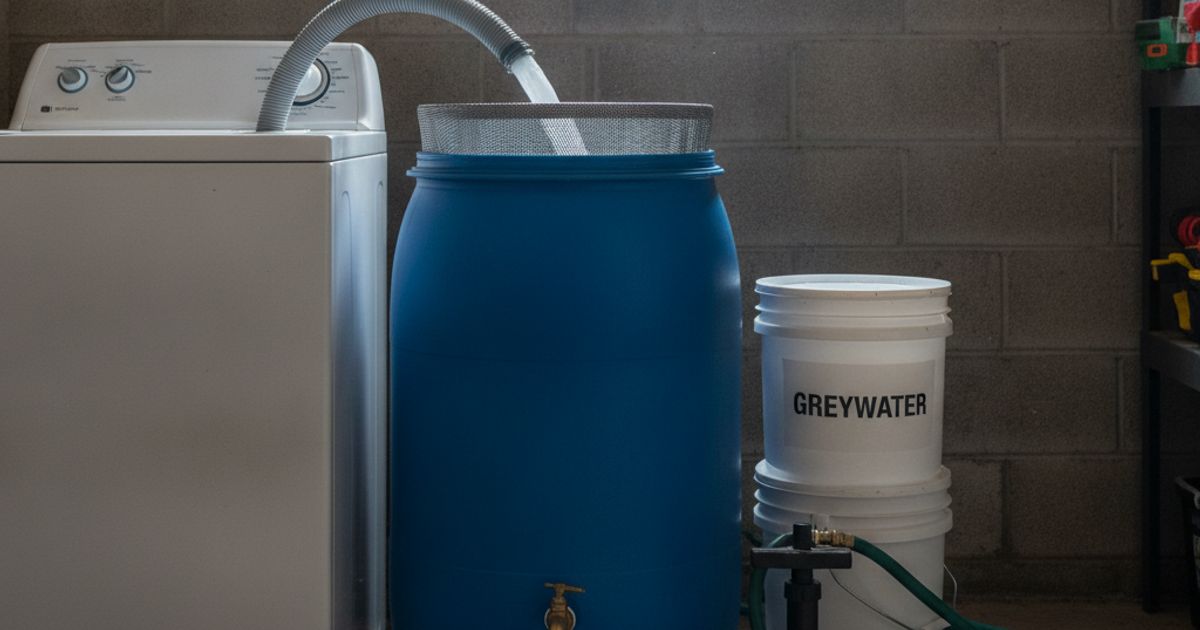
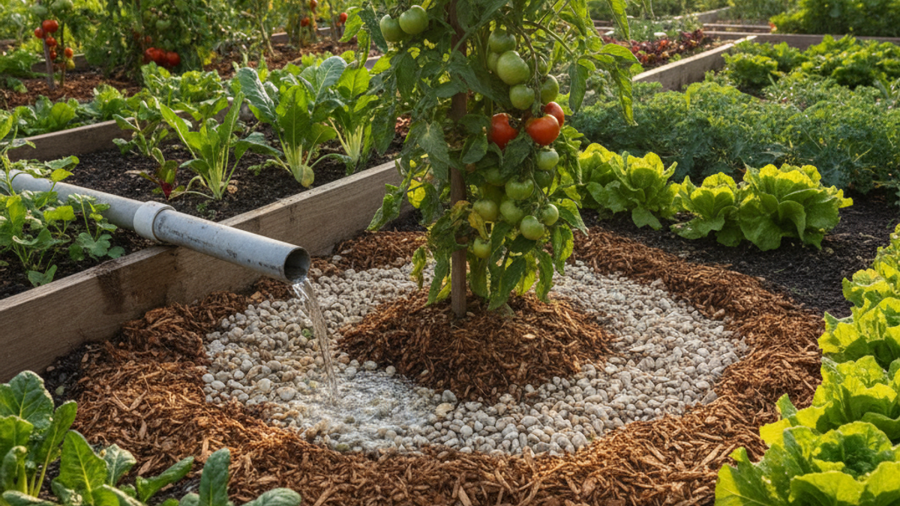
The gold standard of DIY greywater is the laundry-to-landscape (L2L) system. A washing machine already has an internal pump, so you can route its discharge hose outdoors without cutting into a single drain line — which is why California's plumbing code permits clothes-washer greywater systems of up to 250 gallons per day with no permit required. Many other states have similar carve-outs; check yours before building.
The basic build: run the washer's discharge hose to a three-way diverter valve, then to 1-inch tubing that feeds mulch basins around fruit trees and ornamental shrubs. An Orbit 3-way hose splitter with shut-off valves lets you switch between sewer and landscape instantly — critical when you're washing something you don't want on your fruit trees. A single load of laundry produces 15 to 30 gallons. Run four loads a week and you're irrigating with 100+ gallons that would otherwise vanish into a septic tank.
For gravity-fed distribution from a collection barrel, an RTS Home Accents 50-gallon barrel elevated on cinder blocks provides enough head pressure to move water through a Rain Bird 1/2-inch drip tubing kit — though you'll want to use the large-orifice emitters, since standard micro-emitters clog with lint almost immediately.
Filtration, Storage, and the 24-Hour Rule
Here is the rule that keeps greywater from becoming a health hazard: use it within 24 hours. Bacteria in stored greywater multiply rapidly in the presence of organic matter and warmth; by 48 hours, a sealed barrel of shower water will be anaerobic, foul-smelling, and genuinely unsafe to handle. Greywater is a flow-through resource, not a stockpile. Your actual stored drinking water belongs in dedicated food-grade containers — see our guide on choosing and rotating emergency water storage containers.
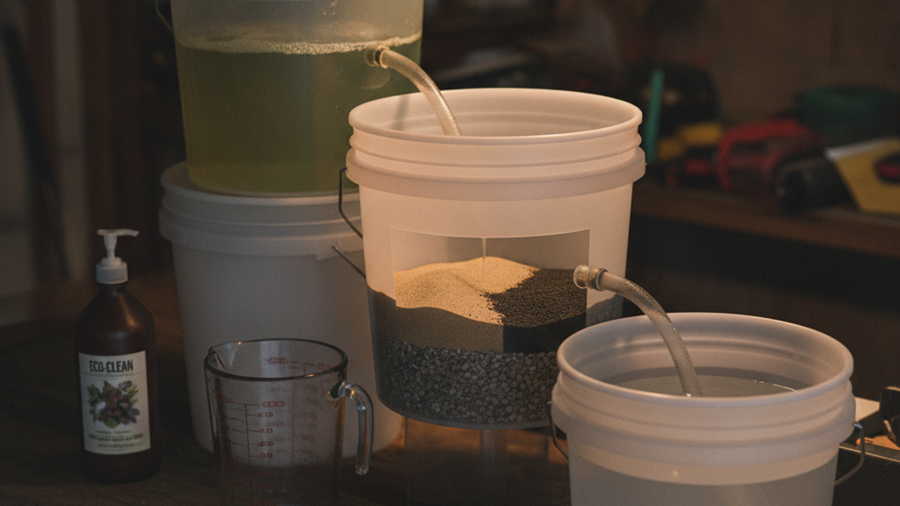
Filtration for greywater means removing solids, not pathogens. Use a lint screen on the washer hose, a hair trap on the shower drain, and a coarse mesh over any barrel opening. If you want to filter out fines, a simple gravel-sand-charcoal column will work — but understand that this water is still not drinkable under any circumstances. If you need actual potable output, you need proper water purification methods, and even then, running greywater through a survival filter is a poor use of expensive filter media.
Soap chemistry matters more than most people expect. Sodium and boron in conventional detergents accumulate in soil and will eventually kill your garden. Switch to liquid, plant-based, low-sodium soaps marked "greywater safe." Avoid powdered detergents entirely — they're bulked with sodium salts.
Step-by-Step Instructions
Step 1: Audit your household water streams
Spend one day tracking where water actually goes. Note shower minutes, laundry loads, and sink use. Multiply shower minutes by 2.5 gallons and laundry loads by 20 gallons to find your realistic greywater yield. Most four-person households discover 80 to 150 reusable gallons per day.
Step 2: Switch to greywater-safe soaps
Replace detergents, body wash, and shampoo with biodegradable, boron-free, low-sodium products before you capture a single gallon. Do this now, during normal times, so the transition is already complete when a crisis hits. Store a six-month supply alongside your emergency food storage.
Step 3: Install capture containers at every source
Place a lidded tub in the shower, a basin under the bathroom sink P-trap, and position a barrel near the washer discharge. Screen every opening to block mosquitoes — standing water breeds disease vectors fast when public health services are down.
Step 4: Build the diversion and distribution plumbing
Install a three-way valve on the washer discharge line so you can send water to either the sewer or the landscape. Run 1-inch tubing to mulch basins at least two inches below the soil surface. Never spray greywater — aerosolized droplets are the primary inhalation risk.
Step 5: Add a pump for elevation changes
If your garden sits uphill from the house, or you're emptying a basement collection drum, gravity won't do the work. A Superior Pump 91250 utility pump with a garden hose adapter moves roughly 1,200 gallons per hour and can run off a modest inverter or portable power station during an outage.
Step 6: Connect hose runs and test the full system
Attach a Camco TastePURE 25-ft hose for clean-water transfer and a separate, clearly marked hose for greywater only. Never cross-connect the two. Run a full laundry cycle and walk the line, checking for leaks, pooling, and clogged emitters.
Step 7: Establish sanitation protocols for everyone in the house
Write the rules down and post them: gloves when handling greywater, no application to root vegetables or leafy greens, no storage past 24 hours, handwashing after every contact. In a grid-down scenario, a preventable gastrointestinal infection can be a death sentence.
Step 8: Flush and winterize seasonally
Every few months, run clean water through the distribution lines to clear lint buildup. Before the first freeze, drain all tubing and barrels completely — frozen greywater splits tubing and cracks barrels.
Recommended Gear
For most households, the highest-value additions are a reliable collection vessel, a pump, and a safe distribution path. A Dial Manufacturing 2300 submersible utility pump is compact enough to drop straight into a tub or barrel and move water on demand, making it one of the most versatile pieces of survival gear you can own — it doubles as a flood-response and basement-dewatering tool. Browse more water-handling equipment on our recommended survival gear page.
Frequently Asked Questions
Can you use greywater on a vegetable garden?
Use it on fruit trees, berry canes, corn, and ornamentals — plants where the edible portion never touches the soil or the water. Never apply greywater to root crops like carrots and potatoes, or to leafy greens like lettuce and spinach. Always deliver it subsurface into mulch basins rather than spraying, and stop greywater irrigation at least two weeks before harvest.
How long can you store greywater safely?
Twenty-four hours is the hard limit. Organic matter in greywater feeds bacterial growth, and within a day or two the water turns anaerobic, develops a sulfurous odor, and becomes a genuine health hazard. Design your system to move water out within hours of collection, not to stockpile it.
Is greywater recycling legal where I live?
It varies widely by state. Arizona, California, Texas, and New Mexico have the most permissive residential greywater codes, with many allowing simple laundry-to-landscape systems without a permit. Other states require plumbing permits or prohibit certain configurations entirely. Check your state health department and local building code before cutting into any drain line — and remember that during a declared emergency, bucket-based reuse requires no permit at all.
Affiliate Disclosure: SHTFPlan.net participates in the Amazon Services LLC Associates Program. Some links are affiliate links — we may earn a small commission at no extra cost to you.