Prepper Livestock: How to Raise Goats for Milk, Meat, and Long-Term Food Security
Goats are one of the most practical animals a prepper can raise. Here's how to get started with a small herd for long-term self-sufficiency.
When the grid goes down and supply chains collapse, the preppers who thrive won't be the ones with the biggest stockpile of freeze-dried meals — they'll be the ones who built living, renewable food systems before SHTF. Goats are one of the most practical, versatile, and resilient livestock animals you can raise for long-term food security. A single dairy doe can produce 1,500 to 2,000 pounds of milk per year. A pair of meat goats can feed a family for months. And unlike cattle, goats can be managed on a fraction of the land and feed, making them accessible to suburban homesteaders and rural preppers alike.
This guide covers everything you need to know about raising goats as part of a serious emergency preparedness strategy — from selecting the right breeds and building shelter to milking, feeding, health management, and meat processing. Whether you have five acres in the country or a large suburban lot, goats may be your most important off-grid investment.
Why Goats Are the Ideal Prepper Livestock for Off-Grid Food Security
Goats have been raised by humans for over 10,000 years — and for good reason. They are dual-purpose animals, providing both milk and meat. Their milk is naturally homogenized, easier to digest than cow's milk for many people, and rich in calcium, potassium, and vitamin A. Goat milk can be consumed fresh, made into cheese, butter, yogurt, and kefir, or used for soap-making — a valuable barter commodity when SHTF.
Compared to cattle, goats require significantly less space — a general guideline is 200 square feet of pasture per goat for browsing. They're browsers rather than grazers, meaning they prefer brush, weeds, and shrubs over grass, which makes them excellent for clearing overgrown land. Their hardiness and adaptability make them well-suited for off-grid living.
For readers who live in suburban areas, check your local zoning laws carefully. Many municipalities now allow small livestock, including goats, especially if they are does (females). A single Nigerian Dwarf doe, for example, can be kept in a relatively small space and still produce a surprising amount of milk. If you're currently apartment-based, understanding livestock systems now and planning for a bug-out property or rural relocation is still an essential part of long-term emergency preparedness. You might also find value in our guide on building a long-term food stockpile while you work toward establishing a livestock operation.
Choosing the Right Goat Breeds for Milk, Meat, and Dual-Purpose Production
Breed selection is critical. Not all goats are created equal, and your choice should reflect your goals, available space, and climate.
Best Dairy Breeds for Preppers
- Nubian: High butterfat content (4–5%), excellent for cheese and butter; large breed, needs more space
- Alpine: High milk volume, hardy in cold climates, good temperament
- Nigerian Dwarf: Small size, extremely high butterfat (6–10%), ideal for suburban lots or small homesteads
- LaMancha: Calm disposition, consistent milk production, adapts well to various climates
Best Meat Breeds for Preppers
- Boer: The gold standard for meat production, fast-growing, excellent muscle mass
- Kiko: Highly disease-resistant, low-maintenance, good for rugged terrain
- Spanish: Hardy, parasite-resistant, excellent foragers in brush-heavy environments
Best Dual-Purpose Breeds
- Boer-Nubian cross: Combines meat muscle with respectable milk production
- Pygmy: Small, hardy, produces reasonable milk and decent meat for their size
For most preppers, starting with 2–3 Nigerian Dwarf does or a small herd of Nubians offers the best balance of milk production and manageable size. Plan to keep a ratio of roughly one buck for every 25–30 does if you intend to breed your own replacements.
What You'll Need
Tools
- Caprine Supply goat milking equipment
- Stainless steel milk strainer/filter
- Hoof trimming shears
- Tattooing or ear tagging kit for identification
Supplies
- Maggift heavy-duty livestock fence panels
- Merrick's livestock mineral supplement for goats
- Dumor goat feed pellets
- Farnam Safe-Guard livestock dewormer
Building Shelter and Fencing: The Foundation of a Goat Operation
Goats are notorious escape artists. A goat that can find a weakness in a fence will find it — and exploit it. Secure fencing is non-negotiable. Field fence or woven wire at least 48 inches high, supplemented with a strand of electric wire at nose height, is the most effective setup. Heavy-duty livestock fence panels are an excellent solution for quickly establishing secure pens or rotational grazing paddocks — they're portable, durable, and can be reconfigured as your herd grows.
Goats need shelter from wind, rain, and extreme temperatures — but they don't need an elaborate barn. A three-sided structure with a solid roof is sufficient in most climates. Aim for at least 15 square feet of covered space per goat inside, and 25–30 square feet of dry lot space per animal outside. Bedding with straw or wood shavings should be kept clean and dry to prevent respiratory illness and hoof rot.
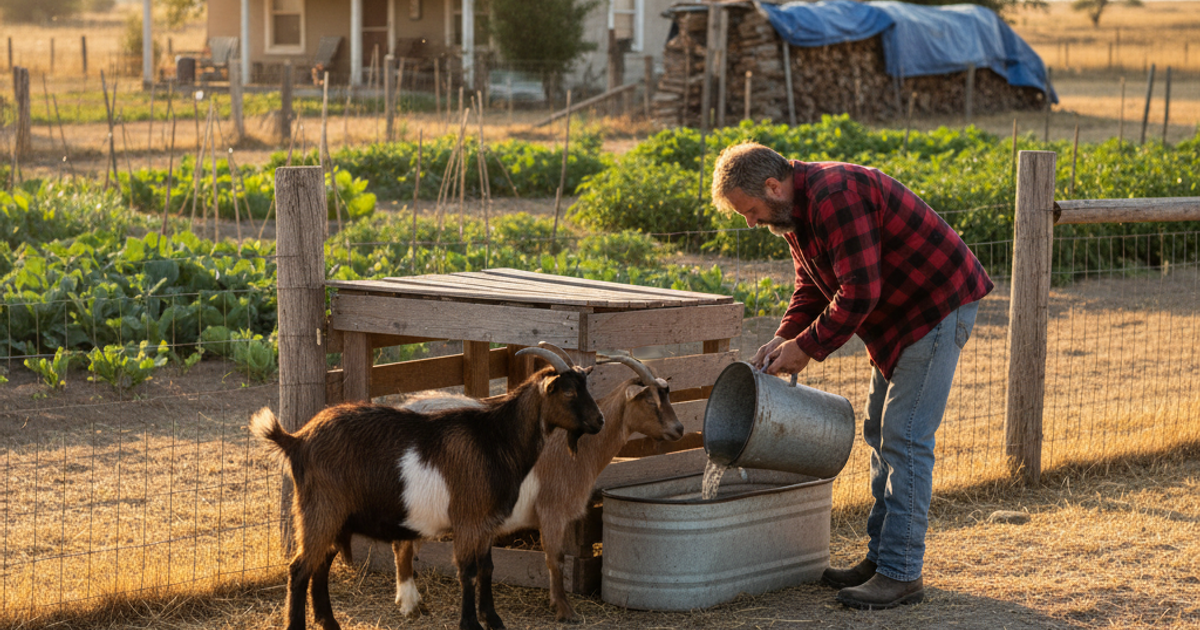
Water access is equally critical. Goats drink 1–3 gallons per day depending on size and lactation status. An automatic livestock water trough ensures a consistent supply without daily manual filling — a major labor saver when you're managing multiple aspects of a homestead or prepper property. In a grid-down scenario, ensure you have a gravity-fed or hand-pump backup for water delivery.
Feeding Goats for Optimal Milk Production and Health
The backbone of a goat's diet should be high-quality forage — pasture, hay, or browse. A lactating doe needs approximately 4–6 pounds of grass hay per day, plus 1–2 pounds of grain during peak milk production. Dumor goat feed pellets are a well-regarded commercially formulated option that provides a balanced energy and protein profile specifically designed for goats — particularly useful during lactation, growth, or cold-weather months when forage quality drops.
Mineral supplementation is often overlooked but critically important. Goats have specific needs for copper, selenium, zinc, and other trace minerals that are frequently deficient in standard hay or pasture. Deficiencies can cause reproductive failure, poor coat condition, and reduced milk production. Merrick's livestock mineral supplement is a trusted free-choice loose mineral blend formulated specifically for goats. Place it in a covered feeder accessible at all times — goats self-regulate mineral intake effectively.
Never feed goat minerals intended for sheep — sheep minerals are often copper-restricted, and copper deficiency is a serious health risk for goats. Always use products labeled specifically for goat use.
Milking Your Does: Technique, Sanitation, and Daily Routine
A dairy doe must be bred and give birth (kidded) before she produces milk. After kidding, she will produce milk for approximately 305 days in a standard lactation cycle. Does are typically milked twice daily, 12 hours apart, to maximize production and prevent mastitis.
Sanitation is everything. Before milking, clean the udder with a pre-dip solution and wipe with a clean cloth. Discard the first few squirts of milk (the fore-milk) to clear bacteria from the teat canal. Milk into a clean stainless steel container, then strain immediately through a stainless steel dairy milk strainer to remove any hair or debris. Stainless steel is preferred over plastic because it's non-porous, easier to sanitize, and doesn't harbor bacteria. Chill the milk rapidly to below 40°F to maximize shelf life — fresh goat milk stored properly will keep 7–10 days.
For hands-on milking equipment, Caprine Supply milking equipment includes everything from milking stands to teat dip cups and udder wash supplies — the full kit a serious prepper dairy operation requires. A milking stand also doubles as a restraint station for hoof trimming and veterinary procedures.
Goat Health Management: Parasites, Vaccines, and Hoof Care
Internal parasites — particularly barber pole worm (Haemonchus contortus) — are the number one killer of goats in the United States. According to the American Consortium for Small Ruminant Parasite Control, barber pole worm alone causes more goat deaths than all other diseases combined. A strategic deworming program is essential. Farnam Safe-Guard livestock dewormer is a fenbendazole-based broad-spectrum dewormer approved for goats — keep it stocked in your livestock medicine cabinet at all times. Use the FAMACHA scoring system (checking eyelid color for signs of anemia) to target treatment to animals that truly need it, which reduces drug resistance.
Core vaccinations include CDT (Clostridium perfringens types C and D plus tetanus) — administer annually to adults, and to kids at 4 and 8 weeks of age. Hoof trimming should be done every 6–8 weeks with sharp hoof shears to prevent hoof rot and lameness.
Every prepper raising goats should have a solid reference on hand. The Nasco Farms goat health management guide provides comprehensive coverage of disease recognition, treatment protocols, and preventive care — invaluable when a veterinarian isn't available, which is exactly the scenario you need to prepare for. Pair this with our guide on stockpiling first aid supplies to build a complete livestock and human medicine cabinet for extended grid-down situations.
Step-by-Step Instructions
Step 1: Research Local Zoning Laws and Plan Your Space
Before acquiring any animals, contact your county extension office or local zoning board to confirm whether goats are permitted on your property. Determine how many animals your land can support — a general rule is 2–4 goats per acre on good pasture. Sketch out your pen, shelter, and pasture layout before spending a dollar on infrastructure.
Step 2: Build or Establish Secure Fencing and Shelter
Install woven wire or field fence at least 48 inches high around your entire goat area, with posts set no more than 8 feet apart. Add a strand of electric wire at 6–8 inches from the ground to deter digging, and at nose height to deter leaning. Build or convert a three-sided shelter with a solid roof that provides at least 15 square feet of covered space per animal, bedded with clean straw.
Step 3: Select and Acquire Healthy Breeding Stock
Purchase goats from a reputable breeder who tests for CAE (Caprine Arthritis Encephalitis) and CL (Caseous Lymphadenitis) — two contagious diseases that can devastate a herd. Start with 2–3 does and one proven buck, or use artificial insemination if a buck is impractical. Quarantine new animals for 30 days before introducing them to your existing herd.
Step 4: Establish a Consistent Feeding and Watering Routine
Provide free-choice quality grass hay at all times, supplemented with goat-specific pellets during lactation or growth phases. Set up a covered mineral feeder with loose goat minerals accessible 24/7. Ensure clean, fresh water is always available — an automatic trough simplifies this considerably on a working homestead.
Step 5: Implement a Preventive Health and Parasite Control Program
Schedule CDT vaccinations annually for your adult herd and establish a kid vaccination calendar. Begin FAMACHA scoring every 2–4 weeks during warm months to monitor parasite burdens. Stock dewormers, injectable vitamins, wound care supplies, and a digital thermometer in a dedicated livestock first aid kit.
Step 6: Breed Your Does Strategically for Year-Round Milk Production
Does are typically bred in the fall (September–November) for spring kids. To ensure continuous milk production, stagger breeding so that some does are always in lactation. A doe should be "dried off" (milking stopped) 2 months before her next kidding date to allow udder recovery and fetal development.
Step 7: Begin the Milking Routine After Kidding
Allow kids to nurse for the first 24–48 hours to receive colostrum — this is critical for immune development. After that, separate kids at night and milk the doe in the morning, then allow kids to nurse during the day, or transition to twice-daily machine or hand milking. Maintain strict udder sanitation protocols at every milking to prevent mastitis.
Step 8: Process, Preserve, and Store Surplus Milk and Meat
Learn to make hard cheeses (which can be wax-coated and stored for months), soft cheeses, yogurt, kefir, and ghee from surplus milk. For meat production, wethers (castrated males) and surplus bucklings are typically harvested at 6–9 months when they reach optimal weight. Learn basic butchering, and consider building or acquiring a smoker to preserve the meat long-term — check out our guide on building a DIY smokehouse for long-term meat preservation.
Goat Products Beyond Milk and Meat: Maximizing Your Herd's Value
Goats are remarkably multi-purpose. Beyond milk and meat, consider these additional outputs from a well-managed herd:
- Fiber: Angora goats produce mohair; Cashmere goats produce cashmere — both are valuable barter commodities
- Manure: Goat manure is one of the best garden fertilizers available, with minimal burning risk compared to chicken or hog manure
- Soap and skincare: Goat milk soap has significant barter and personal use value
- Land clearing: Goats can clear brushy, overgrown terrain that would otherwise require heavy equipment
- Hide and tallow: After slaughter, hides can be tanned and tallow rendered for candles, lubricant, and soap-making
In a post-SHTF barter economy, a healthy milking doe or a pair of breeding animals would be among the most valuable commodities imaginable. Food-producing animals represent renewable wealth that a static stockpile simply cannot match.
Frequently Asked Questions
How many goats do I need to feed a family of four with milk and meat?
For milk production, 2–3 dairy does in active lactation will typically produce more than enough milk for a family of four, plus surplus for cheese and other dairy products. For meat, plan to raise 4–6 meat kids per year for a meaningful protein contribution. A small herd of 6–8 animals — a mix of does, a buck, and growing meat kids — is a realistic and manageable starting point for most homesteads, providing both reliable daily nutrition and a renewable meat supply.
Can I raise goats in a suburban area for emergency preparedness?
In many suburban areas, yes — but it depends entirely on your local zoning ordinances. Many municipalities permit small livestock, particularly does (females), on lots above a certain size, often a quarter acre or more. Nigerian Dwarf goats are the most suburban-friendly breed due to their small size and quiet temperament. Always research local laws first, get any required permits, and be a considerate neighbor. If goats aren't currently permitted in your area, advocacy at the local level and connecting with urban agriculture groups can sometimes change that. In the meantime, building your knowledge and acquiring equipment puts you ahead of most.
What is the biggest health risk for backyard goats and how do I prevent it?
The greatest health threat to goats — particularly in warm, humid climates — is internal parasites, especially barber pole worm. This blood-sucking parasite can kill an adult goat within weeks if left untreated. Prevention involves rotational grazing (moving goats to fresh pasture every 2–3 weeks), avoiding overcrowding, using the FAMACHA eyelid scoring system to identify anemic animals early, and treating only affected individuals with appropriate dewormers to slow resistance development. Maintaining good nutrition and mineral balance also significantly improves a goat's resistance to parasite loads.
Affiliate Disclosure: SHTFPlan.net participates in the Amazon Services LLC Associates Program. Some links are affiliate links — we may earn a small commission at no extra cost to you.