Compost, Manure, and Ash: How to Make Your Own Fertilizer When Supply Chains Collapse
Commercial fertilizer is one broken supply chain away from disappearing. Here's how to build soil fertility from compost, manure, wood ash, and kitchen waste so your survival garden keeps producing.
Synthetic fertilizer is one of the most fragile links in the modern food chain. Roughly half of the world's food production depends on nitrogen pulled out of the air through the Haber-Bosch process, which runs on natural gas. When European gas prices spiked in 2021–2022, ammonia plants across the continent shut down and North American urea prices more than doubled in a single season. Add in the fact that the United States imports the vast majority of its potash from Canada and Russia, and you have a supply chain that can seize up from a war, a pipeline failure, a rail strike, or a sanctions package — no apocalypse required.
For the prepper, the takeaway is simple: a garden that depends on a bag of 10-10-10 from the big-box store is not a survival garden. It's a hobby that ends the moment the trucks stop. Building your own fertility from compost, manure, wood ash, and plant teas is the difference between a garden that feeds you for one season and soil that feeds you for decades.
Understanding What Plants Actually Need
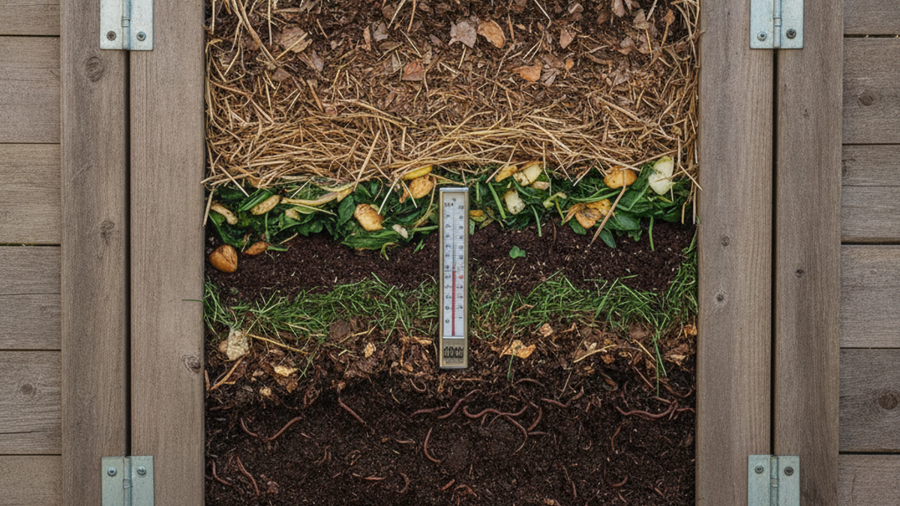
Fertilizer labels list three numbers — nitrogen (N), phosphorus (P), and potassium (K). Nitrogen drives leafy growth, phosphorus drives roots and fruiting, potassium drives disease resistance and overall vigor. Plants also need calcium, magnesium, sulfur, and a long list of micronutrients like boron, zinc, and manganese.
Here's the good news: nearly all of it already exists inside your waste stream. The EPA estimates that food scraps and yard trimmings make up more than 30% of what Americans throw away — well over 60 million tons of food waste annually. That's fertility you're paying someone to haul to a landfill.
What You'll Need
Tools
- Compost pitchfork or garden fork
- Long-stem compost thermometer
- Tumbling composter or stationary compost bin
- 5-gallon buckets with lids (for teas, kitchen scraps, and urine collection)
- Wheelbarrow or garden cart
Supplies
- Compost starter granules
- Composted cow manure
- Bone meal for phosphorus
- Kelp meal for trace minerals
- Soil pH test kit
- Untreated wood ash from a stove or fire pit
How to Make Compost That Actually Feeds Your Soil
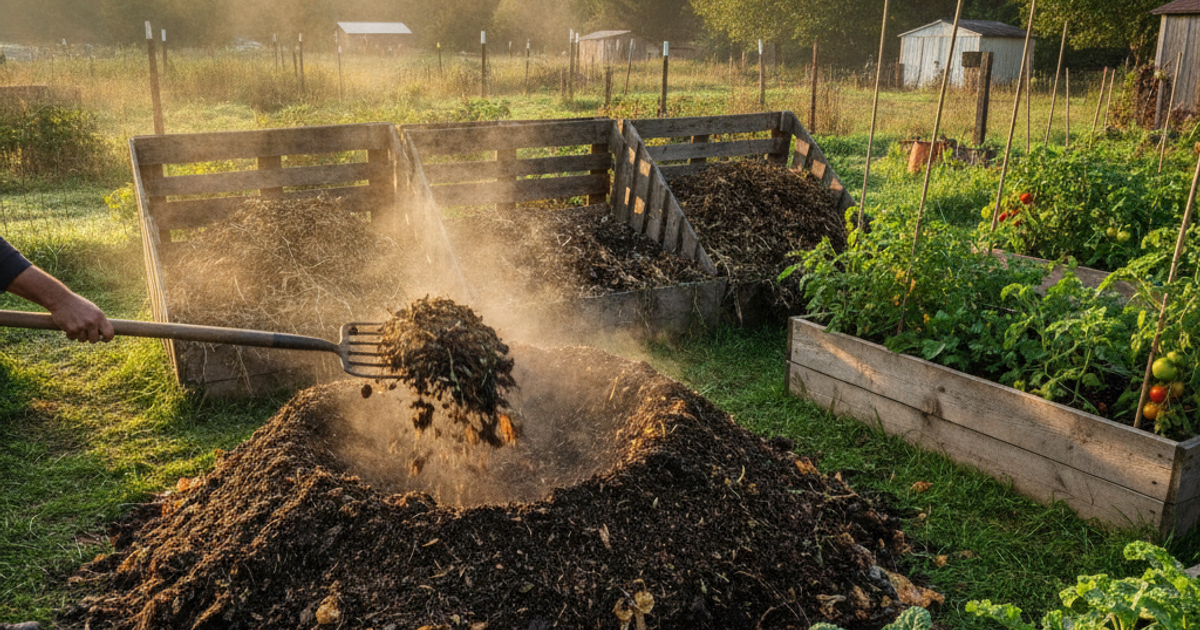
Compost is the backbone of homemade fertility. The entire process comes down to one ratio: roughly 25–30 parts carbon to 1 part nitrogen by weight. In practice, that means about three parts "browns" (dry leaves, straw, cardboard, sawdust, shredded paper) to one part "greens" (kitchen scraps, grass clippings, fresh manure, coffee grounds) by volume.
A properly built hot pile — at least 3 feet by 3 feet by 3 feet — will hit 130–160°F within a few days. That temperature range matters: USDA composting guidelines call for maintaining 131°F or higher for at least three days in a static aerated pile, or 15 days with five turnings in a windrow, to kill pathogens like E. coli and weed seeds. This is where a 20-inch compost thermometer stops being a gadget and becomes a food safety tool. Guessing is how people spread disease in a grid-down scenario.
Composting in an Apartment or on a Balcony
No yard? You still have options. Vermicomposting — red wiggler worms in a stacked bin under the sink — processes about half a pound of scraps per pound of worms per day and produces castings that test around 1-0-0 with exceptional microbial content. Bokashi fermentation uses an inoculated bran in a sealed bucket to pickle food waste, including meat and dairy, in about two weeks, and it produces a nutrient-dense leachate you dilute 1:100 for watering. An enclosed tumbling composter works well on a patio or balcony because it's rodent-resistant, odor-controlled, and doesn't require turning with a fork. Pair small-space composting with container gardening in small spaces and you can run a genuinely closed-loop system in 200 square feet.
How to Use Manure Safely Without Poisoning Your Family
Manure is the highest-value fertility input available to rural and suburban preppers. Approximate NPK values: chicken 1.1-0.8-0.5 (hot, high nitrogen), rabbit 2.4-1.4-0.6 (cold — can be applied directly), horse 0.7-0.3-0.6, cow 0.6-0.2-0.5, sheep 0.7-0.3-0.9.
The critical safety rule: FDA food safety standards recommend a 120-day interval between applying raw manure and harvesting crops whose edible portion contacts the soil (lettuce, carrots, root vegetables), and 90 days for crops that don't. Composting to 131°F+ dramatically shortens that risk window. Never use dog, cat, or pig manure on food crops — parasite risk is too high.
Rabbit manure deserves special attention for suburban preppers. It's the only common manure that can be applied fresh without burning plants, it's nearly odorless, and rabbits can be raised in a garage or backyard hutch. Backyard chickens and dairy goats both convert forage into eggs, milk, and fertilizer simultaneously. If you have no livestock, bagged composted cow manure is worth stockpiling now — it's shelf-stable, cheap, and inoculates new beds with beneficial biology.
How to Use Wood Ash as Free Potassium and Lime
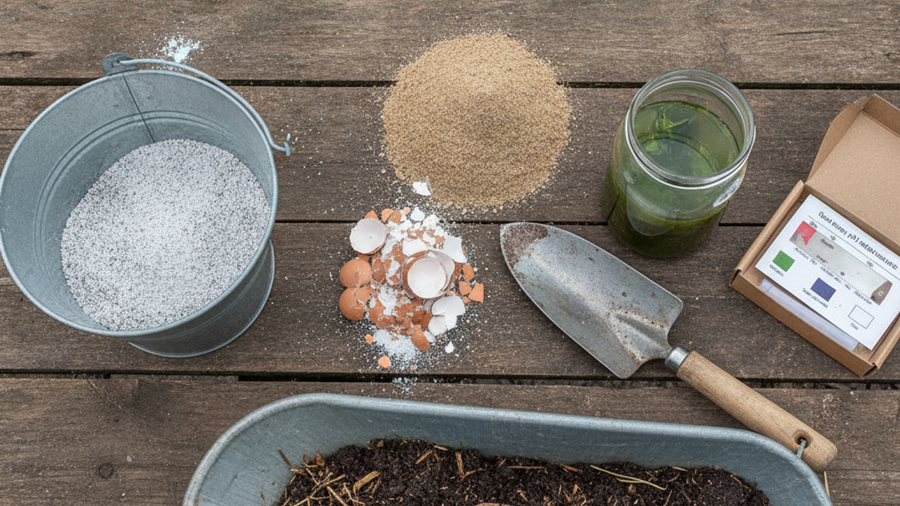
If you heat with a wood stove, you're producing fertilizer every night. Hardwood ash typically contains 3–7% potassium, 1–2% phosphorus, and roughly 20–30% calcium carbonate equivalent — meaning it works as a liming agent with about half the neutralizing power of agricultural limestone.
- Application rate: No more than 15–20 pounds per 1,000 square feet per year, spread thin and worked in.
- Test first. Ash raises pH. If your soil is already above 7.0, skip it entirely.
- Never use on acid-lovers: blueberries, potatoes (encourages scab), azaleas, rhododendrons.
- Only clean wood ash. Never use ash from charcoal briquettes, treated lumber, painted wood, or coal — heavy metals and chemical residues will contaminate your soil permanently.
Brewing Plant Teas and Liquid Fertilizers
Liquid feeds deliver nutrients fast, which matters mid-season when plants are fruiting. Fill a bucket one-third full with chopped comfrey, stinging nettle, or grass clippings, top with water, cover loosely, and let it steep 2–4 weeks. It will smell appalling. Dilute the finished liquid 10:1 with water before applying. Comfrey tea runs roughly 1.8-0.5-5.3 — an excellent potassium source for tomatoes and squash.
Human urine is the most overlooked nitrogen source in prepping. It's sterile in healthy people, averages about 11-1-2.5, and a single adult produces enough nitrogen annually to fertilize roughly 300–400 square feet of garden. Dilute 10:1 for established plants, 20:1 for seedlings, and stop applications a month before harvest. Peer-reviewed trials in Finland and Sweden have shown urine-fertilized cabbage and cucumber yields matching or exceeding conventional mineral fertilizer. Pair this with a DIY composting toilet system for a complete off-grid nutrient loop.
Step-by-Step Instructions
Step 1: Test your soil pH and baseline fertility
Buy a soil test kit or send a sample to your county extension office — most run tests for $10–$25. Without knowing your starting pH and nutrient levels, you're guessing. Most vegetables want a pH between 6.0 and 6.8, and nutrients become chemically unavailable outside that band no matter how much compost you add.
Step 2: Build a three-bin or tumbler composting system
Rural and suburban readers should build three adjacent bins from pallets: one for active building, one for cooking, one for finished compost. Urban readers should use an enclosed outdoor compost bin or tumbler to control odor and rodents. Site the pile in partial shade with drainage below it.
Step 3: Layer browns and greens at a 3:1 ratio
Alternate 4–6 inch layers of carbon material with 2 inches of nitrogen material, moistening each layer to the dampness of a wrung-out sponge. Adding a scoop of compost starter granules between layers seeds the pile with the right bacteria and can cut decomposition time significantly on a cold-weather build.
Step 4: Monitor temperature and turn on schedule
Insert your thermometer to the core daily for the first two weeks. When the temperature climbs past 150°F or drops below 110°F, turn the pile with a heavy-duty compost fork, moving outside material to the center. Expect finished compost in 8–12 weeks with active management, or 6–12 months if you let it sit.
Step 5: Age or hot-compost all manure before use
Stack fresh manure with bedding, keep it above 131°F for at least three days, and turn it at least five times over 15 days. If you can't hit temperature, age it a minimum of six months and observe the 120-day pre-harvest interval on root and leafy crops.
Step 6: Apply wood ash sparingly and test again
Broadcast no more than a 5-gallon bucket of ash per 1,000 square feet, rake it in, and water. Store the rest in a sealed metal container — ash leaches its potassium away in the rain and can retain live coals for days. Retest pH the following season.
Step 7: Brew and apply liquid teas every two to three weeks
Start a comfrey or nettle bucket in spring so you have finished tea by the time plants begin fruiting. Apply diluted tea to the soil around the root zone rather than the foliage, ideally in early morning or evening.
Step 8: Close the loop with cover crops and mulch
Plant clover, vetch, or field peas in fall. Legumes fix 50–150 pounds of nitrogen per acre through rhizobial bacteria — free fertilizer manufactured by the plants themselves. Chop and drop the growth in spring, and mulch heavily to protect the soil biology you've spent all season building.
Recommended Gear for Long-Term Soil Fertility
Homemade compost is often light on phosphorus and trace minerals, which is why a modest stockpile of shelf-stable organic amendments makes sense. Bone meal supplies slow-release phosphorus and calcium for root crops, bulbs, and blossom-end-rot-prone tomatoes — and it's something you can eventually produce yourself from butchering scraps by charring and grinding bones. Kelp meal delivers over 60 trace minerals plus natural growth hormones, and it stores indefinitely in a dry container. Both are inexpensive insurance against the micronutrient deficiencies that quietly cut yields. Also see our recommended survival gear and equipment page, and pair your fertility program with seed saving and storage and defensive gardening tactics so your productive garden doesn't become a target.
Frequently Asked Questions
How long does it take to make compost from scratch?
An actively managed hot pile turned every 5–7 days can produce finished compost in 8–12 weeks. A passive "cold" pile that you simply add to and ignore takes 6–18 months. Tumblers typically fall in the 6–10 week range in warm weather but slow dramatically below 50°F. Vermicomposting produces usable castings in about 3–4 months.
Can I compost in an apartment without it smelling?
Yes. Properly managed compost smells like forest floor, not garbage. Odor means the system has gone anaerobic — usually from too much wet food waste and not enough carbon. Add shredded cardboard or dry leaves and mix. Worm bins and sealed bokashi buckets are both proven apartment-scale systems, and a lidded tumbler works fine on a balcony.
Is human urine really safe to use as fertilizer?
Urine from a healthy person is essentially sterile when it leaves the body. The World Health Organization's guidelines on excreta reuse endorse urine diversion for agriculture with a storage period for single-household use. Dilute it at least 10:1, apply to the soil rather than edible leaves, avoid it entirely if anyone in the household has a urinary infection or is on heavy medication, and stop applications 30 days before harvest.
Affiliate Disclosure: SHTFPlan.net participates in the Amazon Services LLC Associates Program. Some links are affiliate links — we may earn a small commission at no extra cost to you.