Survival Food Forest: How to Plant Fruit and Nut Trees That Feed Your Family for Decades
Annual gardens fail the year you can't plant them. A layered survival food forest of fruit and nut trees keeps producing calories every season with almost no inputs.
Every prepper eventually runs into the same wall: a stockpile, no matter how deep, is a depreciating asset. Rice and beans in mylar bags with oxygen absorbers will carry you through a year, maybe two. But a mature standard-size apple tree produces 300 to 600 pounds of fruit annually for 50 years or more, and a single mature pecan can drop 100 to 200 pounds of high-fat nuts every fall. The USDA Forest Service estimates that a well-established chestnut can yield 1,000 to 3,000 pounds per acre annually without replanting, tilling, or seed purchases. That's the difference between storing calories and generating them.
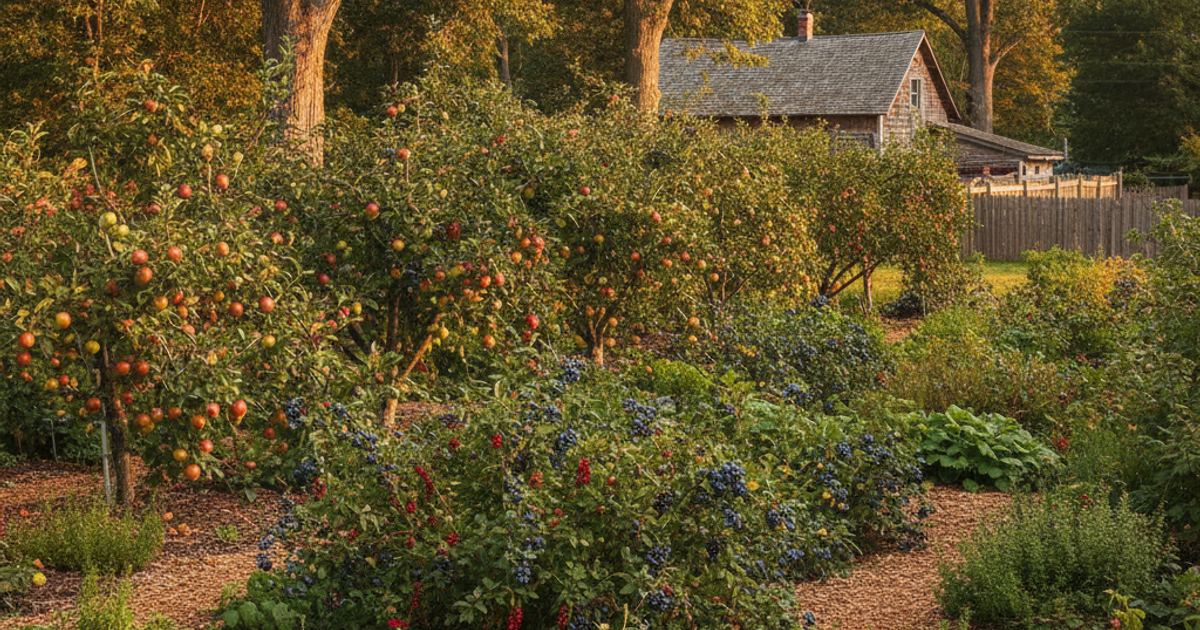
A survival food forest is a layered, perennial planting system that mimics forest structure — canopy trees, understory trees, shrubs, herbaceous plants, ground cover, roots, and vines — so that every vertical foot of your property is producing food. It's the highest-return, lowest-labor food security investment you can make, and it works on a quarter-acre suburban lot, a rural homestead, or even a sunny apartment balcony with dwarf stock in containers.
Why Perennial Food Beats Annual Gardening for Long-Term Food Security
Annual gardens demand seed, tilling, fertilizer, and labor every single season. If you're sick, injured, displaced, or fighting a fuel shortage during the critical planting window, you lose the year. Perennials don't care. They come back whether you're paying attention or not.
Nut trees in particular are the overlooked heavyweight. Walnuts, pecans, hazelnuts, and chestnuts deliver 150-200 calories per ounce — comparable to the cooking oils and animal fats preppers scramble to stockpile. In a grid-down scenario where fat becomes the scarcest macronutrient, a stand of nut trees is a self-replenishing fat supply that requires no refrigeration and stores for months in the shell.
The tradeoff is time. The old orchard proverb — "the best time to plant a tree was 20 years ago; the second best time is today" — exists because dwarf apples bear in 2-3 years, semi-dwarf in 3-5, and pecans and chestnuts in 5-10. Nothing you plant this spring saves you next winter. Everything you plant this spring saves you for the next three decades.
What You'll Need
Tools
- Corona bypass pruning shears
- Fiskars tree pruner pole saw
- Round-point shovel and digging fork
- Soil pH test kit
- 5-gallon buckets for watering and mulch hauling
Supplies
- Bare-root fruit tree seedlings
- Blueberry bush live plants
- Espoma Tree-tone organic fertilizer
- Wood chip or straw mulch (4-6 cubic yards for a small lot)
- Hardware cloth trunk guards and tree stakes
How to Design a Food Forest for Urban, Suburban, and Rural Lots
The Apartment and Balcony Tier
No land is not the same as no option. Columnar apple varieties ("urban columnar" or "ballerina" types) grow 8-10 feet tall and under two feet wide in a 15-gallon container. Dwarf figs, Meyer lemons, dwarf peaches, and blueberries all thrive on a balcony with six hours of sun. A dwarf fruit tree live plant shipped in a pot is the single fastest way for an urban prepper to go from zero perennial food production to an actual harvest. Pair that with the techniques in our guide to growing food in small spaces and a balcony becomes a legitimate calorie source.
The Suburban Quarter-Acre
Most suburban lots can support two to four semi-dwarf fruit trees, six to eight berry shrubs, and a ground layer of perennial herbs and strawberries without looking like anything other than ornamental landscaping. That camouflage matters — a visibly loaded orchard is a billboard in a food-scarce event. Review our guide on growing food without advertising that you have it before you plant anything along a street frontage.
The Rural Acre and Beyond
With real acreage, lead with nut trees. Plant a pecan tree or two on 40-foot centers in the canopy layer, run standard apples and pears beneath, and fill the understory with hazelnuts, elderberry, and serviceberry. Nut trees are a 10-year bet that pays for 100 years — many commercial pecan orchards are still producing after a century.
The Seven Layers of a Survival Food Forest
- Canopy (30-60 ft): Pecan, black walnut, chestnut, standard apple, hickory
- Understory (10-25 ft): Semi-dwarf apple, peach, plum, pear, persimmon, mulberry
- Shrub (3-10 ft): Blueberry, elderberry, currant, gooseberry, hazelnut, aronia
- Herbaceous: Rhubarb, asparagus, comfrey, perennial herbs, horseradish
- Ground cover: Strawberry, creeping thyme, white clover (nitrogen fixer)
- Root layer: Jerusalem artichoke, groundnut, perennial onion
- Vine layer: Grape, hardy kiwi, passionflower on trellises and tree trunks
Step-by-Step Instructions
Step 1: Map Sun, Water, and Soil on Your Site
Track sunlight for a full day and mark zones receiving six or more hours — fruit and nut trees will not produce meaningfully below that threshold. Test soil pH; most fruit trees want 6.0-7.0, while blueberries demand 4.5-5.5 and will fail without amendment. Note where water pools after rain and avoid planting trees in those spots, since root rot kills more young orchards than drought does.
Step 2: Select Varieties Matched to Your USDA Zone
Check your USDA hardiness zone and your area's annual chill hours — low-chill peaches fail in Minnesota and high-chill apples never fruit in Florida. Buy at least two compatible varieties of apple, pear, plum, and most nuts, because the majority require cross-pollination to set fruit. Prioritize disease-resistant cultivars like Liberty or Enterprise apples; in a crisis, there will be no spray program.
Step 3: Dig Wide, Shallow Planting Holes
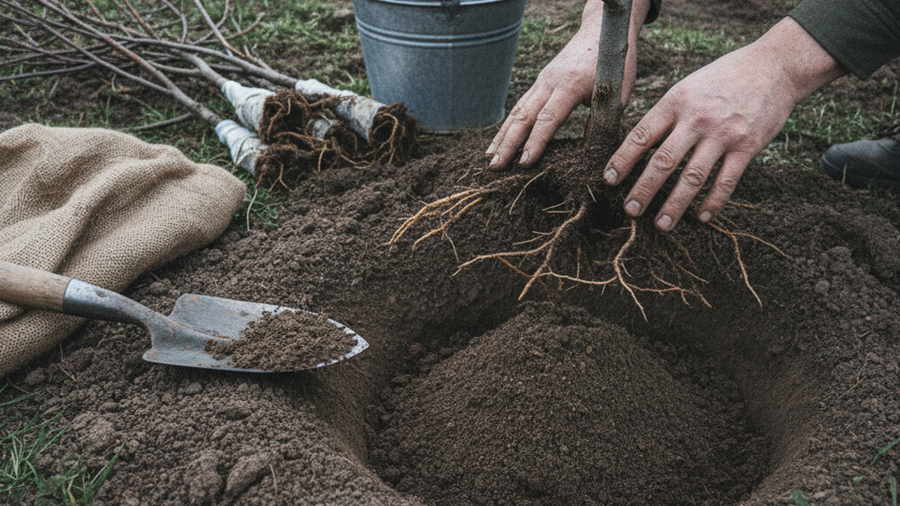
Dig a hole two to three times the root spread but no deeper than the root ball. Set the tree so the graft union sits two to four inches above final soil grade — burying it lets the scion root and destroys the dwarfing effect. Backfill with native soil only; amended backfill creates a "pot effect" that discourages roots from leaving the hole.
Step 4: Mulch Heavily and Install Trunk Protection
Spread four to six inches of wood chips in a four-foot ring, pulled back three inches from the trunk. Mulch cuts water demand by up to 50 percent and suppresses the grass competition that stunts young trees. Wrap trunks in hardware cloth cylinders to stop voles, rabbits, and deer — a single winter of rodent girdling kills a tree outright.
Step 5: Water Deeply Through the First Three Years
Give each young tree 5-10 gallons weekly during the growing season, delivered slowly at the drip line. Deep infrequent watering drives roots down; daily sprinkling keeps them shallow and drought-vulnerable. A rainwater harvesting system makes this sustainable even under municipal water restrictions.
Step 6: Prune Structurally Every Dormant Season
In late winter, remove dead, damaged, and crossing branches, then establish a central leader or open-center form. Good structure built in years one through four prevents the limb failures that destroy mature trees under a heavy fruit load or an ice storm. A pole saw lets you handle overhead cuts without a ladder.
Step 7: Feed the Soil, Not Just the Tree
Apply a balanced organic fertilizer at bud break and again in early summer for the first several years. Over time, transition to homemade compost, manure, and wood ash so your orchard doesn't depend on a supply chain that may not exist.
Step 8: Stagger Plantings to Create Overlapping Harvests
Plant early, mid, and late-season varieties so fresh food arrives from June strawberries through November persimmons. Add plantings each year rather than all at once so trees reach bearing age in waves and a single bad year never wipes out your entire production.
Recommended Gear
Quality stock and the right tools make the difference between a food forest and a graveyard of dead sticks. Stark Bro's fruit tree seedlings and Brighter Blooms dwarf fruit trees ship grafted, named cultivars rather than seedling gambles. Nature Hills blueberry bushes produce for 30-plus years and thrive in containers for apartment preppers. A pecan tree live plant is your long-term fat and protein insurance. For maintenance, Corona bypass pruning shears make clean cuts that heal fast, and a Fiskars tree pruner pole saw handles high limbs safely without a ladder. For feeding, Jobe's Organics fertilizer spikes are foolproof for container and small-lot growers, while Espoma Tree-tone organic fertilizer is the better value for broadcasting across a multi-tree orchard. Browse more long-term food production tools on our recommended survival gear page.
Frequently Asked Questions
How long does it take for a survival food forest to produce food?
Berries and strawberries produce in year one or two. Dwarf fruit trees bear in two to three years, semi-dwarf in three to five, and standard apples and pears in five to eight. Nut trees are slowest — hazelnuts in three to five years, pecans and chestnuts in five to ten. Plant the fast producers and the slow producers in the same season so you get food soon and food forever.
Can I grow fruit and nut trees in an apartment or on a balcony?
Yes, with limits. Dwarf and columnar fruit trees, figs, citrus, and blueberries all produce well in 15-20 gallon containers given six hours of direct sun. Nut trees are not practical in containers. Supplement balcony production with indoor sprouts and microgreens and home mushroom cultivation for year-round fresh nutrition in a small space.
What happens to my food forest if I have to bug out?
Established perennials survive neglect for years — that's their core advantage over an annual garden. A three-year-old mulched tree will live through a season of no care and still fruit. If you return, so does your food supply. That resilience is exactly why a food forest belongs in every serious emergency preparedness plan alongside your emergency food storage and water purification capability.
Affiliate Disclosure: SHTFPlan.net participates in the Amazon Services LLC Associates Program. Some links are affiliate links — we may earn a small commission at no extra cost to you.