Wildfire Evacuation Bag: What to Pack When You Have 15 Minutes to Leave
When wildfire threatens, you may have minutes — not hours — to get out. Here's exactly what to grab and why it matters.
The fire is three miles away. The wind just shifted. Your phone is buzzing with an evacuation order. You have 15 minutes — maybe less.
This is not a hypothetical. According to the National Interagency Fire Center, the United States experienced over 68,000 wildfires in 2023, burning more than 2.7 million acres. In California alone, roughly 11,000 structures were destroyed by wildfire between 2017 and 2021. Paradise, California was consumed in under 90 minutes. When a wildfire accelerates under high winds, the window between "watch" and "run" can close terrifyingly fast.
The difference between survival and tragedy often comes down to preparation done before the smoke hits. Whether you live in a rural mountain home, a suburban development in fire country, or an apartment in a drought-prone city, a pre-packed wildfire evacuation bag — loaded with survival gear and ready to grab — is non-negotiable. This guide tells you exactly what to put in that bag, how to pack it, and how to be out the door in 15 minutes or less.
For a broader look at how to protect your home before a fire arrives, see our Wildfire Survival Guide: How to Protect Your Home and Evacuate Safely.
What You'll Need
Tools
Supplies
- N95 respirator masks (3M, wildfire smoke rated)
- Mountain House freeze-dried meals 72-hour kit
- Pelican waterproof hard case for documents
Why Your Bag Must Already Be Packed
Every prepper understands the concept of the bug out bag — a self-contained emergency preparedness kit built around the idea that you may have to leave fast with no time to gather supplies. The wildfire evacuation bag is a specialized version of this concept, and it must account for threats unique to wildfire: toxic smoke, rapidly shifting routes, power outages, and the potential loss of your entire home and everything in it.
Don't fall into the trap of thinking you'll "grab things quickly" when the order comes. Under stress, cognitive function degrades. You will forget things. You may have children or elderly family members to assist, pets to load, or a vehicle to prepare. The bag must be pre-packed, sitting by the door, and regularly updated. Treat it like a fire extinguisher — you never want to need it, but it had better be ready.
If you're apartment prepping or living in a smaller space, the principles here still apply. A compact bag can cover the essentials without taking up significant room. Check out our guide on Apartment Prepping: How to Build a Serious Emergency Stockpile in a Small Space for tips on maximizing limited space.
Choosing the Right Evacuation Bag for Wildfire Survival
Your bag is the foundation of your entire system. It needs to be large enough to carry 72 hours of supplies without being so heavy you can't carry it under stress. A 40–55 liter pack is the sweet spot for most adults. The 5.11 Tactical Rush72 backpack is a popular choice among preppers for good reason — it's built tough, has a well-organized internal structure, MOLLE webbing for expansion, and can hold a serious load without destroying your back. Whatever bag you choose, pick a neutral or dark color (no bright orange or neon), and make sure it has padded shoulder straps and a waist belt.
The Critical Contents: What Goes in a Wildfire Evacuation Bag
Respiratory Protection — Your First Priority
Wildfire smoke is not just unpleasant — it is deadly. The particulate matter (PM2.5) released by burning structures and vegetation penetrates deep into lung tissue and can cause serious respiratory damage within hours of heavy exposure. Cloth masks and bandanas provide essentially zero protection against fine smoke particles. You need real filtration.
Pack at least four N95 respirator masks rated for wildfire smoke — one for each family member, plus spares. The 3M models with exhalation valves reduce heat buildup during physical exertion, which matters when you're moving fast. Store them in a zip-lock bag inside your pack to keep them dry and dust-free.
Water and Water Purification
Pack at least two liters of water per person in your bag — more if you have the space and strength to carry it. But water is heavy, and in a wildfire evacuation, weight matters. The solution is to pair a modest water supply with a compact filtration device. The LifeStraw personal water filter removes bacteria, parasites, and microplastics from virtually any water source, weighs almost nothing, and needs no batteries or chemicals. It's one of the most reliable water purification tools available for urban survival and rural bugouts alike. Pair it with collapsible water bottles to keep your load manageable.
Food for 72 Hours
Emergency preparedness experts and FEMA both recommend a minimum 72-hour food supply in any emergency kit. During a wildfire evacuation, you may be sheltering in a community center, a relative's home, or a vehicle for days. Pack calorie-dense, shelf-stable foods that require minimal preparation. The Mountain House freeze-dried meals 72-hour kit is an excellent option — the pouches are compact, lightweight, long-lasting, and only require hot water to prepare. They taste far better than most emergency food storage options, which matters for morale, especially with children.
Power and Communication
When wildfires knock out power infrastructure — and they frequently do — keeping your phone charged can be the difference between knowing which evacuation routes are clear and driving into a fire wall. An Anker portable power bank at 20,000mAh capacity can charge a modern smartphone four to six times from a single charge. Keep it topped off and stored in your bag permanently. Pair it with a hand-crank or solar emergency radio so you can receive alerts even when cell networks are overwhelmed. For more on maintaining communication when infrastructure fails, see our article on When Cell Networks Fail: How to Build a Family Emergency Communication Plan.
Critical Documents and Financial Resources
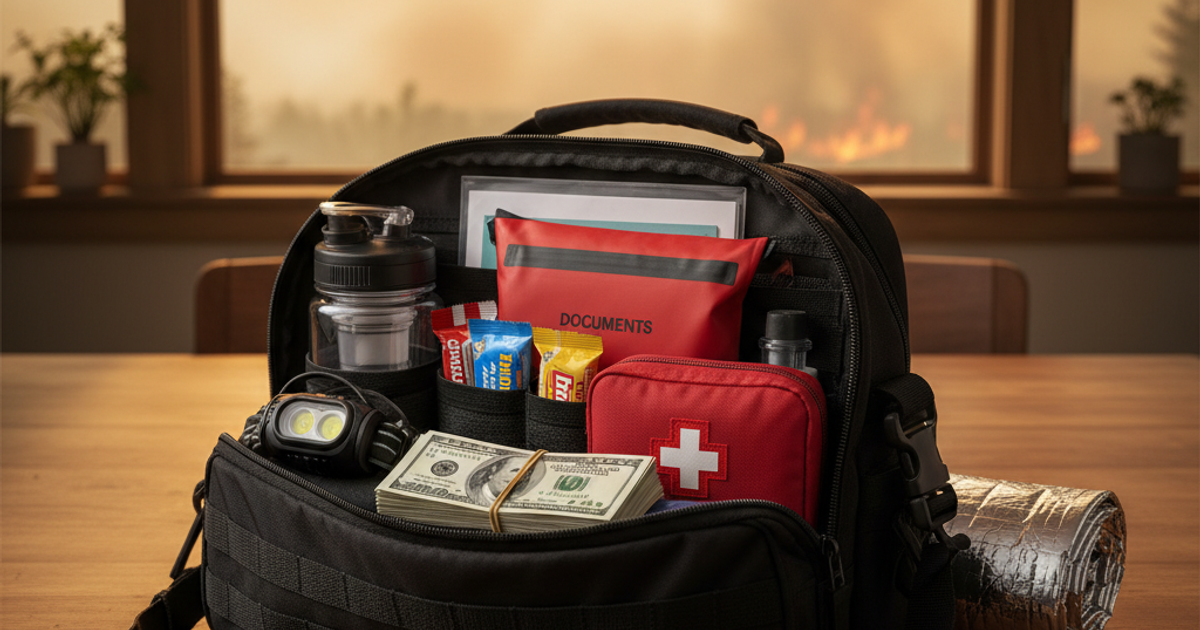
Losing your home to wildfire is devastating. Losing your documents on top of that turns a disaster into a years-long bureaucratic nightmare. Store copies — or originals where possible — of the following in a waterproof container inside your bag:
- Government-issued IDs (passports, driver's licenses)
- Insurance policies and agent contact information
- Birth certificates and Social Security cards
- Medication lists and prescriptions
- Vehicle titles and mortgage or lease documents
- Emergency contact list (printed, not just on your phone)
- Cash in small bills — ATMs may be offline
A Pelican waterproof hard case for documents provides serious protection against water, smoke, and physical damage. These cases are nearly indestructible and will protect your most irreplaceable papers through the chaos of evacuation. Consider also storing a USB drive with scanned copies of all documents as a digital backup.
First Aid and Medications
A compact trauma-capable first aid kit is essential. Include adhesive bandages, gauze, medical tape, antiseptic wipes, burn gel (relevant for wildfire scenarios), over-the-counter pain relievers, and any prescription medications your family requires. A minimum 7-day supply of critical medications should be in the bag at all times. Rotate these regularly so they don't expire. For a deeper dive into building a serious medical kit, see our guide on First Aid Without a Doctor: Building a Trauma Kit for Long-Term Emergencies.
Clothing and Shelter
Pack one change of sturdy clothing per person, including long pants and long sleeves (natural fibers like cotton and wool are less flammable than synthetics), sturdy closed-toe shoes, and a lightweight emergency space blanket. If you have children, pack a small comfort item for them — it's not wasted space when you're managing a traumatized four-year-old in a shelter.
Survival Tools and Fire Lighting Equipment
Even in a wildfire evacuation, having reliable fire-starting capability matters — you may need to signal for rescue, stay warm at an emergency camp, or cook food if the situation extends beyond 72 hours. The Gerber Gear fire starter emergency kit is compact, weather-resistant, and built to work under adverse conditions. Additionally, pack a quality multi-tool, a headlamp with extra batteries, and a whistle for signaling.
Step-by-Step Instructions
Step 1: Select and Prepare Your Evacuation Bag Now
Choose a 40–55 liter backpack with padded straps and a waist belt, capable of holding 72 hours of supplies. Lay it out in a designated spot near your exit — a hallway closet or bedroom door — where every family member knows exactly where it is. Label it clearly if you have children or elderly household members.
Step 2: Pack Respiratory Protection as Your Top Layer
Place N95 masks in a sealed zip-lock bag at the top of your pack where they can be grabbed and donned in seconds before you even walk out the door. Wildfire smoke can be overwhelming immediately, so having masks instantly accessible — not buried under food pouches — can protect your lungs from the moment you step outside.
Step 3: Organize Documents in a Waterproof Case
Gather all critical documents, scan them to a USB drive as backup, and seal originals or certified copies in a waterproof hard case. Place this case in a dedicated compartment inside your bag. Update this document cache annually — or whenever a document changes — and ensure all household members know it exists.
Step 4: Load Food, Water, and Filtration Gear
Pack at least two liters of water per person along with your LifeStraw filter and collapsible bottles. Add your Mountain House 72-hour meal kit or equivalent calorie-dense emergency food. Aim for a minimum of 1,200–1,800 calories per person per day. Include a compact stove or Sterno fuel tabs for heating water if needed.
Step 5: Add Power, Communication, and Navigation Tools
Pack your fully charged power bank, a hand-crank emergency radio, your phone charging cables, and a printed paper map of your region showing multiple evacuation routes. Do not rely solely on GPS — wildfire smoke can disrupt cell signals, and roads may be closed, forcing you onto alternate routes you haven't driven before.
Step 6: Include First Aid, Medications, and Hygiene Supplies
Add your trauma-capable first aid kit, a minimum 7-day supply of all prescription medications, and basic hygiene items: hand sanitizer, wet wipes, toilet paper, and feminine hygiene products if applicable. In a communal shelter environment, basic hygiene becomes critical for preventing illness.
Step 7: Store Your Bag and Conduct a Monthly Check
Keep the bag packed, sealed, and ready at all times. Set a recurring monthly reminder to inspect and rotate food, check medication expiration dates, verify the power bank charge, and update documents. Treat it like a smoke detector — test it regularly so it works when you need it most.
Step 8: Establish and Practice Your Household Evacuation Plan
Every person in your household — including children — should know the bag location, the primary evacuation route, the fallback route, and a predetermined meeting point if family members are separated. Practice a timed drill at least twice a year. For families, see our resource on Family Emergency Plan: How to Prepare Your Household for Any Disaster.
What NOT to Pack in a Wildfire Evacuation Bag
Space and weight are finite. Avoid packing sentimental items (those are loaded last if time permits, not pre-packed), bulky electronics with no survival value, excessive clothing, or items that duplicate function. Every ounce should earn its place. A 35-pound bag will slow you down — and in a wildfire, speed is survival.
Recommended Gear
Two additional products are worth including in your wildfire preparedness system. The Ready America emergency survival kit 72-hour offers a solid pre-assembled baseline that works well as a foundation you can then customize with the more specialized items covered in this guide — it's particularly useful for family members who haven't built their own kit yet. Additionally, if you have a prepping with pets situation — and according to ASPCA data, roughly 67% of U.S. households have pets — remember that animals require their own emergency supply cache including food, water, carriers, and vaccination records. See our guide on Prepping with Pets: How to Keep Your Animals Alive When SHTF for a full breakdown.
Frequently Asked Questions
What should I grab first if I only have 5 minutes to evacuate a wildfire?
If your bag is pre-packed — which is the entire point of this guide — you grab the bag, your family members, your pets, and your car keys, in that order. Don't stop to collect loose items. If medications are stored separately from the bag, grab those. Then go. The single most important thing you can do right now, before any fire threatens you, is to have that bag sitting by the door ready to pick up in one motion. Everything else is secondary to getting out alive.
How is a wildfire evacuation bag different from a regular bug out bag?
A standard bug out bag is built around general SHTF scenarios — grid-down events, civil unrest, extended wilderness survival. A wildfire evacuation bag emphasizes respiratory protection (N95 masks are critical), critical documents for insurance and identity recovery, and a focus on relatively short-term displacement (72–96 hours in a shelter or alternate location). You're less likely to need fire-starting tools for survival warmth, but you absolutely need smoke protection, clean air supplies, and financial/identity documents because your home may not exist when you return.
How much water do I need in my wildfire evacuation bag?
FEMA recommends at least one gallon (approximately 3.8 liters) per person per day for drinking and sanitation. For a 72-hour bag, that's three gallons per person — far more than most people can carry. The practical solution is to pack 2 liters of water per person for immediate needs, add a reliable water purification method like a LifeStraw filter, and plan to resupply from taps, aid stations, or natural sources using your filter. Collapsible water bottles let you carry more when water is available and compact down when it's not.
Affiliate Disclosure: SHTFPlan.net participates in the Amazon Services LLC Associates Program. Some links are affiliate links — we may earn a small commission at no extra cost to you.