Blackout Banking: How to Protect Your Cash, Assets, and Financial Records When the System Goes Down
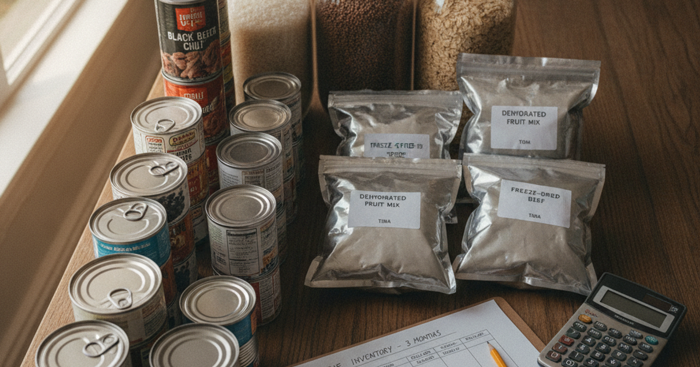
When banks close and ATMs go dark, your financial survival depends on preparation. Here's how to protect your money before the crisis hits.
When the power goes out, ATMs stop working. When banks freeze withdrawals — as they did during the 2013 Cyprus banking crisis, when the government seized up to 47.5% of deposits over €100,000 — the digital money you thought you had becomes inaccessible. When a cyberattack takes down financial infrastructure, as we saw with the 2021 Colonial Pipeline attack that cascaded into regional economic disruption, your debit card is just plastic. Every serious prepper knows that physical preparedness means nothing if your financial life can be wiped out overnight.
Financial preparedness isn't just for economic collapse doomsday scenarios. It matters during regional disasters, prolonged blackouts, banking outages, and civil unrest — events that happen regularly in the real world. A 2022 Federal Reserve report found that 37% of American adults couldn't cover a $400 emergency expense without borrowing. That statistic should alarm every prepper who's spent thousands on emergency food storage and survival gear but has no physical cash reserve.
This guide covers how to protect your cash, assets, and financial records whether you live in a high-rise apartment, a suburban home, or a rural homestead — because the fundamentals of financial survival apply everywhere.
What You'll Need
Tools
Supplies
- Fireproof, waterproof document safe
- Fireproof document bag with zipper
- Locking document organizer portfolio
- Locking cash box with tray
Why Digital-Only Finances Are a Critical Vulnerability
Most Americans have less than $1,000 in physical cash at home — and many have none at all. This is a serious SHTF vulnerability. In virtually every major regional disaster, from Hurricane Katrina to the 2021 Texas winter storm, ATMs ran dry within 24 to 48 hours. Power outages kill card readers. Bank system failures — which occur more frequently than most people realize — render digital balances temporarily meaningless.
The grey man principle applies to financial preparedness just as it does to physical security: you don't want to advertise what you have, but you absolutely need to have it. Your financial resilience should be invisible to outsiders but rock-solid in practice. Understanding OPSEC for your broader preparedness setup is just as important when it comes to your financial reserves — loose talk about cash on hand makes you a target.
How to Build a Physical Cash Reserve for Any Emergency
The first rule of blackout banking is simple: cash is king when the grid is down. Financial advisors typically recommend keeping one to three months of expenses in an accessible savings account, but preppers should go further. A physical cash reserve of $500 to $2,000 — or more, depending on your household size and risk tolerance — stored securely at home gives you immediate purchasing power when digital systems fail.
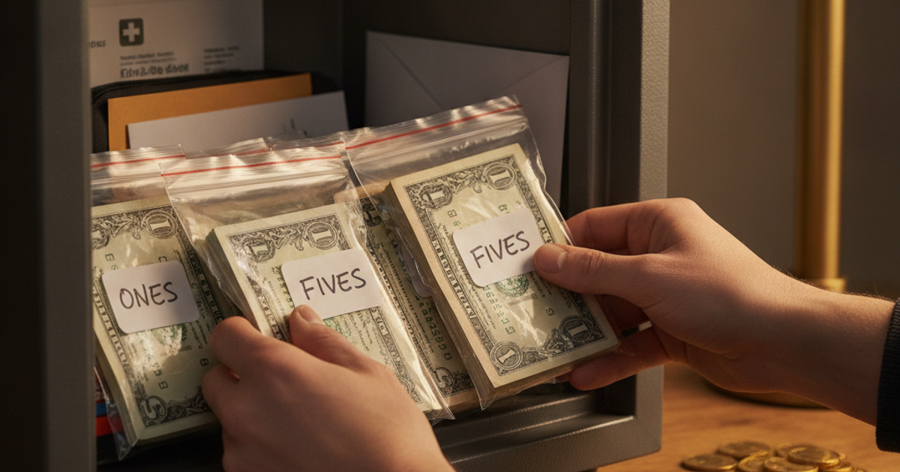
Denomination strategy matters. Don't keep your emergency cash as large bills. Break it down: keep 40% in $20 bills, 40% in $10s and $5s, and 20% in $1s. In a post-disaster environment, sellers often can't make change, and a $100 bill may be useless for a $15 transaction. Small bills are also less conspicuous when paying for goods in a disrupted economy.
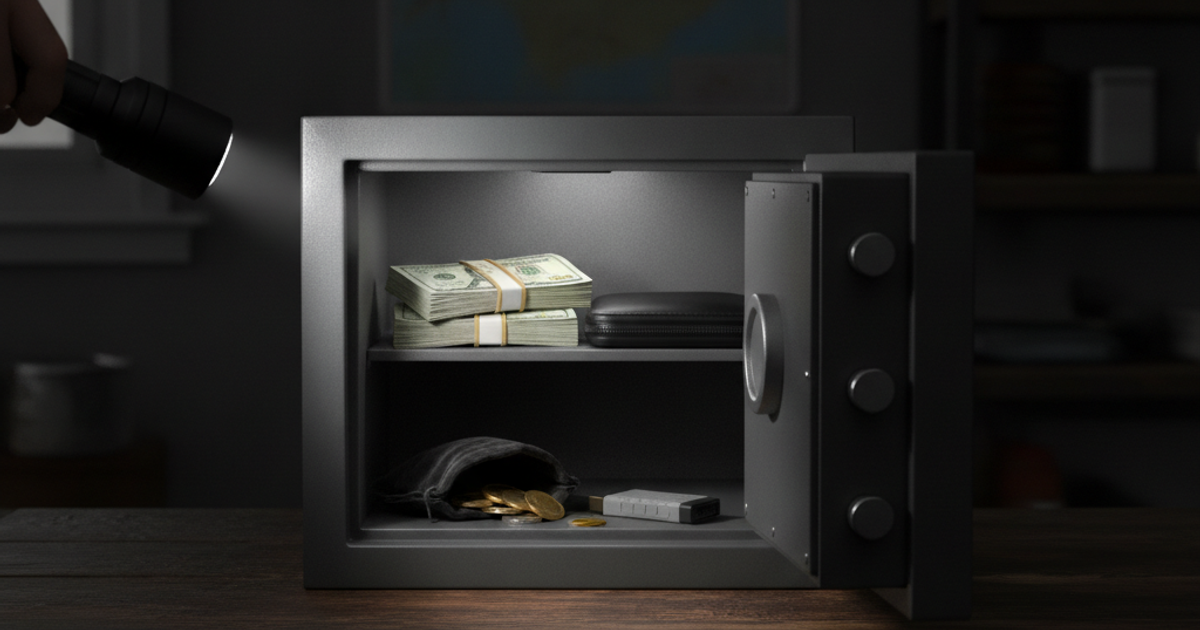
For securing your cash reserve at home, a Honeywell steel security safe is an excellent investment. Look for models that are both fireproof and bolted to a wall or floor — a safe that can be carried out the door is just a locked box. For apartment dwellers, a wall-mounted or furniture-concealed safe is the practical option. Rural homesteaders might consider a secondary buried or hidden cache as a backup.
Beyond cash, consider diversifying into precious metals and barter goods. A small reserve of silver coins — pre-1965 U.S. dimes and quarters (90% silver) are recognizable and divisible — provides a hedge against currency devaluation that paper cash cannot.
Protecting Financial Documents: What to Keep and Where
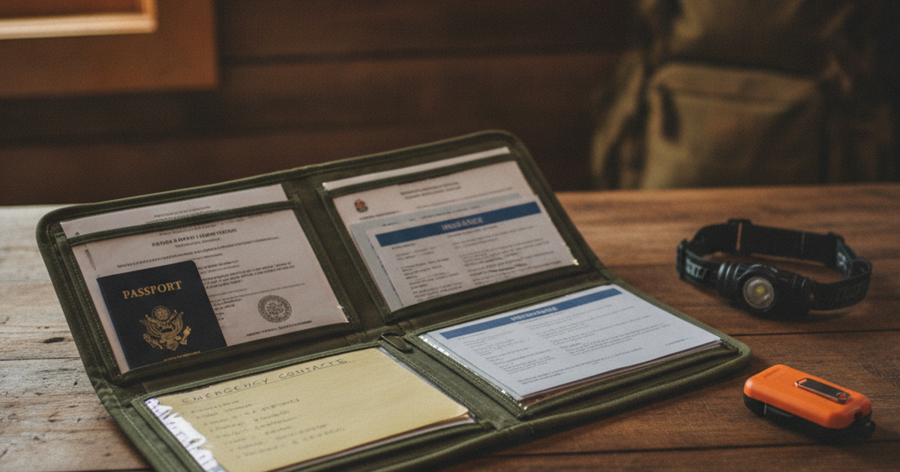
Your financial identity is stored on paper and digital files. In a disaster, losing those documents can set your recovery back by months or years. A comprehensive financial document kit should include:
- Bank account statements (last 3 months)
- Insurance policies (home, auto, life, health)
- Mortgage or lease agreements
- Investment and retirement account statements
- Tax returns (last 3 years)
- Birth certificates, Social Security cards, and passports
- Vehicle titles and property deeds
- Wills, trusts, and power of attorney documents
- A list of account numbers and emergency contact numbers for all financial institutions
These documents deserve layered protection. The SentrySafe fireproof waterproof document safe is a solid home base for your primary document kit — it's designed to survive both house fires (rated to 1700°F) and flood conditions. For a portable backup that travels with you during evacuation, a Samsill fireproof document bag slides easily into a bug out bag or vehicle kit.
For day-to-day document organization that keeps everything accessible but secure, a Vaultz locking document organizer lets you categorize and quickly locate critical paperwork without the bulk of a full safe. This is particularly useful for apartment preppers with limited storage space.
Digital backups matter too. Scan all critical documents and store encrypted copies on a USB drive kept in your fireproof safe. Consider a second encrypted USB copy stored off-site — at a trusted family member's home or a safety deposit box. Do not store unencrypted financial documents in cloud services with weak passwords.
Identity Theft and Information Security in a Crisis
Disasters create prime conditions for identity theft. In the chaos following a major event, mail piles up unattended, paperwork gets scattered, and opportunists move quickly. Protecting your financial identity is as much a part of emergency preparedness as stocking food and water.
Start by eliminating paper vulnerabilities. An Amazon Basics micro-cut paper shredder should be a standard piece of equipment in any prepper household. Micro-cut shredders reduce documents to confetti-sized pieces — far more secure than strip-cut models, which can be reassembled. Shred every bank statement, credit card offer, medical bill, and utility notice before it hits the trash.
Consider a credit freeze with all three major bureaus (Equifax, Experian, TransUnion) as a baseline financial security measure. It's free, reversible, and prevents anyone — including you temporarily — from opening new credit accounts in your name. During a prolonged crisis, this is one less attack surface to worry about.
The Portable Financial Go-Bag: What to Grab If You Have 10 Minutes
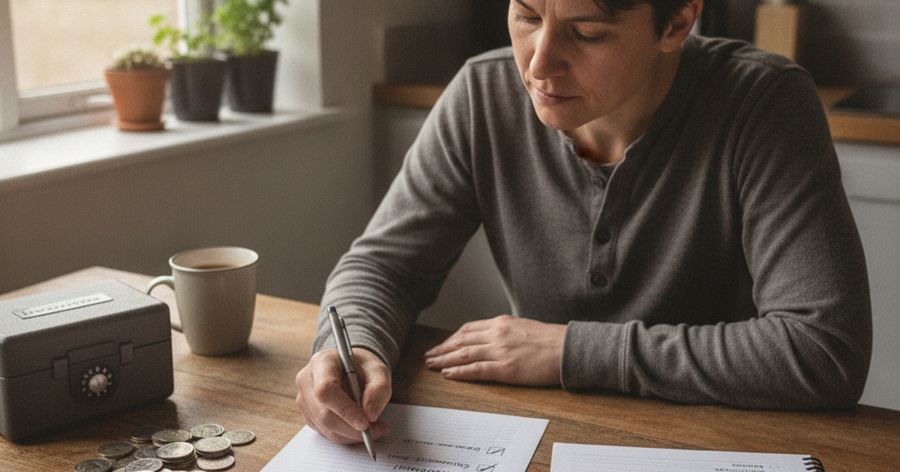
Every household should have a financial go-bag — a compact, organized kit you can grab on the way out the door during a rapid evacuation. If your home burns down or you need to bug out in under ten minutes, your financial recovery depends on what you take with you.
Your financial go-bag should contain:
- Physical cash reserve (at least $500 in mixed denominations)
- One or two credit cards (separate from your wallet)
- Encrypted USB drive with digital document copies
- Laminated card with account numbers, bank phone numbers, and insurance policy numbers
- Copies of IDs and passports
- A small amount of silver or gold as a hedge
A Pelican 1510 waterproof hard case makes an outstanding container for a financial go-bag. It's crush-proof, waterproof, and lockable — protecting your documents and valuables from fire suppression water, flooding, and physical damage during transport. It fits carry-on airline dimensions as well, making it useful beyond just SHTF scenarios.
Staying organized under stress requires good labeling. A Brother P-Touch label maker lets you clearly mark folders, envelopes, USB drives, and storage containers so anyone in your household can locate critical items quickly — not just you. In a crisis, the person grabbing the go-bag might not be the one who organized it.
Barter Economics: When Cash Loses Its Value
In a prolonged grid-down or economic collapse scenario, paper money may lose significant value — or become worthless entirely in hyperinflationary conditions (consider Venezuela's 1,000,000% inflation in 2018, or Zimbabwe's earlier collapse). This is where your preparedness toolkit goes beyond cash.
Understanding bartering skills and the barter economy is the next layer of financial preparedness. Practical barter goods with high post-collapse value include alcohol, ammunition, medications, seeds, hand tools, and fuel. Skills are even more valuable — medical knowledge, mechanical ability, and food preservation expertise can be traded when physical goods run out.
For managing your physical barter and cash reserves day to day, a Steelmaster locking cash box with tray provides an organized, portable solution for cash management at home. The removable tray helps separate denominations or currencies — useful if you're managing both U.S. dollars and silver coins as parallel stores of value.
Step-by-Step Instructions
Step 1: Establish Your Physical Cash Reserve Amount and Denominations
Calculate one month of your household's essential expenses — food, fuel, utilities, and medications. This is your minimum cash reserve target; aim for two to three months if possible. Withdraw this amount gradually over several weeks to avoid drawing attention, and break it into the denomination split described above (40% twenties, 40% fives and tens, 20% ones).
Step 2: Secure Your Cash in a Rated, Fixed Safe
Purchase a fireproof steel safe rated for at least 30 minutes at 1,200°F, and bolt it to a wall stud or concrete floor. Apartment dwellers should use a wall-mount safe behind a picture or inside a closet. Rural homesteaders may want a secondary buried cache in a waterproof container as a redundant reserve. Never store all your cash in a single location.
Step 3: Gather and Organize All Critical Financial Documents
Pull every critical document listed in the section above and create a master financial binder. Use a locking document organizer to categorize them by type: identity documents, banking, insurance, property, and legal. Write a table of contents and laminate it for the front of the binder so anyone in your household can navigate it quickly.
Step 4: Create Digital Backups on Encrypted USB Drives
Scan every document in your binder using a smartphone app (Adobe Scan or Microsoft Lens work well) and save them to an encrypted USB drive using a tool like VeraCrypt. Create two copies — one stored with your fireproof safe at home, one stored off-site. Update these backups every six months or whenever major documents change.
Step 5: Build and Pack Your Financial Go-Bag
Assemble a waterproof, lockable container with your cash reserve, a copy of critical documents, an encrypted USB drive, account numbers, and identification copies. Label everything clearly. Store this go-bag near your main bug out bag so they can be grabbed together. Verify contents every six months and replace any expired items.
Step 6: Implement Identity Theft Protections Before a Crisis Hits
Place a credit freeze with all three major bureaus online — it takes about 15 minutes and costs nothing. Set up fraud alerts on all financial accounts. Shred all incoming financial paperwork immediately using a micro-cut shredder. Opt out of paper statements where possible and redirect to secure email.
Step 7: Diversify Into Tangible Non-Cash Assets
Allocate a portion of your preparedness budget to silver coins, practical barter goods, and skills development. A reasonable starting point is 5-10% of your liquid savings converted to pre-1965 U.S. silver coins or one-ounce silver rounds from a reputable dealer. Store these with your cash safe, separately labeled and inventoried.
Step 8: Test and Verify Your System Under Simulated Stress
Conduct a tabletop exercise with your household: "We have 10 minutes to evacuate — where is the go-bag, who grabs it, and what's the backup if that person isn't home?" Walk through the scenario until everyone knows the answers. Situational awareness doesn't stop at physical threats — it includes knowing exactly where your financial lifeline is at all times.
Frequently Asked Questions
How much cash should I keep at home for emergencies?
Most financial preparedness experts recommend keeping a minimum of one month's essential expenses in physical cash at home, with a target of two to three months for serious preppers. For the average American household, this translates to roughly $1,500 to $4,500 in mixed denominations. Start with $500 to $1,000 if you're just beginning — even that puts you ahead of the vast majority of households when ATMs go dark. Store it in a fireproof, bolted safe and tell only those in your immediate household where it is.
What financial documents should I have in my emergency go-bag?
Your emergency financial document kit should include copies (not necessarily originals) of passports and government IDs, Social Security cards, birth certificates, insurance policies with claim phone numbers, bank account information, property deeds or mortgage documents, vehicle titles, and a laminated card listing emergency contacts for all financial institutions. Keep originals in a fireproof home safe and copies in your portable go-bag. An encrypted USB drive with scanned versions of all documents adds a critical digital layer. Review and update this kit every six months.
What happens to my money if the banking system collapses?
In a partial banking crisis — like account freezes or system outages — FDIC insurance covers up to $250,000 per depositor per institution for standard accounts. However, FDIC protection only kicks in after a bank is officially declared insolvent, which can take time. In the interim, access to your funds may be blocked. This is precisely why physical cash, precious metals, and barter goods serve as parallel systems. A full currency collapse is a more extreme scenario, but hyperinflation events in other countries have shown that diversifying out of 100% paper currency — even partially — provides meaningful protection when monetary systems destabilize.
Affiliate Disclosure: SHTFPlan.net participates in the Amazon Services LLC Associates Program. Some links are affiliate links — we may earn a small commission at no extra cost to you.