Blackout Cooking: How to Prepare Hot Meals Without a Stove, Oven, or Microwave
When the power goes out and the gas gets cut, you still need to eat. Here's how to cook real food with alternative heat sources in any emergency.
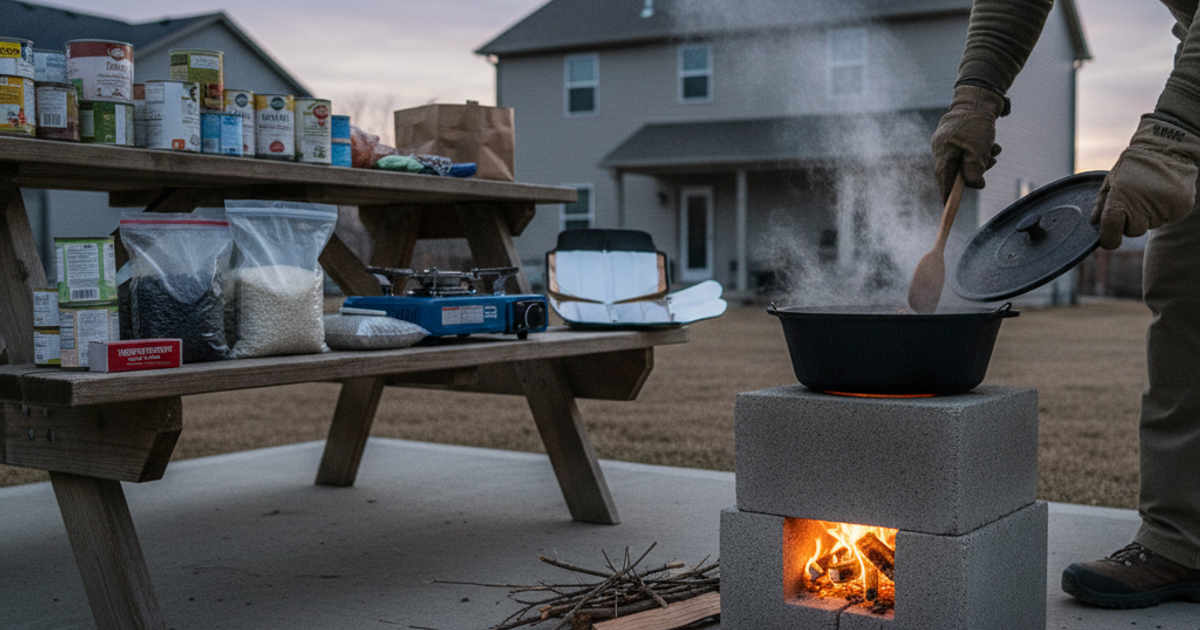
When the power goes out, most people's first instinct is to reach for the phone and order delivery — only to realize the restaurants are closed, the traffic signals are dark, and the cell towers may be overloaded. According to the U.S. Energy Information Administration, the average American experienced more than eight hours of power interruptions in 2020 alone, a figure that has been trending upward as extreme weather events become more frequent. For a serious prepper, a grid-down scenario isn't a question of "if" but "when." And when it happens, your ability to cook a hot meal could mean the difference between maintaining morale, managing caloric needs, and keeping your family functioning — or descending into cold cans and raw frustration.
The good news is that cooking without electricity is not complicated. Humans have been doing it for tens of thousands of years. What separates prepared households from unprepared ones is simply having the right tools, the right fuels, and the right knowledge before the lights go out. Whether you live in a high-rise apartment in Chicago, a suburban tract home in Phoenix, or on a rural homestead in Appalachia, there are viable cooking solutions for your situation. This guide covers all of them.
For apartment dwellers and urban preppers, be sure to check out our guide on Apartment Prepping: How to Build a Serious Emergency Stockpile in a Small Space — many of the same space and safety constraints that apply to food storage apply to emergency cooking as well.
What You'll Need
Tools
- Camp Chef Explorer propane camp stove
- Solo Stove Lite rocket stove
- GoSun Sport solar oven cooker
- Jetboil Flash camping cooking system
- Esbit solid fuel tablet folding stove
Supplies
- Sterno canned heat fuel
- 1-lb and 20-lb propane canisters
- Cast iron cookware
- Waterproof matches and lighters
Understanding Your Cooking Options for a Grid-Down Scenario
Before diving into specific methods, understand that no single cooking method is ideal for every situation. Urban preppers face constraints that rural homesteaders don't — smoke, open flame restrictions, limited outdoor space, and neighbors in close proximity. Your emergency preparedness cooking plan should include at least two methods: a primary and a backup. Think in layers, just like you do with your survival kit and your water storage.
Propane Camp Stoves: The Best All-Around Emergency Cooking Method
For sheer versatility and ease of use, a propane camp stove is the gold standard for most preppers. Propane burns clean, stores indefinitely when sealed, and produces enough heat to boil water, fry, simmer, and bake with the right accessories. It works in virtually any outdoor environment and in well-ventilated garages or covered patios. Never use a propane stove indoors without serious ventilation — carbon monoxide poisoning is a silent killer that claims dozens of lives during power outages every year.
The Coleman Classic propane camp stove two-burner has been a staple of American camping and emergency preparedness for decades. Its dual-burner design lets you cook a main dish and boil water simultaneously, making it highly efficient for family-sized cooking under stress. It runs on standard 1-lb green propane canisters or can be adapted with a hose to a larger 20-lb tank for extended off-grid use.
For more serious cooking capacity — think feeding a group, canning, or running a large pot — the Camp Chef Explorer propane camp stove delivers professional-level BTU output on two independently controlled burners. It's particularly well-suited for suburban and rural users who have outdoor space and want the power to do heavy cooking during an extended blackout. Pair it with your propane storage plan — see our article on Fuel Storage for Preppers: How to Safely Stockpile Gasoline, Diesel, and Propane for Long-Term Emergencies for guidance on how much to store and how to do it safely.
Rocket Stoves and Wood Fires: The Zero-Fuel Fallback
When stored fuel runs out, the ability to cook with wood becomes essential. Rocket stoves are engineered to burn small sticks and twigs at extremely high efficiency by directing airflow into a combustion chamber that burns fuel almost completely. This means minimal smoke, minimal fuel consumption, and significant heat output — all critical advantages in a long-term SHTF scenario.
The Solo Stove Lite rocket stove is a compact, stainless steel gasification stove that burns twigs, pinecones, and wood pellets with impressive efficiency and very little smoke. Its small footprint makes it viable even for urban and suburban users who have access to any outdoor space — a balcony, a fire escape landing (where regulations permit), or a backyard. Always check local ordinances before burning open wood in urban or suburban areas, and keep a fire extinguisher within reach.
For rural preppers, a traditional open wood fire in a fire pit, fireplace, or outdoor fire ring remains one of the most reliable long-term cooking methods available. The key is learning to manage coals for consistent heat, rather than cooking over raw flame. Understanding fire-starting under adverse conditions is foundational — our article on Fire Starting Without Matches: How to Choose and Master Every Ignition Method for Survival covers everything from flint and steel to fire pistons.
Solar Ovens: Silent, Fuel-Free Cooking in Sunlight
Solar cooking is one of the most underrated tools in the prepper's arsenal. A quality solar oven can reach temperatures of 250°F to 400°F on a clear day — enough to bake bread, cook rice, pasteurize water, and slow-cook stews. They require no fuel, produce no smoke, and make virtually no noise, which has significant advantages from an operational security standpoint. No smoke means fewer signals to neighbors that you're cooking, which matters when food scarcity creates social tension.
The GoSun Sport solar oven cooker uses a vacuum tube design that concentrates sunlight into a cooking chamber, reaching temperatures up to 550°F. Its compact size and light weight make it practical for urban preppers and apartment dwellers who can set it up on a balcony, rooftop, or window ledge that receives direct sun. It's one of the few genuine cooking solutions for people with no outdoor ground access.
For higher volume cooking, the All American Sun Oven solar cooker is the professional-grade option. It can reach temperatures up to 400°F in direct sunlight and accommodate full-sized baking pans, making it capable of producing real meals for a family. Solar cooking does have a major limitation: it requires clear skies and direct sunlight, so it should never be your only backup method.
Compact Backpacking Stoves: Fast, Portable, and Precise
For urban survival scenarios and situations where you need to cook with minimal equipment and maximum speed, integrated canister stoves are unbeatable. The Jetboil Flash camping cooking system can boil a liter of water in roughly 100 seconds, making it ideal for rehydrating freeze-dried meals, making hot drinks, and quickly preparing instant food from your emergency food storage. It's also compact enough to slip into a bug out bag.
Solid Fuel Tablets and Canned Heat: The Urban Apartment Solution
For preppers who live in apartments or other situations where open flame and smoke are genuinely not workable, solid fuel tablets and canned heat products offer a viable minimum-viable cooking solution. Sterno canned heat fuel burns clean with minimal odor and can heat food in a pot or chafing dish setup without producing significant smoke. It's not a high-heat cooking solution, but it's enough to warm soups, heat canned food, and boil small amounts of water in a pinch — and it's completely legal and safe for use in most indoor spaces with a cracked window.
Similarly, the Esbit solid fuel tablet folding stove is a military-proven cooking system used by armies around the world. Each hexamine tablet burns for about 12 minutes at high heat — enough to boil 500ml of water. The stove itself folds flat and weighs almost nothing, making it an ideal inclusion in any bug-out bag or vehicle emergency kit. Stock several boxes of tablets and you have weeks of minimal cooking capability in a package smaller than a paperback book.
Step-by-Step Instructions
Step 1: Assess Your Living Situation and Available Cooking Space
Before purchasing or relying on any emergency cooking method, honestly evaluate what space you have available. Apartment dwellers need to prioritize low-smoke, low-flame options like Sterno, solid fuel tablets, or solar ovens on balconies. Suburban and rural users have more flexibility for propane stoves, rocket stoves, and open fires. Write down which methods are physically and legally viable for your specific location before investing in equipment.
Step 2: Establish a Primary and Backup Cooking Method
Never rely on a single cooking system. Choose a primary method — typically a propane stove for most suburban and rural users, or canned heat for apartment dwellers — and a secondary method that uses a completely different fuel type. If your primary depends on stored propane, your backup might be a solar oven or a wood-burning rocket stove. Redundancy is the core principle of sound emergency preparedness.
Step 3: Stock Appropriate Fuel Supplies for Each Method
A cooking stove without fuel is decoration. Calculate how many meals per day your household needs, estimate the fuel consumption of your chosen stove, and stock accordingly. FEMA recommends preparing for a minimum of 72 hours, but serious preppers plan for 30 days or more. For propane, a 1-lb canister yields roughly 1-2 hours of cooking time on medium heat — plan accordingly and rotate stock to prevent degradation.
Step 4: Practice Cooking on Your Emergency Stove Before You Need It
Set up your emergency cooking system on a calm weekend and actually cook a full meal on it. This is not optional — the first time you use unfamiliar equipment should never be during an actual emergency when stress is high and stakes are real. Learn how to control temperature, manage fuel consumption, and adapt your normal recipes to the equipment's limitations. Confidence under pressure comes from practice, not theory.
Step 5: Build Your Emergency Food Storage Around Your Cooking Method
Your emergency food storage should be matched to your cooking capabilities. If you're relying on a solid fuel tablet stove with limited heat output, your food stores should emphasize no-cook or minimal-cook options: canned goods, freeze-dried meals, crackers, nut butters, and ready-to-eat items. If you have a full propane stove, you can store dried beans, rice, pasta, and other ingredients that require extended cooking time.
Step 6: Establish Safe Setup Protocols for Each Cooking Method
Every cooking method has specific safety requirements that must become habit. Propane stoves must be used outdoors or in extremely well-ventilated areas — crack windows and use a CO detector if cooking in a garage. Wood fires require a fire extinguisher or water supply within arm's reach. Solar ovens require protective eyewear during setup due to focused reflected light. Write your protocols down and review them with everyone in your household.
Step 7: Store Cooking Equipment in an Accessible, Designated Location
Your emergency cooking gear should be stored in a single, clearly labeled, easily accessible location — not scattered across the garage, basement, and attic. Consider a dedicated "blackout cooking kit" in a waterproof bin that includes your stove, fuel, a lighter, a small pot, and basic utensils. When the power goes out, you should be able to locate and deploy your cooking setup within five minutes in the dark.
Step 8: Test and Rotate Fuel Supplies on a Regular Schedule
Propane canisters have an indefinite shelf life when sealed, but regulators, hoses, and O-rings degrade over time. Solid fuel tablets can absorb moisture and become difficult to ignite. Sterno has a shelf life of several years. Establish a rotation schedule — check all equipment and fuel stocks twice a year, ideally when clocks change for daylight saving time — and replace anything that shows signs of degradation.
Recommended Gear for Your Emergency Cooking Setup
Building a complete blackout cooking system means layering your options across multiple fuel types and scenarios. The products covered in this article represent the best of each category. For your core propane cooking setup, the Coleman Classic propane camp stove two-burner remains the most proven, widely available, and parts-supported option on the market. For solar cooking, the All American Sun Oven solar cooker offers serious cooking performance without any fuel dependency whatsoever. And for your bug-out bag or get-home kit, the Jetboil Flash camping cooking system and Esbit solid fuel tablet folding stove give you compact, lightweight options that travel wherever you do. You can find a curated selection of vetted emergency cooking equipment on our Recommended Survival Gear & Equipment page.
Your cooking capability also directly supports your broader food security planning. If you're building out a long-term food supply, be sure to read our guide on Long-Term Food Stockpile: How to Build a Supply That Actually Keeps You Alive for a comprehensive approach to stocking the right foods for the right duration.
Frequently Asked Questions
Can I use a propane camp stove inside my house or apartment during a power outage?
No — you should not use a propane or butane camp stove inside an enclosed living space. These stoves produce carbon monoxide, an odorless gas that can reach lethal concentrations quickly in a closed room. The CDC reports that CO poisoning sends more than 20,000 Americans to the emergency room each year, with a significant spike during power outages. Use propane stoves on balconies, in open garages with the door fully raised, or fully outdoors. For true indoor cooking during a blackout, Sterno canned heat or Esbit solid fuel tablets used with a cracked window are your safest options.
How much emergency cooking fuel should I stockpile for a two-week power outage?
For a family of four cooking two to three hot meals per day, plan on roughly one to two 1-lb propane canisters per day with a standard camp stove, depending on cooking duration and temperature. For a two-week scenario, that's 14 to 28 canisters minimum — or one to two 20-lb tanks with an adapter hose, which is far more economical and space-efficient. If you're using solid fuel tablets as your primary or backup, stock at least 100-200 tablets per person for a 14-day period. Always store more than you think you'll need, and rotate stock on a regular schedule.
What emergency cooking method is best for someone who lives in an apartment with no outdoor space?
Apartment dwellers with no outdoor access should prioritize three solutions: Sterno canned heat for warming pre-cooked or canned foods, solar cooking via a GoSun-style vacuum tube cooker that can be positioned in a south-facing window or on a windowsill, and a well-stocked supply of no-cook emergency foods — canned goods, nut butters, crackers, jerky, and ready-to-eat freeze-dried meals that only require cold water rehydration. Building your emergency food storage around minimal-cook options is the most practical approach for urban dwellers with genuine space and ventilation constraints. Check out our complete guide on Apartment Prepping: How to Build a Serious Emergency Stockpile in a Small Space for a full breakdown of urban-specific strategies.
Affiliate Disclosure: SHTFPlan.net participates in the Amazon Services LLC Associates Program. Some links are affiliate links — we may earn a small commission at no extra cost to you.