Bushcraft Rope and Cordage: How to Make and Use Natural Cordage When You Run Out of Paracord
When your paracord runs out, knowing how to twist natural fibers into strong, reliable cordage could save your life.
Paracord is one of the most versatile pieces of survival gear you can carry. Lightweight, strong, and cheap enough to stuff into any bug out bag, it belongs in every survival kit regardless of whether you live in a Manhattan high-rise or a rural homestead. But what happens when the paracord runs out — or when you never had any to begin with?
This is not a hypothetical scenario. In a true SHTF situation, supply chains fail, stores close, and you work with what nature provides. The ability to make functional rope and cordage from raw plant fibers is one of the oldest and most critical bushcraft skills in human history. Archaeological evidence from sites in Europe and the Middle East shows humans were twisting plant fibers into cordage at least 50,000 years ago — long before any synthetic material existed. If our ancestors could build shelters, set traps, and lash tools together using nothing but plant matter, so can you.
Whether you are a rural prepper with 40 acres of land or an urban apartment dweller with access to a city park, understanding natural cordage is a force multiplier for your emergency preparedness strategy. This skill pairs directly with other primitive techniques — if you haven't already, check out our guide on Fire Starting Without Matches: How to Choose and Master Every Ignition Method for Survival for another fundamental bushcraft skill.
What You'll Need
Tools
- Mora Bushcraft knife fixed blade
- Schrade SCHF9 full tang survival knife
- Smooth flat rock or wooden dowel (for fiber separation)
- Small comb or stiff brush (for fiber preparation)
Supplies
- Atwood Rope MFG paracord 550 type III (for comparison and supplementing natural cordage)
- Plant fibers (dogbane, stinging nettle, cattail, inner bark strips)
- Water or damp cloth (for keeping fibers pliable)
Why Natural Cordage Skills Matter for Every Prepper
Synthetic cordage like Atwood Rope MFG paracord 550 type III is excellent survival gear — it has a minimum break strength of 550 pounds, contains inner strands that can be harvested for sutures or fishing line, and weighs almost nothing. Every serious prepper should have it. But no cordage supply is infinite, and no bug out bag survives indefinitely without resupply.
Natural cordage fills the gap. In an extended off-grid situation, you need rope constantly: for shelter construction, snare-setting, tool-making, load-bearing, climbing assists, and dozens of other applications. A study published in the Journal of Archaeological Science demonstrated that ancient twisted cordage made from plant fibers can achieve tensile strengths sufficient for carrying loads exceeding 50 pounds — more than adequate for most field applications when made correctly.
For urban and suburban preppers, this skill is equally valuable. City parks, vacant lots, highway medians, and even rooftops grow fibrous plants. Knowing what to look for and how to process it transforms ordinary green spaces into a materials supply chain. This knowledge also has significant bartering value in a community survival scenario — a skill that produces useful goods from nothing is exactly the kind of asset described in our Prepper's Guide to Bartering: What Skills and Goods Will Actually Have Value When SHTF.
Best Plant Fibers for Natural Cordage in North America
Not all plants produce usable fiber. You are looking for long, strong, flexible strands that resist breakage when twisted. Here are the top candidates:
- Dogbane (Apocynum cannabinum): Considered by many bushcraft experts to be the single best North American cordage plant. Found in disturbed soils, roadsides, and open fields across most of the continent. Dead stalks retain excellent fiber through winter.
- Stinging Nettle (Urtica dioica): Exceptionally strong fibers, historically used for fishing nets and clothing. Found in moist, disturbed areas and urban waste ground. Wear gloves during processing — the sting neutralizes once dried.
- Cattail (Typha spp.): Leaves produce softer cordage suitable for lashing and weaving. Found in almost every wetland, pond edge, and drainage ditch in North America, including urban areas. Extremely accessible.
- Yucca (Yucca spp.): Leaves contain long, strong fibers. Common in the Southwest and increasingly found in suburban landscaping nationwide. One of the easiest plants to process.
- Milkweed (Asclepias spp.): Stem fibers produce moderately strong cordage. Found in fields, roadsides, and urban lots. Also a food and medicine source, making it highly valuable.
- Inner bark of trees: Basswood, cedar, willow, and elm inner bark (the cambium layer just beneath the outer bark) produces excellent strands for rope. This is the go-to option when you have a sharp knife and trees but no other fibrous plants nearby.
A quality fixed-blade knife is absolutely essential for harvesting and processing plant fibers. The Fallkniven F1 bushcraft fixed blade knife is purpose-built for exactly this type of work — its convex grind handles fine processing tasks like fiber separation and bark stripping with precision. Similarly, the Esee Izula neck knife bushcraft is a lightweight option you can keep on your body at all times, ready for impromptu cordage-making whenever materials present themselves.
The Reverse Wrap Technique: Core Method for Natural Cordage
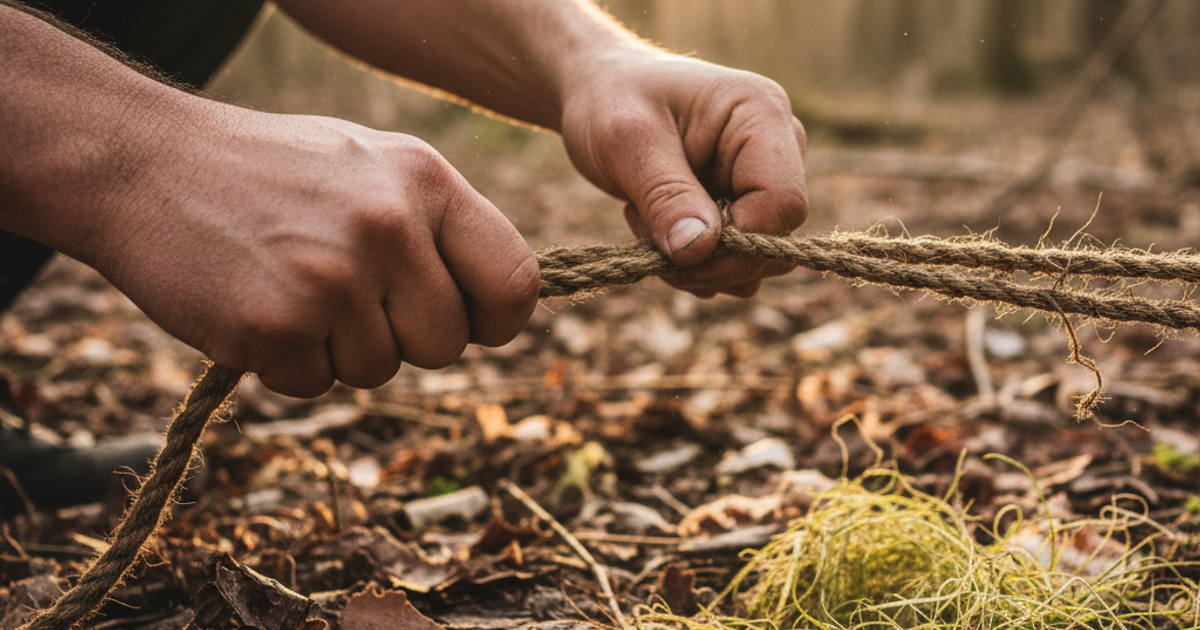
The reverse wrap (also called the two-ply twist) is the foundational technique used to make natural cordage. It is how virtually all primitive rope in human history was made, and it works on almost any fibrous material. Once mastered, an experienced practitioner can produce several feet of cordage per hour.
The principle is simple: two bundles of fiber are each twisted in one direction, then wrapped around each other in the opposite direction. This counteracting tension locks the twist in place and prevents unraveling. The result is structurally equivalent to modern two-ply rope construction.
For heavier loads, you can braid three or more strands of finished two-ply cordage together, significantly increasing strength. Fieldcraft studies suggest that properly executed three-strand braided natural cordage can achieve break strengths comparable to medium-weight paracord when using high-quality fibers like dogbane or nettle.
Step-by-Step Instructions
Step 1: Harvest and Identify Appropriate Plant Material
Locate a fibrous plant using the identification guide above. For dogbane or nettle, collect dead stalks from the previous season — these are already partially retted (naturally processed) and easier to work with. Harvest stems at least 12–18 inches long for usable fiber length. For inner bark, locate a live or recently fallen tree, make a vertical cut through the outer bark, and peel back long strips of the inner cambium layer.
Step 2: Ret or Dry the Plant Material
Fresh green plants contain moisture and chlorophyll that make fibers sticky and weak. Allow harvested material to air dry for several days, or briefly hold stems near (not over) a fire to accelerate drying. Historically, retting — soaking material in water for days to break down non-fibrous tissue — was the professional method. In a field setting, working with pre-dried material is faster and more practical.
Step 3: Extract and Separate the Fibers
Break the dried stalk into sections and peel away the outer layer. For dogbane and nettle, gently crush the woody core between two rocks or against your knee, then carefully peel the pithy core away from the outer fiber sheath. You want long, parallel fiber bundles — these are your raw cordage material. A Mora Bushcraft knife fixed blade is ideal for scoring stalks cleanly before splitting. Separate fibers into two roughly equal bundles and lightly dampen them to keep them pliable during twisting.
Step 4: Begin the Reverse Wrap Twist
Hold the two fiber bundles together at one end, pinched between thumb and forefinger. With your other hand, twist one bundle clockwise until it kinks slightly — this is your working strand. Now wrap that twisted strand counterclockwise over the second bundle. Bring the second bundle forward, twist it clockwise, and wrap it counterclockwise over the first. Repeat this motion rhythmically: twist clockwise, wrap counterclockwise, alternate strands. The tension between the two directions is what creates structural integrity.
Step 5: Splice in New Fibers to Extend Length
When a fiber bundle gets short, add new fibers by overlapping them with the existing bundle by 2–3 inches before continuing the twist. Stagger your splices — never add new fibers to both bundles at the same time, or you will create a weak point. Well-executed splices are nearly invisible and do not significantly reduce the cordage's overall strength.
Step 6: Test and Condition the Finished Cordage
Once you have the length you need, tie off both ends with an overhand knot. Test the cordage by applying progressive tension — start with hand pressure, then try hanging light weight from it. Good natural cordage stretches slightly and holds. If it unravels easily, your twist tension was insufficient; re-twist and test again. Lightly rubbing the finished cordage with animal fat or plant oil conditions the fibers and improves weather resistance.
Step 7: Store or Deploy the Cordage for Shelter and Trap Use
Coil finished cordage in loose loops to prevent kinking and store it in a dry location. Natural cordage degrades faster than synthetic when wet repeatedly, so use it for fixed applications like shelter lashing or tool construction where it won't be repeatedly soaked and dried. For applications requiring high reliability, back up natural cordage with your remaining synthetic supply or use it as a backup system for your improvised tarp shelter rigging.
Urban and Suburban Applications
If you live in an apartment or suburb, you might assume bushcraft cordage is irrelevant to you. It isn't. Cattails grow in virtually every drainage ditch, retention pond, and urban wetland in North America. Stinging nettle colonizes waste ground and alley borders. Yucca is planted in landscaping throughout the country. Even in a dense urban environment, a short walk from your building likely puts you within reach of usable fiber sources.
For urban survival, natural cordage also provides a low-profile, grey man alternative to obviously tactical gear. Carrying a bundle of homemade rope attracts zero attention in ways that coils of bright-orange paracord might not. This aligns with the broader principle of maintaining situational awareness and a low observable profile during a crisis — the same mindset discussed in our Escape and Evasion: How to Move Undetected When SHTF guide.
Recommended Gear for Bushcraft Cordage and Field Survival
A capable fixed-blade knife is your single most important tool for natural cordage work. The Buck 119 Special fixed blade hunting knife is a legendary American-made blade that handles bark stripping, fiber processing, and every other field task with authority. For those who prefer a full-tang heavy-duty option, the Schrade SCHF9 full tang survival knife provides excellent grip control for detailed fiber work. Knowledge is equally important as tools: the Primal Survivor bushcraft field guide book covers plant identification, fiber processing, and dozens of other primitive skills in a compact format suitable for your bag. For deep study of wilderness survival from one of the most respected practitioners in the field, the Tom Brown wilderness survival book field guide provides comprehensive instruction that goes far beyond cordage into tracking, shelter, water, and fire. You can also find additional tools and supplies on our Recommended Survival Gear & Equipment page.
Frequently Asked Questions
How strong is natural plant cordage compared to paracord?
Strength varies significantly depending on the plant species, fiber quality, and execution of the twist. Well-made dogbane or stinging nettle two-ply cordage can achieve tensile strengths of 30–80 pounds depending on diameter — sufficient for snares, shelter lashing, and light load-bearing. Paracord 550 has a rated minimum break strength of 550 pounds, so synthetic cordage is considerably stronger for the same diameter. However, natural cordage can be made in any diameter by using thicker fiber bundles or braiding multiple strands, and its key advantage is that it can be produced indefinitely from renewable materials with no tools other than your hands.
What plants can I use for natural cordage in a city or suburban area?
Cattails are the most widely available urban cordage plant — they grow in retention ponds, drainage channels, and any wet area, including city parks. Stinging nettle grows on disturbed urban soils, alley edges, and vacant lots. Yucca is commonly planted in suburban and commercial landscaping. Iris leaves from ornamental garden plants also produce usable short-length fiber. In wooded urban parks, basswood and willow trees provide excellent inner bark cordage material. The key is learning to identify these plants before an emergency — walk your neighborhood now with a plant identification guide and note where fibrous species grow.
How long does natural cordage last, and how should I store it?
Properly made and stored natural cordage can last for years — archaeologists have recovered functional cordage thousands of years old from dry cave environments. In the field, the primary enemies are moisture, mold, and UV degradation. Keep finished cordage dry and away from prolonged direct sunlight. Treating with rendered fat or plant oil significantly extends lifespan and improves water resistance. For field storage, coil loosely and keep inside a dry container or wrapped in bark. In wet environments, inspect natural cordage regularly for fiber breakdown and replace critical lashings more frequently than you would synthetic rope.
Affiliate Disclosure: SHTFPlan.net participates in the Amazon Services LLC Associates Program. Some links are affiliate links — we may earn a small commission at no extra cost to you.