Travel Survival Kit: How to Prepare for Disaster When You're 1,000 Miles From Home
Most preppers plan for disaster at home — but crisis doesn't wait for you to get back. Here's how to build a travel survival kit, secure a hotel room, and find your way home when everything stops.
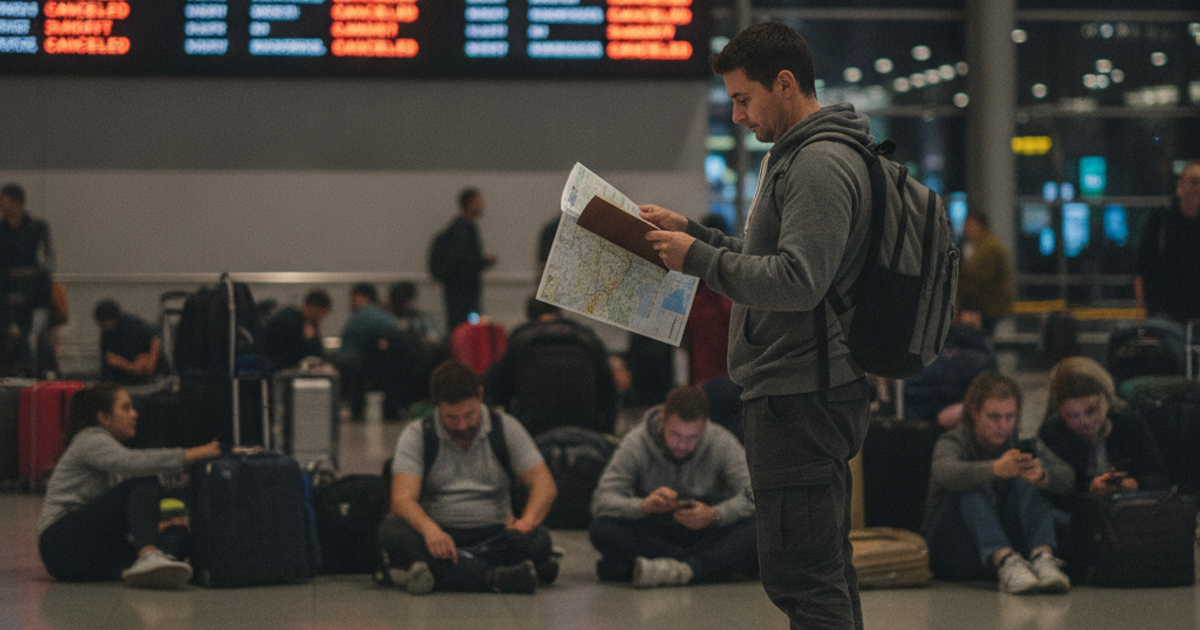
Every prepper's plan has a blind spot, and for most of us it's the airport terminal. You've got six months of emergency food storage in the basement, a bug out bag by the door, water stored in the garage, and a generator wired to the panel. Then you board a flight to a conference in Denver or drive 14 hours to see family in another state — and your entire support system is suddenly a thousand miles behind you.
This isn't a hypothetical risk. Americans took roughly 2.3 billion person-trips in 2023 according to the U.S. Travel Association, and the TSA screened more than 904 million passengers that year. Meanwhile, FEMA has issued major disaster declarations in all 50 states over the past decade. The odds that a hurricane, earthquake, grid failure, civil unrest event, or regional shutdown catches you away from home over the course of your life are not small — they're close to inevitable. The 2003 Northeast blackout stranded an estimated 50 million people. Hurricane Katrina left tens of thousands of travelers trapped in a city with no functioning infrastructure.
The good news: a travel survival kit that fits airline rules and weighs under five pounds can carry you through the critical first 72 hours. Here's how to build it, how to secure whatever room you're sleeping in, and how to plan a route home before you ever need one.
What You'll Need
Tools
- Black Diamond Spot headlamp
- Addalock portable door lock
- Master Lock portable travel door security bar
- Kidde portable smoke and CO detector
Supplies
- Sawyer MINI water filtration system
- Potable Aqua purification tablets
- Compact watertight first aid kit
- Cash in small bills, paper maps, N95 masks, 550 paracord
How to Build a TSA-Compliant Travel Survival Kit
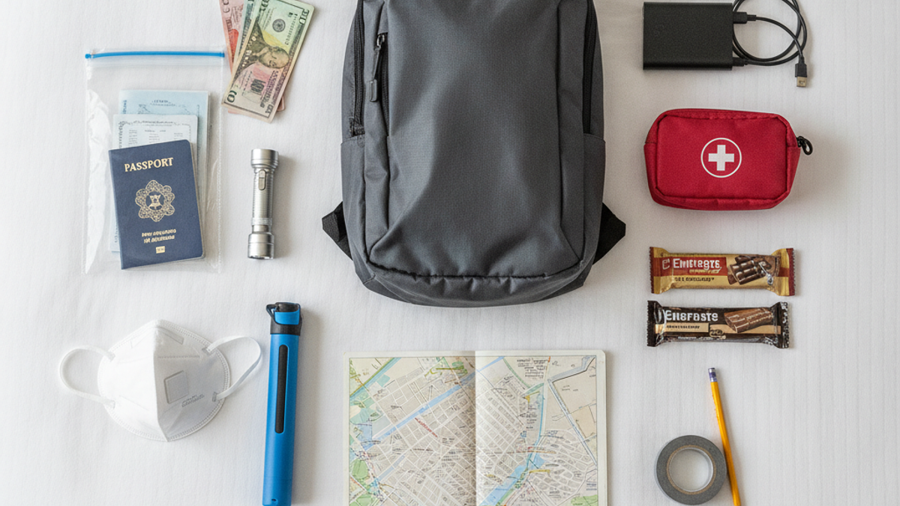
The core constraint is simple: no blades over 4 inches in checked bags without declaration, no blades at all in carry-on, no flammable fuel, no self-defense sprays in the cabin (4 oz or less is allowed in checked luggage with a safety cap), and all liquids in carry-on limited to 3.4 ounces. Everything else in a serious travel kit is legal.
Water. Dehydration kills faster than hunger, and municipal water is the first utility to fail after a quake or flood. A Sawyer MINI water filtration system weighs two ounces, filters 100,000 gallons to 0.1 microns, and sails through security every time. Pair it with a LifeStraw Personal water filter straw for a redundant drinking option, and carry Potable Aqua water purification tablets as chemical backup — filters handle bacteria and protozoa, but tablets add virus protection in flood-contaminated urban water. If you want a deeper dive on choosing between methods, read our guide to boiling, filtering, and chemical water purification.
Light. Hotel hallways and stairwells go pitch black in a blackout. A Black Diamond Spot headlamp gives you hands-free light with a red mode that preserves night vision and doesn't broadcast your position down a dark corridor.
Medical. An Adventure Medical Kits Ultralight Watertight first aid kit covers trauma dressings, blister care, and basic meds in a package smaller than a paperback. Add a 7-day buffer of any prescription medication in its original labeled bottle.
Food and cash. Three days of 400-calorie bars and a few electrolyte packets. Then $300–$500 in twenties, tens, and fives. During the 2021 Texas grid failure, card readers went down across the state. Cash is the only payment method that survives a power outage.
Hotel and Lodging Security: Hardening a Room You Don't Own
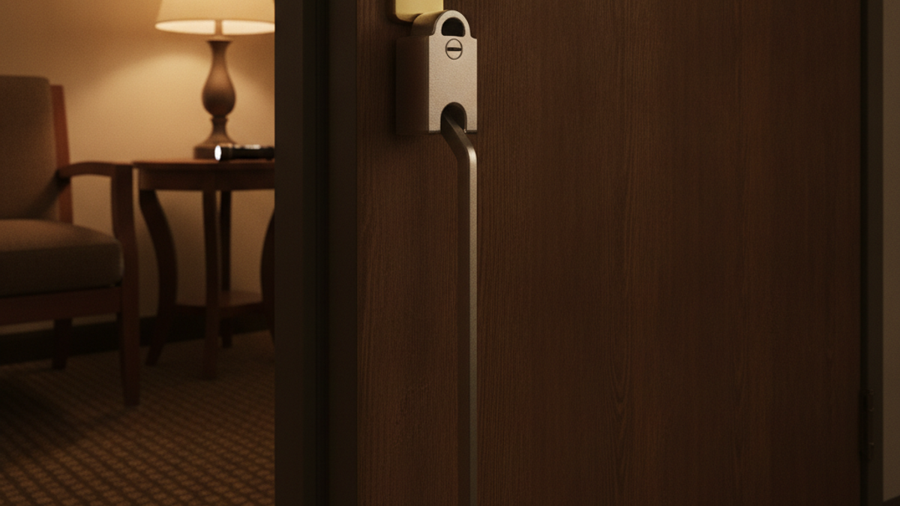
Hotel door hardware is designed for housekeeping access, not for stopping a determined intruder. Master keycards get cloned, latch bars get defeated with a rubber band and a strip of plastic. Two cheap tools fix this. An Addalock portable door lock installs in the strike plate in three seconds and cannot be overridden from outside. A Master Lock portable travel door security bar braces under the handle and buys you precious seconds to get to the window or the phone.
Fire is the bigger statistical threat. The NFPA logs roughly 3,900 hotel and motel structure fires per year in the U.S. Carbon monoxide is worse — CDC data attributes hundreds of accidental deaths annually to CO poisoning, and multiple high-profile hotel CO fatalities have traced back to faulty pool heaters and boilers in rooms with no detector at all. A Kidde portable smoke and carbon monoxide detector sits on the nightstand and weighs almost nothing.
Request a room between floors 2 and 6 — above ground-floor smash-and-grab risk, within reach of most fire department ladders. Count the doors between your room and the nearest two stairwells so you can crawl to an exit in zero visibility. If you're in a high-rise, our guide to escaping a skyscraper when elevators and power fail is worth reading before you check in.
How to Plan a Route Home When Flights Are Grounded
After 9/11, U.S. airspace was closed for roughly three days and hundreds of thousands of travelers were stranded. Assume aviation is unavailable and build from there.
Tier 1: Rental car, booked immediately — inventory evaporates within two hours of a major event. Tier 2: Rail or intercity bus, which often keeps running when airports close. Tier 3: Rideshare or a local contact willing to drive. Tier 4: On foot or by bicycle to a safer node outside the affected metro.
Carry a paper state map for every region you travel through. GPS fails when cell networks saturate — and in rural areas, coverage gaps are routine even on a normal Tuesday. Mark two highway routes and one secondary-road route home. Rural travelers face long fuel-desert stretches; urban travelers face gridlock and checkpoints. Study dead reckoning navigation for blocked roads before you need it.
Finally, set a communication protocol with family: a specific check-in time, an out-of-state relay contact, and a rally point. Text messages often get through when voice calls fail because SMS uses minimal bandwidth.
Step-by-Step Instructions
Step 1: Audit your trip for specific regional hazards
Before booking, check the hazard profile of your destination — hurricane season, wildfire corridors, seismic zones, flood plains, or areas with recent civil unrest. Pull up the local Office of Emergency Management page and note the county alert system and emergency radio frequency.
Step 2: Assemble a TSA-legal kit under five pounds
Pack water filtration, purification tablets, a compact first aid kit, a headlamp with spare batteries, 2,400 calories of bars, N95 masks, 50 feet of paracord, and a charged 10,000 mAh power bank. Keep it in a single pouch that transfers between your carry-on and a daypack.
Step 3: Secure your documents and cash redundantly
Carry a physical passport or ID, a printed copy of your itinerary, and photocopies of insurance cards. Split cash between your wallet, your bag, and a shoe or money belt. Store encrypted digital copies in cloud storage and on a USB drive.
Step 4: Harden your room within five minutes of arrival
Install the portable door lock and security bar, place the travel CO detector near the bed, locate both stairwells, and verify the window opens. Set your bag by the door, packed and ready, so you can grab and go in the dark.
Step 5: Map three independent routes home
Mark a primary interstate route, a secondary highway route, and a non-vehicle option on paper maps. Identify fuel stops, hospitals, and safe overnight points roughly every 150 miles along each.
Step 6: Establish check-in windows with family
Agree on a daily check-in time, an out-of-area relay contact, and a defined trigger — if you miss two consecutive check-ins, your family activates the plan. Share your route cards before you leave.
Step 7: Practice gray man discipline in transit
Travelers are soft targets. Dress like a local, keep gear concealed, avoid logos that mark you as a prepper or an out-of-towner, and maintain constant situational awareness in terminals, lobbies, and parking structures.
Frequently Asked Questions
What can I legally pack in a travel survival kit for a flight?
Water filters, purification tablets, first aid supplies, headlamps, paracord, food bars, masks, and multi-tools without blades are all carry-on legal. Knives, multi-tools with blades, and pepper spray (4 oz or less) must go in checked baggage. Always verify current TSA rules before departure — they change.
How far can I realistically walk home if transportation collapses?
An unconditioned adult covers about 10–15 miles a day on pavement with a light pack; a conditioned one with proper footwear can manage 20. That makes walking viable for 50–100 mile distances, not 1,000. For long distances, your plan must be vehicle-based with walking only as a bridge to the next transport node. Building that fitness in advance through rucking pays off here.
Is a hotel safer than driving during a regional disaster?
Usually yes, for the first 24–48 hours. Roads after earthquakes, hurricanes, and major unrest are the most dangerous place to be. A hardened hotel room with water, food, and light is a legitimate shelter-in-place position. Move once conditions stabilize and you have current, verified route intelligence.
Affiliate Disclosure: SHTFPlan.net participates in the Amazon Services LLC Associates Program. Some links are affiliate links — we may earn a small commission at no extra cost to you.