The Prepper's Guide to Wildfire Defensible Space: How to Harden Your Property Before Flames Arrive
When wildfire threatens, your yard is your first line of defense. Learn how to create defensible space that gives your home a fighting chance.
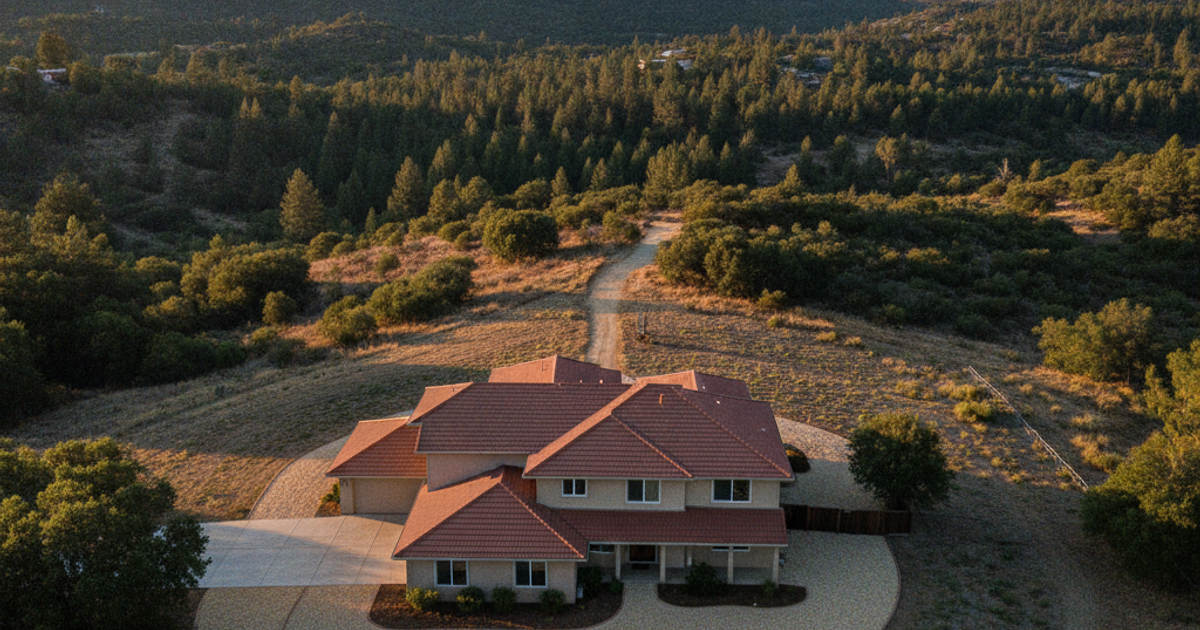
Wildfires don't discriminate. They consume subdivisions, rural homesteads, and everything in between. According to the National Interagency Fire Center, more than 68,000 wildfires burn an average of 7 million acres annually in the United States — and the trend is accelerating. What separates homes that survive from homes that don't is rarely luck. Research from the Insurance Institute for Business and Home Safety (IBHS) consistently shows that homes with fire-resistant construction and properly maintained defensible space have dramatically higher survival rates when wildfires pass through. The good news: whether you own a suburban quarter-acre or a rural 40-acre spread, there are concrete, affordable steps you can take right now to harden your property before fire season arrives.
If a wildfire is already bearing down and evacuation is the only option, understanding the psychology of that decision is critical — read our guide on Wildfire Evacuation Psychology: How to Override Panic and Make Life-Saving Decisions Under Extreme Stress for insight on how to think clearly when seconds count. But this article is about what you do before that moment — building your property's defenses while you still have time.
Why Embers Are the Real Threat — Not the Flame Front
Most people picture wildfire as a wall of flame that rolls up to a house and engulfs it. The reality is more insidious. Studies from the USDA Forest Service and Cal Fire indicate that embers — burning firebrands carried on the wind — are responsible for the majority of home ignitions during wildfires. Embers can travel a mile or more ahead of the main fire front, landing on dry debris in gutters, on wood decks, in gaps around vents, and against wood fences. Your home can ignite from embers while the fire is still blocks or miles away.
This means ember-proofing — not just clearing brush — is the foundation of any serious wildfire hardening strategy. Every gap, every pile of debris, every combustible surface near your home is a potential ignition point waiting to be activated by a single floating ember.
What You'll Need
Tools
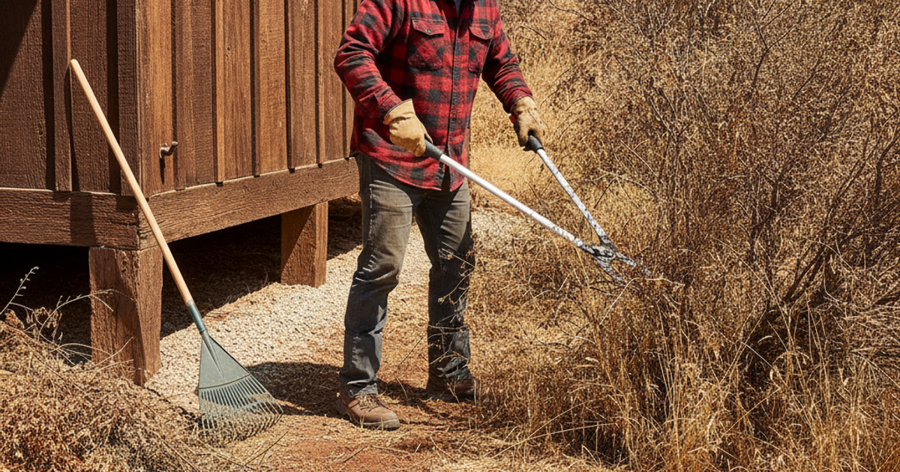
- Fiskars heavy duty loppers for brush clearing
- Corona extendable pruning saw for limb removal
- DeWalt cordless leaf blower for debris clearing
- Heavy-duty garden rake
- Flat shovel
Supplies
- Amerimax gutter guard ember protection mesh
- Scotts EZ Seed drought-tolerant fire-resistant grass
- Orbit B-hyve smart sprinkler controller for fire protection
- Hardware cloth (1/8-inch mesh) for vent screening
- Non-combustible mulch (gravel, rock, or decomposed granite)
Understanding the Three Zones of Defensible Space
Fire agencies and researchers universally organize defensible space into concentric zones around a structure. Each zone has different requirements and serves a different purpose in your fire defense strategy.
Zone 1 — The Home Ignition Zone (0 to 30 Feet)
This is the most critical area. Within 30 feet of your home, the goal is to eliminate all easily ignitable fuels and create conditions that give the structure its best chance of surviving ember showers. The IBHS refers to this as the "home ignition zone" — the area where embers land and smolder, eventually reaching the structure itself. In this zone, all dead vegetation must be removed immediately. Firewood stacks should be relocated outside this zone or stored in an enclosed, non-combustible space. Combustible patio furniture, doormats, and outdoor cushions should be brought inside or removed before fire season. Replace wood mulch within five feet of the foundation with non-combustible material such as gravel or decomposed granite — this single change significantly reduces the ignition pathway between the ground surface and your siding.
For suburban and urban homeowners with small lots, Zone 1 may encompass most or all of your property. That's fine — concentrate your effort here first. Even apartment dwellers should consider their balconies as a micro-version of Zone 1: clear all dead plants, combustible storage, and debris from any exterior space.
Zone 2 — The Transition Zone (30 to 100 Feet)
In Zone 2, the goal is to interrupt fire's ability to travel from the wildland into Zone 1. Vegetation should be managed so that fire stays low and loses intensity. Trees should be limbed up so the lowest branches are 6 to 10 feet off the ground — this prevents a ground fire from "laddering" up into the crown. Shrubs should be spaced so they are not continuous fuel. Mow grasses to no higher than four inches during fire season. Rural preppers with significant acreage will spend the majority of their labor in this zone; suburban homeowners may find Zone 2 extends into neighboring properties or public rights-of-way, which presents a different challenge requiring community coordination.
Zone 3 — Extended Defense (100 Feet and Beyond for Rural Properties)
On rural properties, fire management beyond 100 feet focuses on reducing overall fuel loads: removing dead trees and snags, thinning dense forest stands, and maintaining firebreaks or fuel breaks that deny fast-moving fire a continuous fuel path toward your home. This zone is primarily the concern of rural and exurban property owners.
Step-by-Step Instructions
Step 1: Assess Your Property for Fire Vulnerability Before Doing Anything Else
Walk the perimeter of your home with fresh eyes and a notepad. Identify every combustible material within 30 feet: wood mulch, propane tanks, firewood, dead shrubs, wood fencing, deck furniture, and debris. Note all exterior vents, gaps under eaves, and junction points where different materials meet. This assessment is your work order — do not skip it. Many states publish free wildfire home assessment checklists (California's IBHS Wildfire Prepared Home program is one of the best) that you can use as a scoring guide.
Step 2: Clear Dead Vegetation and Combustible Debris from Zone 1
Begin at the foundation and work outward. Remove all dead plant material, leaf litter, dry grass, and accumulated debris from within 30 feet of the structure. Pay special attention to beneath wood decks and porches — these are notorious ember traps. A DeWalt cordless leaf blower makes clearing gutters, decks, and tight spaces far faster than raking alone, and since it runs on battery power, you can use it anywhere on your property without extension cord limitations.
Step 3: Ember-Proof Your Gutters and Roof Assembly
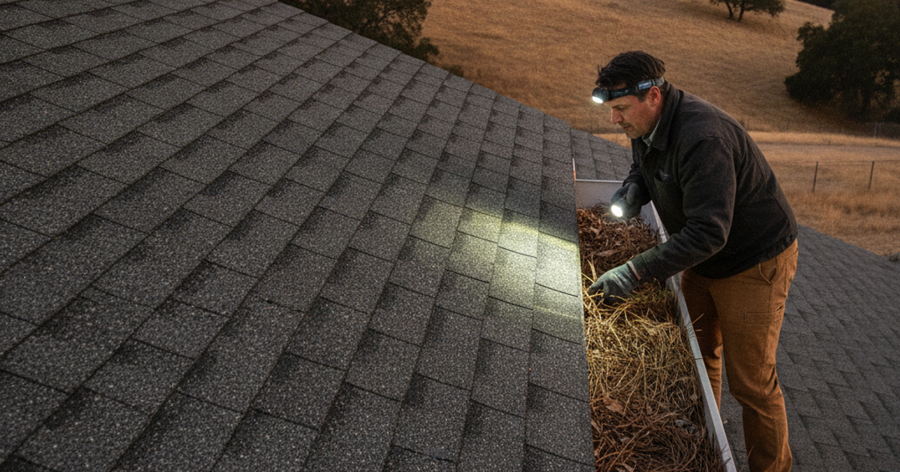
Clean gutters thoroughly and install a quality ember-blocking gutter guard. Amerimax gutter guard ember protection mesh is an excellent option for keeping burning debris out of your gutters while still allowing water to flow freely. Inspect your roof for wood shake shingles (replace with Class A materials if possible), and check all roof-to-wall junctions, skylights, and chimney connections for gaps where embers could infiltrate. A spark arrestor on the chimney is non-negotiable in fire-prone areas.
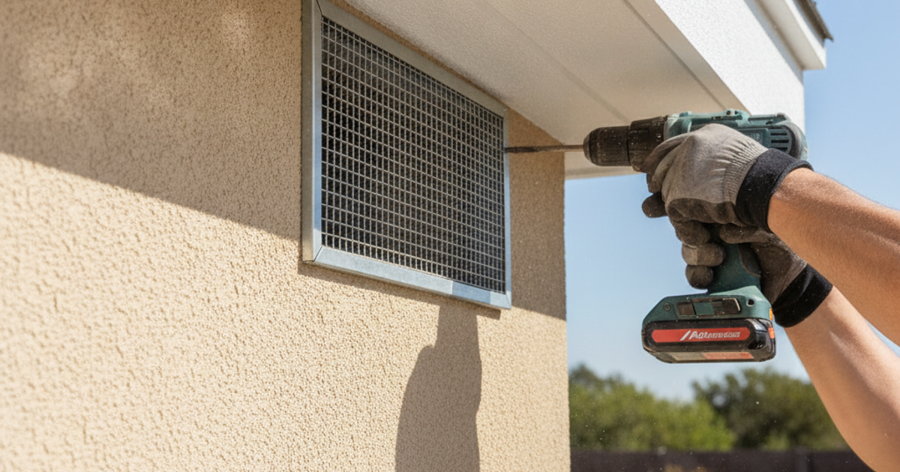
Step 4: Screen All Vents with 1/8-Inch Hardware Cloth
Foundation vents, attic vents, and under-eave vents are direct pathways for embers to enter your home's interior. Replace or cover existing vent screens with 1/8-inch mesh hardware cloth — this is the mesh size that blocks the embers most likely to cause ignition. If your home has older louvered vents, check whether they are ember-resistant rated; if not, replace them. This is one of the highest-value improvements you can make per dollar spent.
Step 5: Remove and Replace Flammable Vegetation in Zone 1
Certain plants are dramatically more combustible than others. Juniper, arborvitae, ornamental grasses, and rosemary contain resins and oils that make them highly ignitable. Remove these from within 30 feet of the structure. Replace them with low-water, low-resin alternatives such as succulents, ice plant, or fire-resistant sod. Scotts EZ Seed drought-tolerant fire-resistant grass is a practical choice for creating a low-fuel lawn around the structure that can be kept mowed and irrigated without excessive water use.
Step 6: Prune Trees and Cut Back Shrubs in Zone 2
Use a quality pruning saw for larger limbs — the Corona extendable pruning saw allows you to reach high branches safely from the ground without ladders, making the job of limbing up trees significantly less dangerous. For heavy brush and overgrown shrubs, Fiskars heavy duty loppers provide the cutting power needed for stems up to two inches in diameter without fatigue. Work systematically through the zone, limbing trees to 6-10 feet, removing dead shrubs, and creating horizontal separation between plant groupings.
Step 7: Install or Upgrade Your Irrigation System for Pre-Fire Wetting
One of the most effective last-minute fire defenses is wetting your property before a fire front arrives — but only if you have the water supply and time to do so safely. A smart sprinkler controller like the Orbit B-hyve smart sprinkler controller allows you to activate your entire irrigation system remotely from a smartphone, meaning you can begin saturating your property as you evacuate without having to physically set each zone manually. This type of system also enables precise scheduling to maintain vegetation moisture throughout fire season.
Step 8: Seal, Harden, and Secure the Structure's Exterior Attachment Points
Inspect every point where combustible materials attach to the structure: wood fences connected directly to the house, wood decks, combustible lattice, and wood siding that reaches close to the ground. Break the fence-to-house connection by installing a non-combustible metal or masonry section at the point where the fence meets the exterior wall. Coat exposed wood deck surfaces and siding with fire-retardant paint or sealant. Ensure that any propane tanks are at least 10 feet from the structure and shielded from radiant heat.
Ember-Proofing for Apartment and Condo Residents
If you don't own a house, you're not off the hook — and you're not powerless either. Apartment and condo dwellers in wildfire-prone regions should focus on a few key actions. Clear all combustible materials from balconies and patios. Know your building's construction type — concrete and steel buildings are dramatically more fire-resistant than wood-frame construction. If smoke penetration is a concern during nearby wildfires, sealing gaps around doors and windows and running HEPA air filtration inside are critical measures. Check out our detailed guide on Wildfire Smoke and Toxic Air: How to Filter Indoor Air and Protect Your Lungs When SHTF for room-by-room strategies.
When working outdoors during fire season or wildfire smoke events, protect your lungs with a quality respirator. A 3M P100 respirator provides genuine filtration against fine particulate matter — far superior to paper dust masks or cloth coverings, which offer negligible protection against the ultrafine particles produced by wildfire combustion.
Fire Pit and Outdoor Fire Feature Safety
Outdoor fire features — fire pits, chimineas, and wood-burning grills — are ignition hazards when not properly managed. All outdoor fires should have a quality ember screen in place. The Landmann fire pit ember screen and spark arrestor is designed specifically to contain flying embers from recreational fire pits, reducing the risk of escaped sparks igniting nearby dry vegetation. During red flag conditions — high winds, low humidity, high temperatures — suspend all outdoor burning entirely, regardless of local regulations.
Coordinating with Neighbors and the Community
Defensible space has a collective dimension that solo preparedness often ignores. A property that is thoroughly hardened can still be threatened if adjacent properties are overgrown and unmanaged. Wildfire preparedness is one area where community coordination is not optional — it's survival strategy. Organize a neighborhood vegetation management day, share information about fire-resistant landscaping, and consider coordinating with local fire departments that often offer free home assessments. For preppers thinking about broader community resilience, our article on Neighborhood Mutual Aid Networks: How to Build a Community Survival Team Before SHTF covers how to organize your immediate community before any disaster strikes.
Recommended Gear Summary
To round out your wildfire hardening toolkit: the Fiskars heavy duty loppers and Corona extendable pruning saw will handle the bulk of your vegetation work. The Amerimax gutter guard addresses one of the most critical ember entry points on any structure. The Orbit B-hyve smart sprinkler controller gives you remote irrigation capability that can be activated as you evacuate. The Scotts EZ Seed helps you establish low-fuel ground cover that replaces high-risk ornamentals. The Landmann ember screen keeps recreational fires contained. And the 3M P100 respirator protects your lungs throughout the work and during any subsequent smoke events. If you're putting together your complete emergency preparedness plan, also visit our Recommended Survival Gear & Equipment page for a broader selection of vetted gear.
Also worth reviewing before wildfire season: our Wildfire Evacuation Bag: What to Pack When You Have 15 Minutes to Leave covers exactly what needs to be ready to go when you can't stay and defend.
Frequently Asked Questions
How far does defensible space need to extend around my home to actually protect it?
Most fire agencies and researchers recommend a minimum of 100 feet of managed defensible space, broken into two zones (0–30 feet and 30–100 feet), each with specific vegetation and fuel management requirements. However, slope dramatically affects this calculation — on steep terrain, fire travels faster and generates more radiant heat, meaning effective defensible space may need to extend further downslope. If your property is smaller than 100 feet in any direction, manage every inch of it as aggressively as possible and focus intensively on ember-proofing the structure itself, which research shows to be the most effective survival factor when space is limited.
What plants are considered fire-resistant for landscaping in wildfire-prone areas?
Fire-resistant plants share several characteristics: they have high moisture content, low resin or oil content, and fine-textured or sparse foliage that doesn't accumulate dead material. Good examples include succulents (sedum, aloe, agave), ice plant, lavender (when kept well-irrigated and maintained), native bunch grasses in green condition, and many ornamental sages when properly pruned. Avoid juniper, arborvitae, Italian cypress, pampas grass, and rosemary within Zone 1 — these species ignite aggressively and are among the most common contributors to home ignitions. Local fire agencies and extension services publish region-specific plant lists that are more accurate than general recommendations.
Can I really protect my home from wildfire if I only have a small suburban lot?
Yes — and research bears this out. IBHS studies of homes that survived wildfires in California and Colorado found that the condition of the structure itself (ember-resistant vents, non-combustible roofing, sealed gaps) was the single most important factor in survival, often more important than the amount of space available. Suburban homeowners with limited land should prioritize: replacing any wood shake roofing, installing 1/8-inch mesh vent screens, clearing gutters and installing gutter guards, removing combustibles from within five feet of the foundation, and ensuring there is no continuous combustible path from the fence line to the house. These steps are achievable on any lot size and make a measurable difference in survivability.
Affiliate Disclosure: SHTFPlan.net participates in the Amazon Services LLC Associates Program. Some links are affiliate links — we may earn a small commission at no extra cost to you.