Wildfire Evacuation Psychology: How to Override Panic and Make Life-Saving Decisions Under Extreme Stress
When fire is racing toward your home, panic kills. Here's how to train your brain to stay sharp and act fast when every second counts.
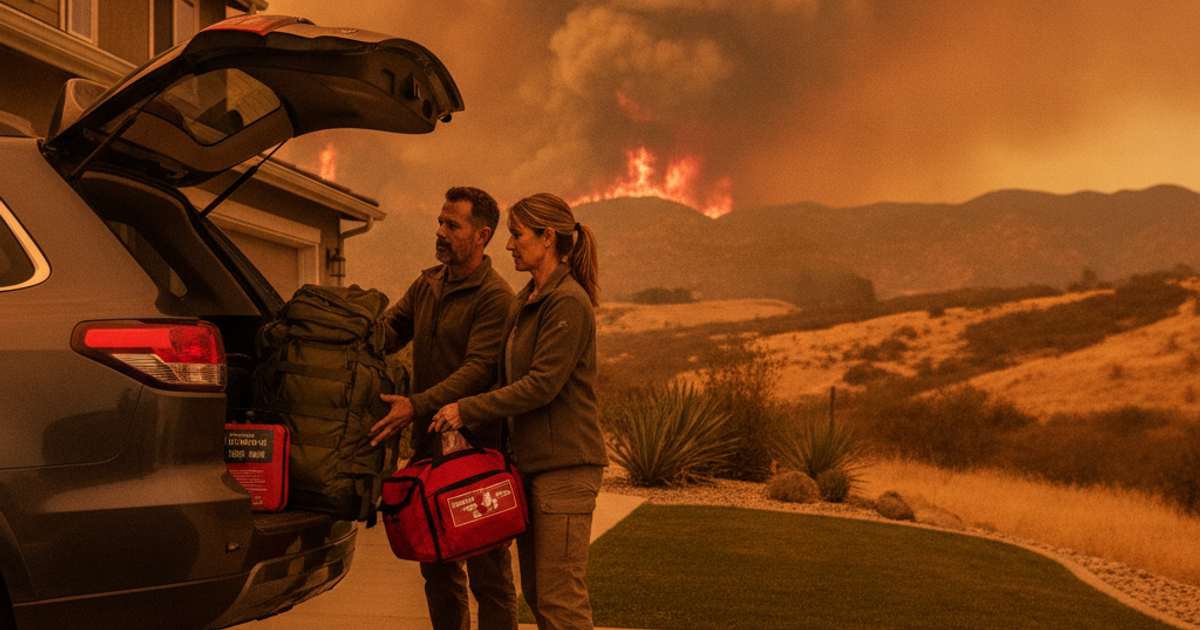
When the sky turns orange and embers start falling in your neighborhood, the difference between life and death often comes down to a single factor: your ability to think clearly under extreme stress. Wildfire evacuations kill people not just because of the fire itself, but because of what panic does to the human brain. Understanding that psychology — and training yourself to override it — may be the most critical survival skill you develop as a prepper.
Research published in the journal Risk Analysis found that delayed evacuation decisions are one of the leading contributors to wildfire fatalities. People wait too long, freeze up, or make irrational last-minute choices when they finally do act. A 2018 Camp Fire study showed that the majority of the 85 people who died had vehicles and functional escape routes — the problem wasn't physical, it was cognitive. Panic had already consumed them.
This applies whether you live in a rural cabin surrounded by timber, a suburban tract home with a brush-covered hillside behind it, or an urban apartment near wildland-urban interface zones. Fire doesn't discriminate, and neither does the stress response it triggers.
What the Brain Does Under Extreme Stress — and Why It Works Against You
When your brain perceives a life-threatening situation, the amygdala — your brain's threat-detection center — hijacks rational thought. Cortisol and adrenaline flood your system. Your heart rate spikes. Blood flow shifts away from the prefrontal cortex (responsible for planning, decision-making, and impulse control) toward the muscles and survival reflexes. This is the fight-or-flight-freeze response, and in a wildfire scenario, it can be catastrophically counterproductive.
Common cognitive failures under fire-related stress include:
- Normalcy bias — Refusing to believe the threat is real until it's too late to safely act
- Analysis paralysis — Becoming overwhelmed by options and failing to choose any
- Milling behavior — Seeking social confirmation before acting, even when seconds matter
- Task fixation — Becoming obsessed with retrieving non-essential items at the expense of safe egress
- Tunnel vision — Losing situational awareness and focusing narrowly on one threat while missing others
Recognizing these failure modes in advance is the first step to defeating them. Situational awareness — a core prepper discipline — doesn't stop being important just because chaos is unfolding. In fact, it becomes more important.
Stress Inoculation: Training Your Brain for High-Pressure Disaster Scenarios
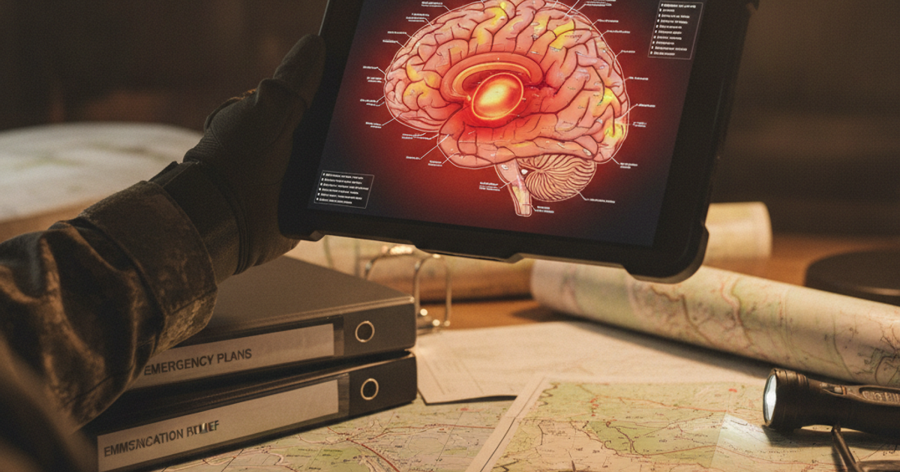
Military and emergency response professionals have long used a technique called stress inoculation training (SIT) to prepare personnel for high-stakes decision-making. The concept is straightforward: expose yourself to controlled, escalating stress scenarios so that your nervous system becomes accustomed to functioning under pressure. The goal isn't to eliminate stress — that's impossible — but to reduce the gap between your trained behavior and your panicked behavior.
For civilian emergency preparedness, stress inoculation looks like this:
- Running timed evacuation drills — not casual walkthroughs, but actual timed exercises under mild physical stress
- Practicing loading your bug out bag in the dark, in under five minutes
- Rehearsing your evacuation routes in different weather and traffic conditions
- Conducting mental simulations — vivid, detailed "what if" scenarios — to pre-load decision trees in your brain
- Learning and practicing tactical breathing to rapidly lower your heart rate mid-crisis
Tactical breathing (also called box breathing or 4-4-4-4 breathing) is particularly powerful. Inhale for four counts, hold for four, exhale for four, hold for four. This technique directly stimulates the parasympathetic nervous system, slowing the stress response and restoring access to rational thought. Special operations units use it before and during high-stakes missions. You can use it the moment you smell smoke.
Ongoing mental health practices also strengthen your baseline stress tolerance. Many preppers have found that consistent mindfulness practice dramatically improves their ability to stay calm under pressure. A Headspace meditation app gift card makes an excellent addition to your preparedness toolkit — not just as a gift for someone in your group, but as a genuine investment in the mental hardware you'll depend on when things go sideways.
Pre-Decision Making: The Power of the "Already Decided" Framework
One of the most effective psychological strategies for wildfire evacuation is to eliminate as many in-the-moment decisions as possible before the emergency happens. Cognitive load under stress is finite. Every decision you force yourself to make during a crisis drains your capacity for the next one. The solution is to pre-decide everything you possibly can.
Create what emergency psychologists call a decision threshold: a specific trigger condition that automatically initiates your evacuation. For example: "If a mandatory evacuation order is issued within 20 miles," or "If I can see smoke on the ridge to the north," you leave — no deliberation, no negotiation with yourself. The decision has already been made. You're simply executing a plan.
Document your complete evacuation plan in a dedicated notebook. A Moleskine emergency planning notebook is a practical choice — durable, compact, and easy to grab with your gear. Write down your trigger conditions, your primary and alternate evacuation routes, rally points for family members who may be separated, and your destination options. Review it regularly. The more familiar it becomes, the more automatically your brain will access it under stress.
The Role of Early Warning Systems in Reducing Panic

Panic is often a function of surprise. The less warning you have, the more your brain interprets the situation as uncontrollable — and that perception of uncontrollability is what causes psychological shutdown. The antidote is a layered early warning system that gives you maximum lead time.
A Midland WR120B NOAA weather alert radio is one of the most important pieces of equipment a prepper can own. It receives direct government alerts — including Red Flag Warnings and evacuation notices — even when cell networks are congested or down, which is common during major wildfire events. Place it in your bedroom so it can wake you during nighttime fire events, which are among the most dangerous precisely because of delayed detection.
For communication when infrastructure collapses entirely, a BaoFeng UV-5R emergency ham radio allows you to monitor local emergency frequencies and communicate with your group when cell towers are overwhelmed or destroyed. Pair this with a family communication plan, and you significantly reduce the chaos that fuels panic. For more on building redundant communication systems, see our article on how to build a layered emergency communication plan that works without cell service.
If you live in a remote rural area or plan to evacuate through backcountry terrain, a Garmin inReach Mini satellite communicator gives you two-way satellite messaging and SOS capability that works anywhere on Earth, completely independent of cell networks. This device alone can be the difference between a controlled evacuation and a desperate, isolated situation.
Managing Group Dynamics and Family Panic During Evacuation
Individual panic is difficult enough. Group panic is exponentially more dangerous. When multiple people are frightened simultaneously, they amplify each other's fear through emotional contagion — a well-documented psychological phenomenon where stress responses spread through social groups like a contagion.
As the prepared member of your household, your role during an evacuation is partly tactical and partly psychological. Calm, decisive leadership is contagious in the same way panic is. Speak slowly and clearly. Use names. Give specific, simple instructions rather than open-ended questions. "Get your bag and get in the car" is far more effective than "What should we do?" Avoid catastrophizing language. Acknowledge the danger without amplifying it.
Pre-assign roles to every household member. Children, elderly family members, and individuals with disabilities all need specific, pre-rehearsed roles that match their capabilities. When everyone knows their job before the crisis begins, the cognitive and emotional load of the evacuation drops dramatically for everyone involved. For deeper guidance on the psychological aftermath of trauma, our article on psychological first aid for trauma survivors when mental health services are gone provides essential context for both pre- and post-event mental health management.
What You'll Need
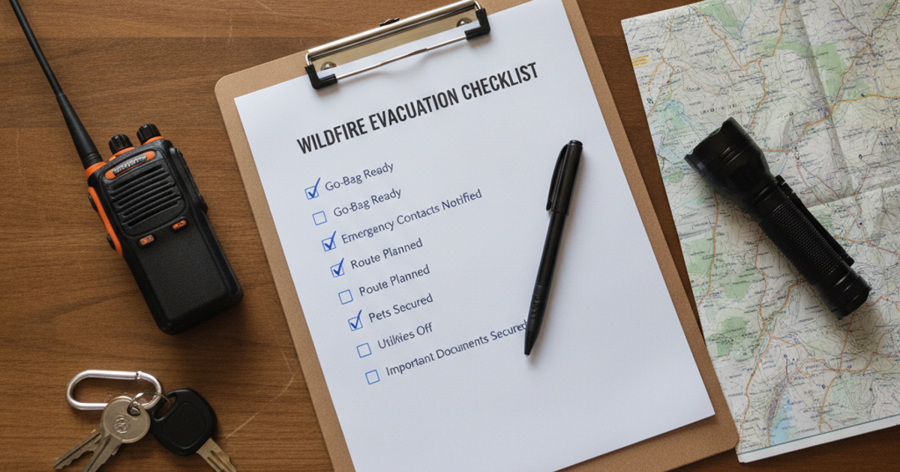
Tools
- Midland WR120B NOAA weather alert radio
- Garmin inReach Mini satellite communicator
- BaoFeng UV-5R emergency ham radio
Supplies
- 5.11 Tactical RUSH72 bug out bag
- Ready America 72-hour emergency kit
- First Aid Only emergency first aid kit
- Moleskine emergency planning notebook
Step-by-Step Instructions
Step 1: Establish Pre-Determined Evacuation Trigger Conditions
Sit down before wildfire season and write out specific, observable conditions that will trigger your automatic evacuation — no debate, no hesitation. Examples include: any mandatory evacuation order within your county, visible smoke within five miles, or air quality index above a certain threshold. Posting these triggers on your refrigerator or inside your emergency notebook ensures they're accessible to every household member, not just in your head.
Step 2: Build and Pre-Load Your Bug Out Bag Before Fire Season
A pre-packed bug out bag eliminates one of the most dangerous panic behaviors: frantically gathering random items under time pressure. The 5.11 Tactical RUSH72 backpack offers military-grade construction with enough capacity for a 72-hour load-out for one person. Pack it, seal it, and put it somewhere you can grab it within thirty seconds. For apartment dwellers, keep it near your front door or in your car's trunk. Also ensure a compact First Aid Only emergency kit is included — injuries during chaotic evacuations are far more common than people expect.
Step 3: Practice Tactical Breathing to Restore Cognitive Function Mid-Crisis
When you notice your heart pounding and your thoughts racing, stop movement for fifteen seconds and execute box breathing: inhale for four counts, hold for four, exhale for four, hold for four. Repeat three to four cycles. This physiological intervention directly counteracts the stress hormone cascade and restores access to your prefrontal cortex — the part of your brain responsible for the decisions that will keep you alive. Practice this weekly so it becomes automatic under pressure.
Step 4: Conduct Timed Evacuation Drills at Irregular Intervals
Schedule two to four evacuation drills per year, and don't announce them all in advance. Set a timer for fifteen minutes — the realistic window you may have in a fast-moving fire — and require every household member to be ready to leave with bags in hand before the timer expires. Debrief afterward: what took too long, what was forgotten, what created confusion. Each drill is a rehearsal that builds the neural pathways your brain will follow under actual stress.
Step 5: Map and Drive Multiple Evacuation Routes in Advance
Your primary evacuation route may be blocked by fire, downed power lines, or gridlocked traffic. Identify at least three routes out of your area — including backroads that most people don't know — and physically drive each one. Note fuel stations, bridge chokepoints, and alternate rally points. For navigation when GPS is congested or fails, print physical maps and store them in your vehicle. Consult our guide on land navigation using a topographic map and compass when GPS fails for essential backup navigation skills.
Step 6: Establish a Family Communication and Reunion Protocol
If an evacuation order hits while family members are at work, school, or elsewhere, you need a pre-established protocol for where to go and how to communicate. Designate an out-of-area contact who can relay messages between separated family members. Identify two reunion points: one near your home and one outside your immediate area. Program these into every family member's phone — and write them in your emergency notebook in case phones die. A Ready America 72-hour emergency kit kept in your vehicle ensures that even if you can't reach home first, you have critical supplies already in your car.
Step 7: Implement an Early Warning Monitoring System
Program your phone to receive Wireless Emergency Alerts and local county alerts. Place your NOAA weather alert radio in your bedroom. Monitor local fire agency social media and scanner apps during elevated risk periods. The earlier you receive warning, the more time you have to act calmly — and calm, early action is always safer than frantic, late action. Every hour of additional lead time reduces both the physical danger and the psychological pressure exponentially.
Step 8: Build Daily Stress Resilience Through Deliberate Mental Practice
Wildfire psychology preparedness isn't only about what you do during the event — it's about the mental conditioning you build beforehand. Regular physical exercise, adequate sleep, and mindfulness practice all directly improve your stress tolerance and cognitive function under pressure. Run scenario simulations in your head regularly: "If I smell smoke right now, what are the first three things I do?" The brain treats vivid mental rehearsal as partial real-world experience, building genuine neural pathways for emergency response. For additional mental resilience strategies, our article on how to stay calm and make smart decisions when a crisis hits covers a broad range of pressure-management techniques applicable to any SHTF scenario.
Recommended Gear
In addition to the items mentioned above, consider keeping a comprehensive evacuation kit in your vehicle at all times during wildfire season. The Ready America 72-hour emergency kit includes food, water, light, and basic first aid in a compact package that fits in a car trunk without taking up significant space — a practical option for apartment dwellers and suburban residents who may not have space for a full home stockpile. Pair it with a dedicated survival kit tailored to your specific geographic risks.
For those who want to build serious psychological resilience as part of their ongoing emergency preparedness practice, investing in a Headspace meditation app gift card offers a structured, research-backed approach to mindfulness and stress reduction. Studies from Carnegie Mellon University found that just 25 minutes of mindfulness meditation over three days significantly reduced psychological stress. For preppers, this is not soft advice — it's biological optimization for high-performance decision-making under threat.
Also consider our comprehensive guide to what to pack in your wildfire evacuation bag when you have 15 minutes to leave, which covers the physical gear side of evacuation in granular detail and pairs directly with the psychological framework covered here.
Frequently Asked Questions
How do I stop panicking during a wildfire evacuation?
The most effective immediate intervention is tactical breathing — inhale for four counts, hold four, exhale four, hold four. This physiologically interrupts the panic response by activating the parasympathetic nervous system. Beyond the moment, the most powerful anti-panic tool is advance preparation: pre-made decisions, rehearsed evacuation plans, and familiarity with your routes eliminate the cognitive overload that turns stress into paralysis. Preparation doesn't just give you tools — it gives you confidence, and confidence is the antidote to panic.
What is the biggest psychological mistake people make during wildfire evacuations?
Normalcy bias — the tendency to underestimate the severity of a threat and delay action — is responsible for more wildfire deaths than almost any other single factor. People see smoke, tell themselves it's probably fine, check social media instead of acting, and wait for definitive confirmation that never comes in time. The solution is to pre-establish evacuation triggers so that the decision is made before the crisis, not during it. When the trigger condition is met, you act. No deliberation required.
How do I keep my kids calm during a wildfire evacuation without lying to them?
Children take powerful emotional cues from the adults around them. Your calm, purposeful demeanor is the single most effective tool for keeping children regulated. Use age-appropriate honesty: "There's a fire nearby and we're going to go somewhere safe — here's what we're going to do." Give children specific, manageable jobs — carrying their own bag, holding the dog's leash, or watching for the next street sign — because a sense of purpose dramatically reduces fear. Pre-rehearsing evacuations as family drills (rather than first experiencing them as real emergencies) is the most powerful long-term preparation you can give your children.
Affiliate Disclosure: SHTFPlan.net participates in the Amazon Services LLC Associates Program. Some links are affiliate links — we may earn a small commission at no extra cost to you.