Corded, Wireless, and Wearable: How to Choose the Best Personal Alarm and Alert System for Home Security When SHTF
When police response times stretch to hours—or never come—your early warning system becomes your first line of defense. Here's how to choose and deploy the right alerts.
When the grid goes down, civil unrest spikes, or a natural disaster isolates your neighborhood, the assumption that someone is coming to help can get you killed. Average police response times in the United States sit around 10 minutes in urban areas — and in rural counties, that number can exceed 30 to 45 minutes under normal conditions. In a true SHTF scenario, that response may never come at all. Your perimeter, your early warning system, and your reaction time are the only things standing between your family and a threat that has already crossed your threshold.
Personal alarm and alert systems — ranging from simple door sensors to solar-powered cameras and wearable panic alarms — are one of the most underrated layers in any emergency preparedness strategy. They don't require law enforcement. They don't require cell service. And many of them work completely off-grid. Whether you live in a high-rise apartment in Chicago, a suburb of Dallas, or on 40 acres in rural Montana, there is a personal alarm configuration that fits your situation and your budget.
This guide breaks down every major category of home security alarm technology through a prepper lens, helping you build a layered alert system that buys you the most valuable commodity in any crisis: time. For additional context on how physical deterrents integrate with early warning systems, see our guide on Reinforcing Doors and Windows: How to Harden Your Home's Weakest Entry Points Before SHTF.
What You'll Need
Tools
- Screwdriver set (Phillips and flathead)
- Drill with masonry and wood bits
- Wire stripper and crimping tool (for hardwired systems)
- Multimeter (for testing power continuity)
Supplies
- Doberman Security door alarm sensor (wireless)
- Guardline wireless driveway alarm motion sensor
- SABRE personal alarm keychain (130dB)
- Noco lithium battery backup power supply
- Zip ties, mounting tape, and weatherproof silicone sealant
- Spare AA, AAA, and CR123A batteries (stockpile at least 6 months' worth)
Understanding the Three Tiers of Personal Alarm Systems
Effective home security in an off-grid or SHTF environment isn't about one magic device — it's about layered detection. Think of your alarm system in three concentric rings: outer perimeter, entry points, and personal/last-resort. Each tier catches what the previous one might miss, and together they create a detection web that's difficult to defeat without significant noise and delay.
Outer Perimeter: Driveway and Property Alarms
Your first line of defense should trigger long before anyone reaches your door. For rural preppers, this might mean a driveway a quarter mile long. For suburban dwellers, it means the edge of your yard or the gate to your property. Even apartment preppers can adapt perimeter principles to hallways, stairwells, and common entry points.
The Guardline wireless driveway alarm motion sensor is one of the most field-proven systems in this category. It uses passive infrared (PIR) detection to alert a base receiver inside your home when motion is detected up to 500 feet away, operates on battery power, and is weather-resistant enough for year-round outdoor use. Installing two or three of these units at staggered distances gives you tiered advance warning — you'll know someone is approaching long before they know you've been alerted.
For properties with gates or longer driveways, the Mighty Mule wireless gate driveway alert system is worth serious consideration. Designed specifically for rural and semi-rural properties, it provides a reliable alert signal that reaches receivers inside the home at substantial distances. This is the kind of early warning system that gives a household enough time to wake up, gear up, and position — rather than react in the dark.
For visual surveillance to complement motion alerts, the Reolink solar powered security camera with motion alert is one of the best off-grid options available. It charges via a small integrated solar panel, sends push alerts when paired with a local network, and stores footage on a microSD card — no cloud subscription, no monthly fee, no dependence on grid power. In a grid-down scenario, this camera can be paired with a portable battery bank to maintain continuous operation. Pair it with our article on Surveillance on a Budget: How to Set Up a Home Security Camera System for SHTF for a more complete camera strategy.
Entry Point Alarms: Doors, Windows, and Interior Zones
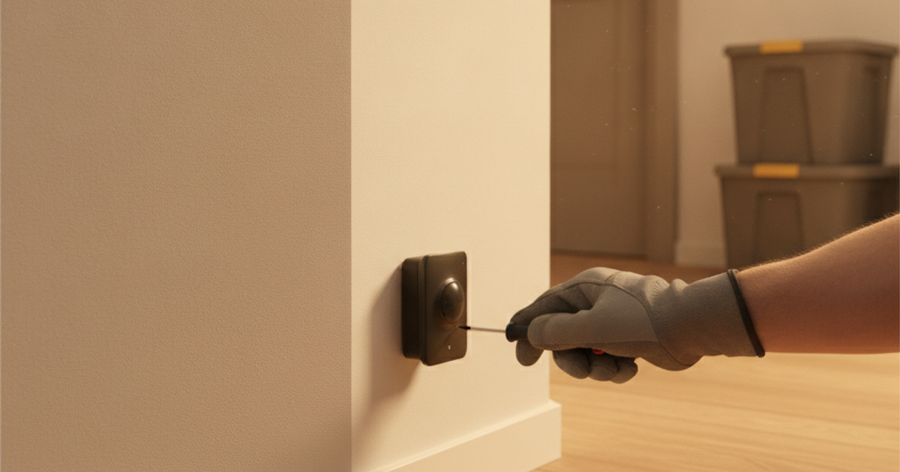
Once someone has crossed your perimeter, your next layer needs to trigger the moment they attempt entry. Door and window sensors are inexpensive, easy to install, and require zero technical expertise. A basic magnetic contact sensor splits into two halves — one on the door or window frame, one on the moving panel — and sounds an alarm or sends a signal when the connection is broken.
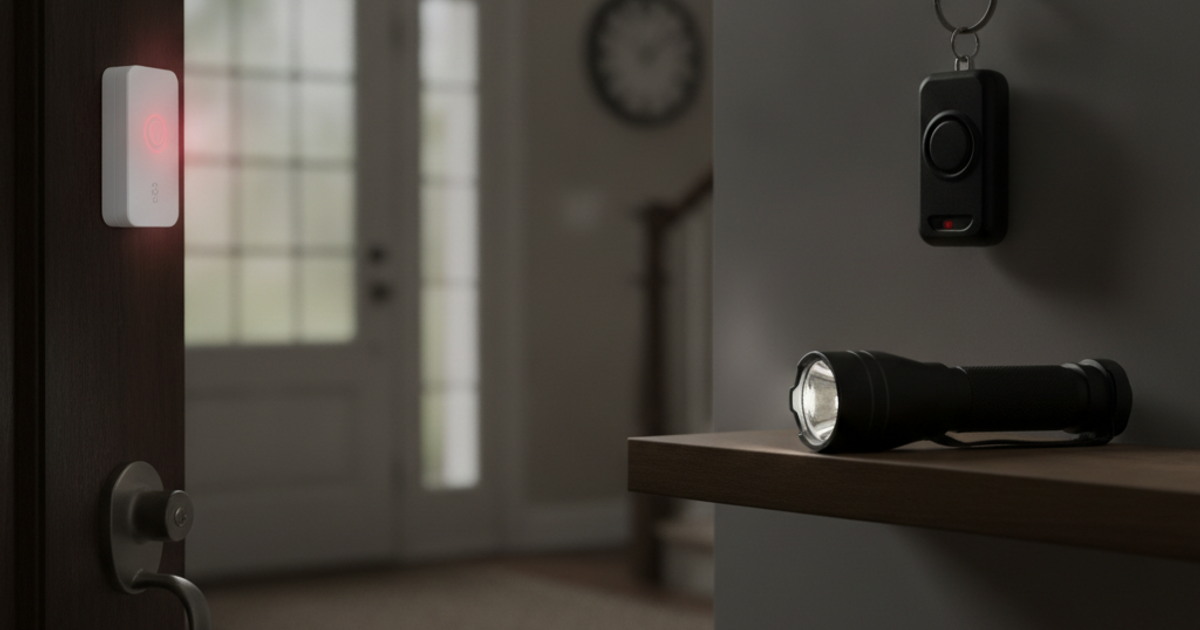
The Doberman Security door alarm sensor wireless units are a staple in the prepper community for good reason. They're self-contained (no hub required), battery-powered, loud enough to startle an intruder, and inexpensive enough to deploy on every door and window in a small home. For apartment preppers, a single unit on your front door can serve as both deterrent and alert — the 100dB alarm is enough to wake the household and announce an intrusion instantly.
For interior motion detection, the Wyze motion sensor home security kit offers an affordable smart home entry point that works locally even when internet connectivity is limited. The sensors pair with a Wyze hub and can trigger alerts, activate connected sirens, or interface with other smart devices without requiring constant cloud access. In a partial-grid scenario where local WiFi remains active but internet is down, Wyze sensors continue to function and alert — making them more resilient than most consumers realize.
For a standalone audible deterrent that needs no hub or connectivity whatsoever, a 120dB standalone siren alarm with strobe light mounted near your entry points is brutally effective. A strobe combined with a 120dB siren is disorienting to an intruder, audible to neighbors at distance, and capable of operating entirely on its own internal battery. These units are especially valuable in a layered system as a backup to sensor-triggered alerts.
Wearable and Personal Alarms: Your Last Line of Defense
Wearable personal alarms are the most portable, most personal, and most universally applicable tier of your security system. They work for the elderly, children, solo preppers, and anyone who may be vulnerable while away from their primary security setup. According to the Bureau of Justice Statistics, a significant percentage of violent crimes occur during periods when potential victims are most isolated — precisely the scenario that worsens in a SHTF environment.
The SABRE personal alarm keychain at 130dB is one of the loudest and most reliable options in this category. Activating it is as simple as pulling a pin — no fumbling with buttons under stress. The 130dB output exceeds the sound level of most power tools and is audible at distances up to 600 feet. In an urban survival scenario where you want to attract attention and deter an assailant, this device is a force multiplier that weighs almost nothing and fits on a keychain. Every member of your household — including teenagers and elderly family members — should carry one as part of their everyday carry (EDC) loadout.
Power Independence: Keeping Your System Running Off-Grid
Every alarm system in the world is worthless the moment it loses power. This is the single most overlooked failure point in prepper security planning. Your perimeter alarms, door sensors, cameras, and sirens must have a power strategy that survives a grid-down scenario — potentially for weeks or months.
Battery-powered standalone devices are your most resilient option. Stockpile quality batteries in every size your devices require and rotate them on a schedule — just as you rotate your emergency food storage. For devices that draw more consistent power (cameras, hub-based systems), a dedicated battery backup is essential. The Noco lithium battery backup power supply offers a compact, high-capacity solution that can keep low-draw security devices running for extended periods without grid power. Lithium chemistry holds a charge far longer than lead-acid alternatives and performs better in cold temperatures — critical for winter preparedness.
Solar-powered devices (like the Reolink camera mentioned above) represent the most sustainable long-term power strategy for outdoor security hardware. Pair them with our article on Prepper's Guide to Solar Panel Selection to build a more comprehensive off-grid power infrastructure that can keep your entire security system operational indefinitely.
Adapting Your System to Your Living Situation
Apartment and Urban Dwellers
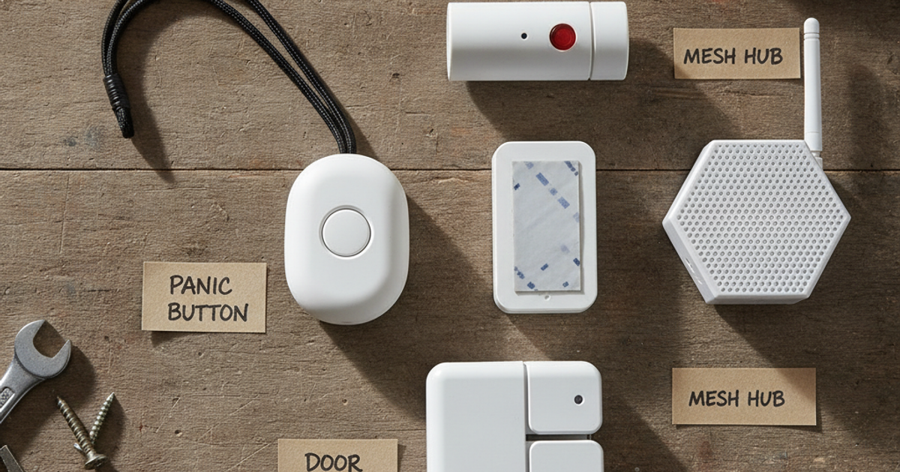
Urban preppers face unique constraints: limited installation rights, shared walls, and a higher density of potential threats. Focus on door and window sensors for your unit's entry points, a wearable personal alarm for every household member, and a standalone siren that can be triggered manually. A simple door handle alarm that activates when pressure is applied is renter-friendly and requires no drilling. Grey man principles apply here — you don't want your security setup to advertise your preparedness to neighbors who might become threats in a resource-scarce environment. Keep your visible security footprint minimal while maximizing your detection capability.
Suburban Preppers
Suburban environments offer more installation flexibility and typically more standoff distance from the street. Deploy door and window sensors on all ground-floor entry points, add a motion-sensing driveway alert for your approach, and consider a solar camera at your driveway entrance and rear yard. A standalone outdoor siren mounted under an eave and wired to your sensor system adds an audible deterrent layer. Coordinate with trusted neighbors as part of a mutual watch network — a community that communicates is exponentially more secure than isolated households. See our guide on Night Watch: How to Set Up a Rotating Security Watch Schedule for Your Survival Group for practical team security protocols.
Rural Homesteaders
Rural preppers have the most flexibility and face the longest potential response delays. Invest heavily in outer perimeter detection: multiple driveway alarm sensors at different distances, a solar camera system covering key approach vectors, and a manual alert system (air horn, bell, or radio) to wake sleeping household members. Trip wire alarms and passive IR sensors along treelines and fence lines add additional detection depth. For more on perimeter-specific techniques, read our detailed guide on Perimeter Alarms and Trip Wires: How to Detect Intruders Before They Reach Your Door.
Step-by-Step Instructions
Step 1: Map Every Entry Point and Approach Vector on Your Property
Walk the full perimeter of your home and property at different times of day, noting every door, window, gate, and natural approach path a person could use. Sketch a simple floor plan and property map marking these points. This map becomes the foundation of your alarm placement strategy and ensures you don't leave blind spots in your coverage.
Step 2: Prioritize Detection Zones by Threat Likelihood
Not all entry points carry equal risk. Ground-floor doors and windows, attached garages, and unlighted rear or side approaches are statistically more likely intrusion vectors. Rank your entry points from highest to lowest risk and allocate your best sensors to the highest-priority zones first. Budget constraints are real — prioritize coverage where it matters most and expand outward over time.
Step 3: Install Outer Perimeter Motion Sensors Along Key Approaches
Mount driveway alarm sensors (such as the Guardline unit) at the outermost detection range along your primary approach routes. Position sensors at a height of 3-4 feet aimed slightly downward to detect human-sized movement while reducing false triggers from small animals. Test each unit's range and angle before final mounting, and verify the indoor receiver activates reliably from the sensor location.
Step 4: Deploy Door and Window Sensors on All Ground-Level Entry Points
Install magnetic contact sensors on every exterior door and accessible window. Follow manufacturer instructions for alignment — most sensors require the two halves to be within a quarter inch of each other at rest. Test each sensor by opening and closing the door or window slowly, then quickly, to confirm reliable triggering. Label each zone in your receiver or hub if your system supports zone identification.
Step 5: Position Standalone Sirens and Strobe Units for Maximum Effect
Mount at least one loud standalone siren in a central location inside the home where it will wake all occupants. If your system supports exterior sirens, mount one under an eave at the front and rear of the structure — exterior sirens serve as deterrents and can attract attention from neighbors. Ensure all siren units have fresh batteries and are tested monthly.
Step 6: Establish and Distribute Power Backup for All Security Devices
Identify every device in your security system that requires power beyond a simple replaceable battery. For hubs, cameras, and receivers, connect a lithium battery backup and verify it can sustain the device for a minimum of 72 hours without charge. For solar-powered devices, confirm panel exposure and test charge cycling across a full overcast day. Document battery replacement schedules and tape them inside your gear cabinet.
Step 7: Assign Wearable Personal Alarms to Every Household Member
Issue a personal keychain alarm to every person in your household — including children old enough to use one responsibly. Demonstrate how to activate and deactivate the device, and establish a household protocol for what each person should do when they hear the alarm activated. Conduct a practice drill so the response becomes automatic under stress.
Step 8: Test the Full System End-to-End and Document Your Response Plan
Run a full end-to-end test of every component in your alarm system: trigger each sensor and verify the correct response (audible alarm, base station alert, camera notification). Time your household's response from alert to readiness. Write a simple one-page response plan covering who does what when each zone triggers, and post it in a visible location. Review and test the system quarterly.
Frequently Asked Questions

What is the best personal alarm system for someone living in an apartment with no installation rights?
Renters and apartment dwellers have several excellent options that require zero permanent installation. Self-contained door handle alarms hook over your door handle and scream when the handle is turned — no drilling required. Freestanding door wedge alarms slide under any inward-opening door and trigger when pressure is applied. Window sensors using peel-and-stick adhesive mounting (like Doberman units) leave no damage and are easily relocated. A wearable personal alarm on every household member rounds out the system. These options collectively provide solid entry-point detection and personal protection without violating any lease agreement.
How do I keep my alarm system running during a long-term power outage or grid-down scenario?
The most resilient alarm systems in a prolonged grid-down scenario are those that rely entirely on replaceable batteries or solar charging. Prioritize devices that run on standard AA, AAA, or CR123A batteries — these are widely available and easy to stockpile. Maintain at least a 6-month supply of batteries for every device in your system and rotate them on a calendar schedule. For devices requiring more sustained power (cameras, hubs), use a lithium battery backup rated for your device's draw and pair it with a small solar panel to enable self-sustaining operation. Avoid systems that are entirely cloud-dependent, as these fail completely when internet connectivity is lost.
Can personal alarms actually deter intruders, or are they just for alerting household members?
Research on criminal behavior consistently shows that noise and light are among the most effective deterrents against opportunistic intruders. A study by the University of North Carolina found that most burglars avoid homes that present higher risk of detection — and a loud audible alarm dramatically raises that perceived risk. A 120-130dB siren is physically painful at close range, disorienting, and immediately draws attention from anyone within several hundred feet. For this reason, a good alarm system serves dual purpose: it alerts your household to a threat while simultaneously increasing the intruder's perceived cost of continuing. In a SHTF environment where an intruder may be more desperate, the deterrent value of loud, visible security measures remains significant — and the advance warning time your system buys is what allows you to respond from a position of preparation rather than surprise.
Affiliate Disclosure: SHTFPlan.net participates in the Amazon Services LLC Associates Program. Some links are affiliate links — we may earn a small commission at no extra cost to you.