Formula, Diapers, and Baby Food: How to Build an Infant Emergency Stockpile That Lasts
Babies can't wait for the supply chain to recover. Here's how to build a rotating stockpile of formula, diapers, baby food, and sanitation gear that carries an infant through months of crisis.
When the grid goes down, the supply chain seizes, or a hurricane closes every road out of your county, adults can ration. We can skip meals, drink less, tolerate discomfort. An infant cannot. A three-month-old has roughly a 24-hour margin of error before dehydration becomes a medical emergency — and there is no substitute for the calories, fluid, and hygiene a baby requires every single day.
The 2022 U.S. infant formula crisis proved this isn't theoretical. After the Abbott Nutrition plant shutdown in February 2022, retail tracking firm Datasembly recorded formula out-of-stock rates above 70% nationally by late May, with some metro markets exceeding 90%. Parents drove across state lines. That happened during otherwise normal times — no blackout, no storm, no civil unrest. A genuine SHTF scenario would be far worse.
This guide walks through building an infant stockpile that actually lasts, whether you're in a 700-square-foot apartment or on 40 rural acres.
What You'll Need
Tools
- Dr. Brown's Natural Flow baby bottles set
- Munchkin Latch bottle brush and drying rack
- Philips Avent microwave steam sterilizer bags
- Camp stove or butane burner for boiling water
Supplies
- Similac 360 Total Care powder formula tub
- Enfamil NeuroPro ready-to-feed formula bottles
- Pampers Swaddlers one-month supply box
- Cloth prefold diapers and covers (24–36 minimum)
- Stored potable water — 1 gallon per person per day minimum
How Much Infant Formula Should You Stockpile?
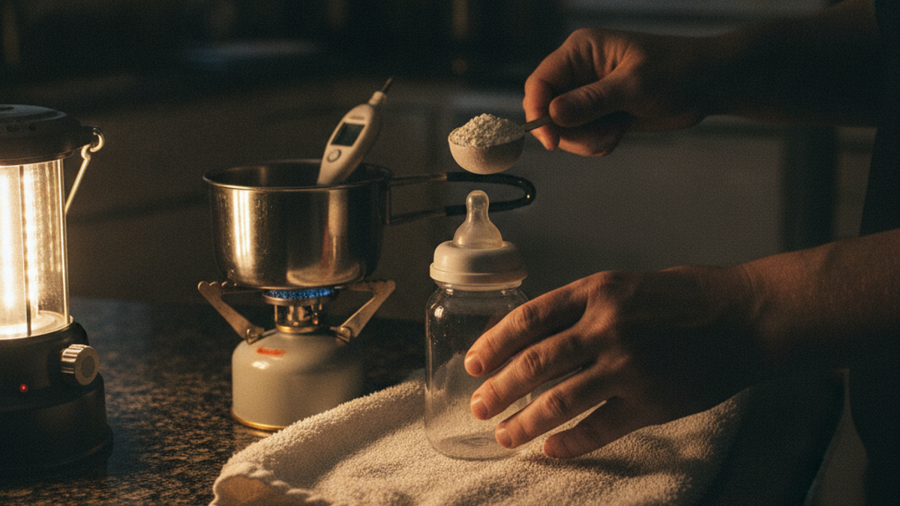
Start with the math, not a guess. Infants under six months consume roughly 2 to 2.5 ounces of formula per pound of body weight per day. A 12-pound baby drinks about 26–30 ounces daily. A standard 12.4-ounce powder canister yields around 90 fluid ounces of prepared formula — so that baby burns through a can every three days, or about 10 to 12 cans per month.
A 90-day supply for an infant in the heaviest feeding stage is therefore roughly 30–36 canisters. That sounds like a lot until you realize it fits under a bed or in two plastic totes in a closet. Powder formula like the Similac 360 Total Care tub is the backbone of any infant stockpile because it delivers the most calories per cubic inch of storage space and per dollar spent.
Formula Shelf Life and Rotation Rules
- Unopened powder: typically 12–18 months from manufacture. The printed "use by" date is a quality guarantee — nutrient potency (especially vitamin C) declines after it.
- Opened powder: use within 30 days. Non-negotiable.
- Unopened ready-to-feed (RTF): usually 12–24 months and shelf-stable at room temperature.
- Prepared bottle: 2 hours at room temperature, 24 hours refrigerated, 1 hour once the baby has started drinking.
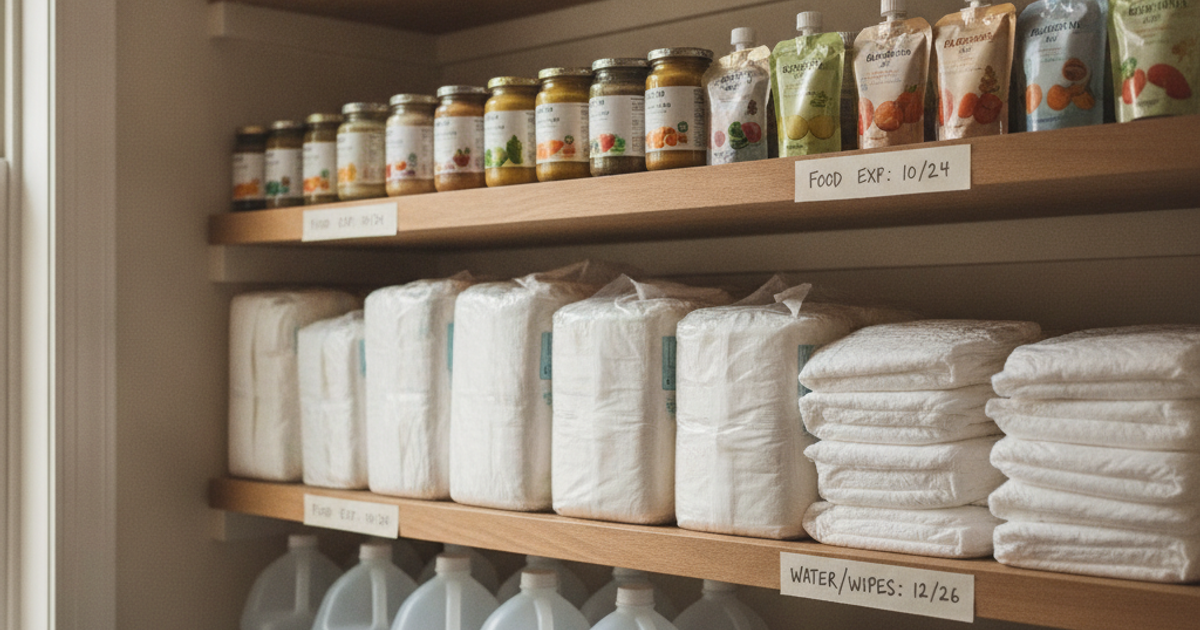
Because formula expires faster than rice or beans, rotation isn't optional — it's the entire game. Run strict FIFO: new cans go to the back, oldest to the front. Write the purchase month on the lid in marker. Apply the same discipline you'd use for the rest of your pantry, as outlined in our guide to stockpile inventory management and rotation.
Keep a layer of Enfamil NeuroPro ready-to-feed bottles in reserve too. RTF requires no water, no mixing, and no sterilization of measuring scoops — which makes it the single most valuable formula format during a boil-water advisory, a power outage, or an evacuation. Toss a few 32-ounce containers of Gerber Good Start ready-to-use formula into your vehicle kit and bug out bag.
Critical warning: never dilute formula to stretch it. Water intoxication in infants causes hyponatremia, seizures, and death. Never use homemade internet formula recipes. If a baby over six months faces a total formula gap, the AAP has stated that plain whole cow's milk for a few days is safer than diluting or improvising — but that is a last-resort bridge, not a plan.
How Many Diapers Does a Baby Actually Go Through?
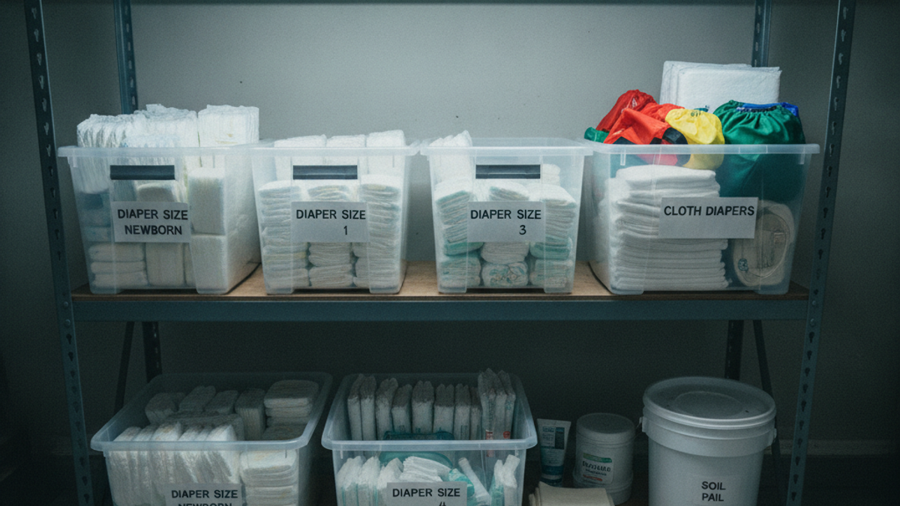
Newborns use 10–12 diapers per day. By six months that drops to 6–8, and toddlers average 5–6. Budget conservatively:
- 30-day supply: ~300 newborn diapers, ~240 for older infants
- 90-day supply: ~900 diapers
- 6-month supply: ~1,500–1,800 diapers
The National Diaper Bank Network's research has found that roughly half of U.S. families with young children experience "diaper need" — the inability to afford enough diapers — even in normal economic conditions. In a crisis, diapers become a top-tier barter good.
Buy across two sizes at all times: the size your baby wears now and the next size up, because babies grow faster than disasters resolve. A Pampers Swaddlers one-month supply box is the most storage-efficient way to bank 30 days at a time, and a Huggies Little Snugglers giant pack in the next size up covers growth spurts. Disposable diapers don't chemically expire, but the elastic and adhesive degrade over 2–3 years — store them cool, dry, and off concrete floors.
Why Every Family Needs a Cloth Diaper Backup
Disposables are finite. Cloth is renewable. A set of 24–36 cotton prefolds plus 6–8 waterproof covers will handle full-time use indefinitely and takes up about the same shelf space as two weeks of disposables. The catch is water: washing cloth diapers consumes roughly 4–6 gallons per load by hand. If your water situation is precarious, pair cloth with a solid emergency water storage plan and review our guide to doing laundry without running water. Even a partial cloth strategy — cloth at home, disposables saved for travel and illness — can double or triple how long your stash lasts.
Baby Food Storage for Infants Over Six Months
Commercial purees in jars and pouches carry 1–2 year shelf lives and rotate easily into daily use. Beyond that, build depth with plain shelf-stable staples you can mash: canned sweet potato and pumpkin, applesauce, infant rice and oat cereal, and pressure-canned or freeze-dried meats and vegetables. A hand-crank food mill turns almost any adult meal into infant-appropriate texture without electricity.
Whole grains ground fresh make excellent infant porridge — see our guide on using a hand grain mill for long-term grain storage. Never give honey to a child under 12 months due to infant botulism risk, and skip home-canned low-acid foods for babies unless you pressure-canned them yourself to spec.
Safe Water for Bottles When the Taps Fail
Powdered infant formula is not sterile. Cronobacter sakazakii contamination is rare but frequently fatal in newborns. The CDC recommends preparing formula with water boiled for one minute (three minutes above 6,500 feet), then cooled to no lower than 158°F (70°C) before mixing for infants under three months, preterm babies, or immunocompromised infants. Let the bottle cool to body temperature before feeding.
Filtration alone does not sterilize. If you're relying on a gravity filter, boil the output before it touches formula powder. Review the tradeoffs in our breakdown of boiling, filtering, and chemical water purification methods. Budget an extra half-gallon per day beyond your baseline for bottle prep and washing.
Feeding and Sterilizing Without Power
Bottles must be cleaned after every feeding — hot soapy water, a dedicated brush, and air-drying. The Munchkin Latch bottle brush and drying rack gets into nipple channels and vent systems where residue breeds bacteria. Keep at least 8–10 bottles on hand so you can batch-wash once daily instead of scrubbing after every feed — the Dr. Brown's Natural Flow set is a common standard with widely available replacement parts.
For sterilization, Philips Avent microwave steam sterilizer bags work in a microwave when you have power, and the same steam principle works over a camp stove with a covered pot. Boiling bottles and nipples for five minutes accomplishes the same thing with nothing but fuel and water.
Step-by-Step Instructions
Step 1: Calculate your baby's actual 90-day consumption
Multiply your infant's weight in pounds by 2.5 ounces to get daily formula volume, then divide by 90 ounces per can to find cans per day. Multiply by 90. Do the same for diapers using your real daily count, not an average. Write these numbers down — they change every month as the baby grows.
Step 2: Build to 30 days first, then extend to 90
Buy one extra can and one extra diaper pack per shopping trip rather than dropping $600 at once. This avoids expiration clustering, spreads cost, and keeps you off the radar of anyone tracking bulk purchases.
Step 3: Store supplies in a cool, dry, pest-proof location
Target under 75°F with low humidity. Use sealed plastic totes to block rodents and moisture — apartment dwellers can use under-bed bins and closet shelves. See our apartment prepping guide for small-space storage tactics.
Step 4: Label and rotate every canister with FIFO
Mark purchase dates in permanent marker. Oldest in front, newest in back. Feed from the stockpile daily and replace what you use — a stockpile you never touch is a stockpile that quietly expires.
Step 5: Stage a grab-and-go infant module
Pack a dedicated bag with three days of ready-to-feed formula, 40 diapers, wipes, two bottles, a changing pad, and a spare outfit. Keep it by the door or in the vehicle so evacuation never requires packing decisions.
Step 6: Test your no-power feeding routine
Kill the power for a weekend. Boil water on your camp stove, mix formula, wash and sterilize bottles by hand. You'll discover your fuel consumption rate and any missing gear while the stakes are still zero.
Step 7: Audit and resize the stockpile monthly
Babies outgrow diaper sizes every 6–10 weeks and transition off formula around 12 months. Reassess on the first of every month and donate or trade anything your child has outgrown before it becomes dead weight.
Frequently Asked Questions
How long does baby formula last in storage?
Unopened powdered formula typically lasts 12–18 months from manufacture, and ready-to-feed liquid lasts 12–24 months. Once opened, powder must be used within 30 days. Formula cannot be repackaged in Mylar bags for long-term storage the way grains can — the fats oxidize and nutrients degrade regardless of oxygen exclusion.
What should I do if I run out of formula in an emergency?
Never dilute formula and never use homemade recipes — both can cause fatal electrolyte imbalances. Contact local diaper banks, WIC offices, and hospitals, which often hold reserve stock. For infants over six months, plain whole cow's milk for a few days is the pediatric fallback. Breastfeeding or relactation, where possible, is the most resilient option of all.
How many diapers should I stockpile for a newborn?
Plan on 300 diapers for 30 days, 900 for 90 days. Split your purchases between the current size and the next size up, and add 24–36 cloth prefolds as an unlimited-duration backup once disposables run out.
Affiliate Disclosure: SHTFPlan.net participates in the Amazon Services LLC Associates Program. Some links are affiliate links — we may earn a small commission at no extra cost to you.