Special Needs Prepping: How to Build an Emergency Plan for Elderly and Disabled Family Members
Standard prepping advice assumes everyone can walk, carry, and think clearly. Here's how to build a realistic emergency plan for family members with mobility, medical, or cognitive needs.
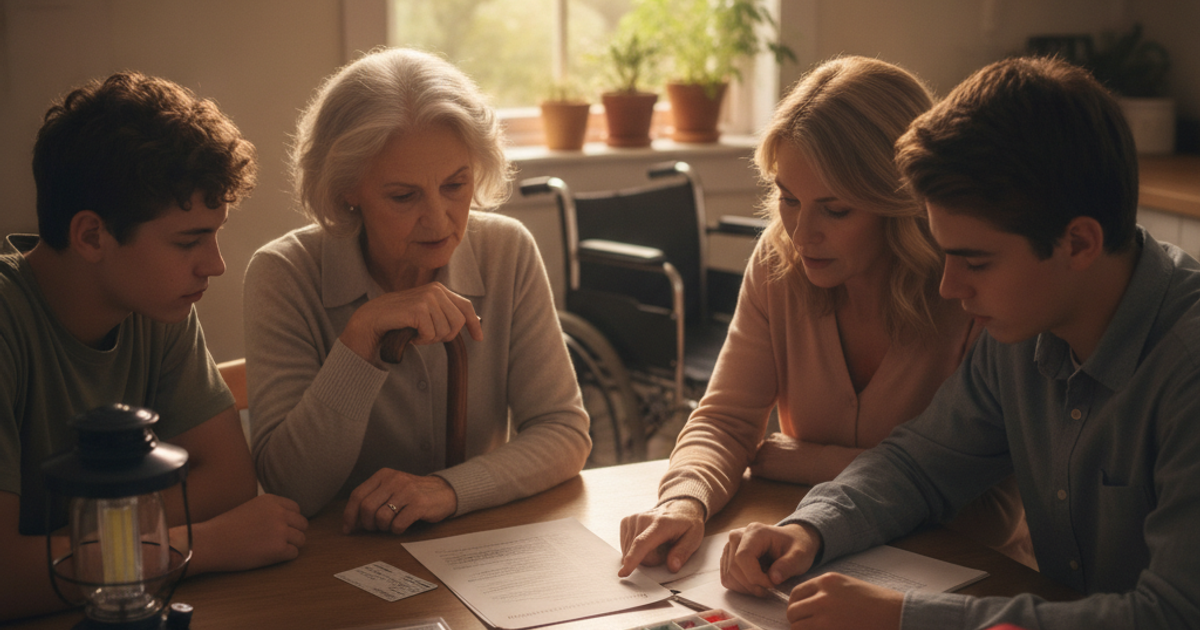
Most preparedness advice assumes a healthy, mobile adult who can shoulder a 40-pound pack and walk out of a city if the roads clog. That describes almost none of the people who die in disasters. FEMA and CDC after-action data tell the same story every time: the elderly and disabled are disproportionately killed by hurricanes, heat waves, blackouts, and floods. During Hurricane Katrina, roughly 71% of the dead were over 60 years old. In the 2021 Texas winter storm, the majority of hypothermia deaths were people over 60 who could not leave cold homes. Studies of European heat waves have found that people with mobility impairments face several times the mortality risk of their neighbors.
If your household includes a parent with oxygen dependency, a spouse using a CPAP, a child with a feeding tube, or a grandparent with dementia, your emergency preparedness plan cannot be a copy of someone else's bug out bag checklist. It has to be built around the person. This guide covers medical go-bags, backup power for medical equipment, evacuation assistance, and the caregiver contingency almost nobody plans for — for apartments, suburbs, and rural properties alike.
What You'll Need
Tools
- Portable power station (1000Wh class)
- Folding transport wheelchair
- Folding walker with wheels
- Medical alert system with fall detection
Supplies
- Weekly pill organizer
- Insulin cooler travel case
- Printed medical summary sheets in waterproof sleeves
- 30-day medication reserve and spare durable-equipment consumables
How to Build a Medical Go-Bag for a Dependent Family Member
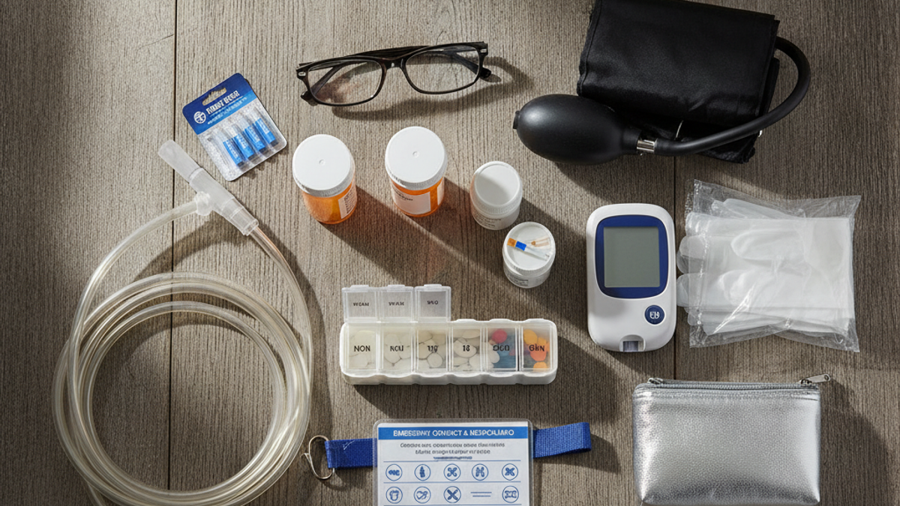
A standard 72-hour survival kit keeps a healthy person alive for three days. A medical go-bag has a different job: it keeps a treatment regimen intact for two weeks, because that is roughly how long it takes for pharmacies, dialysis centers, and home-health services to come back online after a major regional disaster.
Build the bag around four layers:
- Documentation. One page listing diagnoses, allergies, medications with doses, prescribing doctors, insurance and Medicare numbers, pharmacy, DNR/POLST status, and emergency contacts. Laminate it. Put a copy in the bag, one in the wallet, one on the refrigerator, and a photo on every family phone.
- Medications. A minimum 14-day supply, rotated. A Sagely Smart XL weekly pill organizer is worth the extra space — under evacuation stress, caregivers routinely double-dose or skip doses, and an XL organizer with large compartments and clear day labeling prevents that. Read our guide to building a prescription and OTC drug reserve for legal ways to get ahead on refills.
- Temperature-sensitive drugs. Insulin, certain biologics, and some eye drops degrade above 86°F. A MedActiv insulin cooler travel case uses evaporative gel to hold safe temperatures for days without ice or power — critical in a hot-weather evacuation. See our deeper guide on storing insulin and EpiPens off-grid.
- Consumables. Catheters, ostomy supplies, nebulizer masks, CPAP filters and tubing, hearing aid batteries, glucose strips, incontinence supplies, wound care, and nutrition shakes. These are the items that disappear from shelves first and that no shelter stocks in your size.
Backup Power for Medical Equipment When the Grid Fails
The Department of Health and Human Services emPOWER program tracks more than 4 million Medicare beneficiaries who depend on electricity for medical equipment at home. Oxygen concentrators, CPAP and BiPAP machines, ventilators, powered wheelchairs, and feeding pumps all stop when the lights do.
Do the math before you buy. A CPAP without a humidifier draws roughly 30–60 watts; an oxygen concentrator can pull 300–600 watts continuously. Multiply watts by hours needed, then add 20% for inverter losses. A CPAP user needing 8 hours at 40 watts needs about 320Wh per night — well within the range of a EcoFlow River 2 Pro portable power station, which recharges fast and is light enough for an apartment dweller to carry down stairs. For a concentrator or multiple devices, step up to a Jackery Explorer 1000 portable power station, which can be paired with folding solar panels for indefinite off grid operation.
Reduce the load, too. A ResMed AirMini CPAP travel machine is a fraction of the size and power draw of a bedside unit and runs comfortably off a battery bank all night — a serious asset for both sheltering in place and evacuating. Rural readers with generator capacity should still keep a battery as the silent, indoor-safe first layer; see our guides on backup power for medical devices and whole-house standby generators.
Finally, register with your utility's medical baseline or critical-care customer list, and with your county's functional-needs registry. It does not guarantee anything, but it puts you on a restoration priority list.
Evacuation Assistance: Getting a Non-Ambulatory Person Out
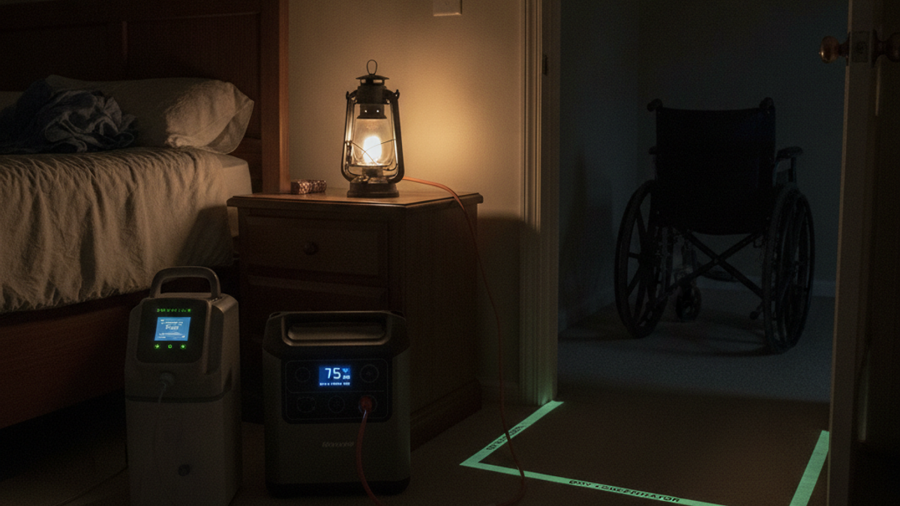
Urban apartment dwellers face a specific nightmare: elevators fail during fires, blackouts, and earthquakes. If your family member lives above the ground floor, you need a written stair plan — who carries, how, and with what. Practice a two-person carry and a stair-chair descent before you need it. Keep a Medline steel folding transport wheelchair in the vehicle or hall closet; it folds flat, weighs far less than a full-size chair, and turns a 200-yard walk into a survivable one. For semi-ambulatory family members, a Drive Medical folding walker with wheels in the trunk prevents falls on unfamiliar shelter floors.
Rural families have the opposite problem: no crowd to help. Identify two neighbors within five miles who know your situation, and confirm your driveway and turnaround can accept an ambulance. Learn improvised stretchers and casualty carries — a tarp and two poles moves a person your arms cannot.
Evacuate early. Research on hurricane evacuation consistently shows that households with disabled members take significantly longer to leave. Set your personal trigger one full warning level earlier than your neighbors.
Caregiver Contingency Planning: What If You're the One Who Goes Down?
This is the gap in almost every plan. If the primary caregiver is injured, quarantined, stranded at work, or killed, who takes over within four hours? Name two backups by name and phone number. Give them a written care sheet covering medications, feeding, transfers, toileting, behavioral triggers for dementia patients, and where the go-bag is stored. Consider a limited healthcare power of attorney so a backup can authorize treatment.
A MobileHelp medical alert system with fall detection covers the hours a caregiver is away and works on cellular rather than a landline, which matters when phone lines are down. Pair it with a family emergency communication plan that includes an out-of-state contact everyone calls.
Step-by-Step Instructions
Step 1: Assess Individual Functional Needs Honestly
Sit down and list every task the person cannot perform alone: walking stairs, standing, hearing alarms, understanding instructions, self-medicating, toileting. Rate each as "assistance needed" or "fully dependent." This list, not a generic checklist, drives every purchase and plan that follows.
Step 2: Build the Medical Go-Bag and Document Kit
Assemble 14 days of medications, consumables, and laminated medical summaries in a wheeled duffel that anyone can grab. Add spare glasses, hearing aid batteries, denture supplies, and a comfort item. Tape a contents list and expiration-check date to the outside.
Step 3: Calculate and Install Backup Power
Find the wattage label on every powered device, multiply by required daily runtime, and buy a power station with at least 1.5x that capacity. Test the actual device on the battery for a full night before an emergency. Store the battery at 60–80% charge and top it off monthly.
Step 4: Register With Utility and Local Emergency Services
Call your electric utility and ask to be added to the medical baseline or critical-care list. Contact your county emergency management office about a special-needs or functional-needs registry, and ask which local shelters accept medical equipment, service animals, and caregivers.
Step 5: Rehearse the Evacuation Physically
Time a real move from bed to vehicle, including stairs, wheelchair transfer, oxygen, and the go-bag. Do it once in daylight and once in the dark with flashlights. Fix whatever fails — usually a doorway that's too narrow or a chair nobody can lift.
Step 6: Designate and Brief Backup Caregivers
Choose two people, hand them the written care sheet, and walk them through a full care cycle in person. Give them a key, gate code, and the location of medications and the power station. Confirm annually that they're still willing and reachable.
Step 7: Review and Rotate Every Six Months
Tie the review to daylight saving time changes. Refill medications, replace expired supplies, update the medical summary after any diagnosis or prescription change, cycle the power station, and re-test the alert system.
Frequently Asked Questions
What should I put in a medical go-bag for an elderly parent?
At minimum: 14 days of prescription medications in a labeled organizer, laminated medical and insurance documentation, spare glasses and hearing aid batteries, incontinence and wound-care supplies, a temperature-controlled case for refrigerated drugs, nutrition shakes, a change of clothes, and a comfort item such as a photo or blanket. Add device-specific consumables like CPAP filters or catheter kits, and keep the bag on wheels so any adult can move it.
How long can a CPAP or oxygen concentrator run on a portable power station?
A CPAP without heated humidification draws roughly 30–60 watts, so a 1000Wh battery can typically run it for two to three nights. An oxygen concentrator drawing 350 watts will drain that same battery in under three hours. Turn off humidifiers, use a travel-sized CPAP, and pair the battery with solar panels or a generator for anything beyond a single night.
Do emergency shelters accept people with medical equipment and caregivers?
General population shelters vary widely, and many are not equipped for electricity-dependent equipment. Under federal law shelters must provide reasonable accommodation, but in practice you should call your county emergency management office now and identify which specific facilities have generator-backed outlets, accessible cots, and space for a caregiver. Never assume — verify and write the address down.
Affiliate Disclosure: SHTFPlan.net participates in the Amazon Services LLC Associates Program. Some links are affiliate links — we may earn a small commission at no extra cost to you.