Tainted Tap: How to Survive a Do-Not-Drink Order When Your City's Water Supply Is Compromised
Boil-water notices, chemical overfeeds, and hacked treatment plants can turn your faucet into a hazard overnight. Here's how to spot the warning signs and switch your home to independent water fast.
Over the past week, news reports have described a wave of cyberattacks targeting control systems at U.S. water utilities, with broadcast coverage framing attacks on water systems as one of the latest major cyber vulnerabilities facing the country. According to trade coverage from SC World, water utilities are now seeking additional cybersecurity support in the wake of those attacks, with assistance being directed toward small and rural systems that lack in-house security staff.
You don't need to panic over that news, but you should take the hint. A municipal water system can fail for a dozen ordinary reasons — a main break, a flood, a treatment plant malfunction, a backflow incident, a chemical overfeed — and now there's one more. The practical question for a household isn't why the water went bad. It's how fast you can switch from tap dependency to stored and filtered water, and how long you can hold that position. That's a skill, and it's one of the cheapest pieces of emergency preparedness you'll ever buy.
Boil-Water Order vs. Do-Not-Drink Order: Know the Difference
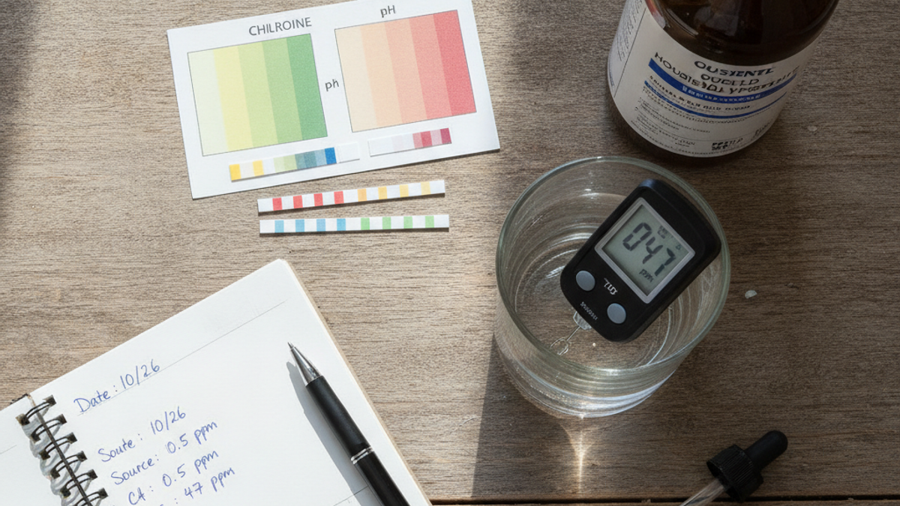
These two advisories sound similar and are handled completely differently. Getting them mixed up can make you sick.
A boil-water advisory means the utility suspects biological contamination — bacteria, viruses, protozoa — usually after a pressure loss event. Bringing water to a rolling boil for one minute (three minutes above 6,500 feet elevation, per CDC guidance) kills those pathogens. Boiled tap water is safe for drinking, cooking, brushing teeth, and washing produce.
A do-not-drink order is more serious. It means a chemical, fuel, solvent, or heavy metal may be in the system. Boiling does not help — it concentrates the contaminant. In a do-not-drink scenario, you need an alternate source entirely. A do-not-use order goes further still: no bathing, no laundry, no dishes, because the contaminant may be absorbed through skin or inhaled as vapor in a hot shower.
The default assumption when an advisory first drops and details are thin: treat it as do-not-drink until the utility says otherwise. Shut off the icemaker, tell the kids, and tape a note over the kitchen faucet. In households with small children, that sign is not overkill.
What You'll Need
Tools
- Berkey gravity water filter system
- LifeStraw Home water filter pitcher
- Sawyer Squeeze water filter system
- Large stockpot and heat source (stove, propane burner, or camp stove)
Supplies
- WaterBrick stackable water storage containers
- Reliance Aqua-Tainer 7 gallon water container
- Aquatabs water purification tablets
- Big Berkey PF-2 fluoride and arsenic filter elements
- Unscented household bleach (5–6% sodium hypochlorite) and a medicine dropper
How Much Water Your Household Actually Needs
FEMA and Ready.gov put the baseline at one gallon per person per day, with a minimum of a three-day supply for evacuation and two weeks for sheltering at home. That gallon covers drinking and minimal food prep — not showers, not laundry, not flushing. A family of four aiming at two weeks needs 56 gallons. That's roughly eight 7-gallon Aqua-Tainer jugs in a closet, or a stack of WaterBricks under a bed in an apartment. Add more if you have infants, nursing mothers, pets, or anyone with a medical condition.
Most municipal advisories resolve in two to five days. But Jackson, Mississippi and Flint, Michigan both demonstrated that water crises can stretch into weeks or years. Plan for the short outage; build toward the long one. Our guides on choosing and rotating emergency water containers and rationing on one gallon a day go deeper on both ends.
Filtering Your Way Through a Contamination Event
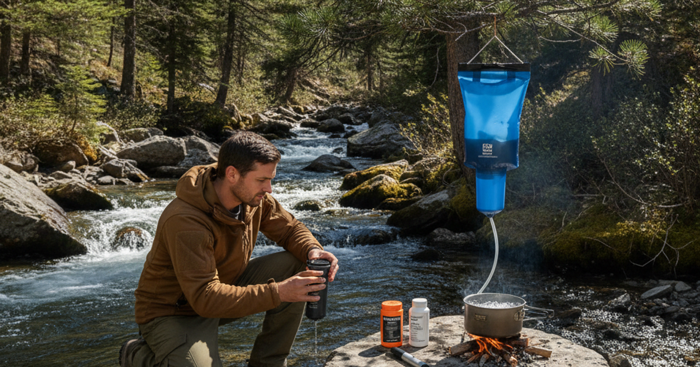
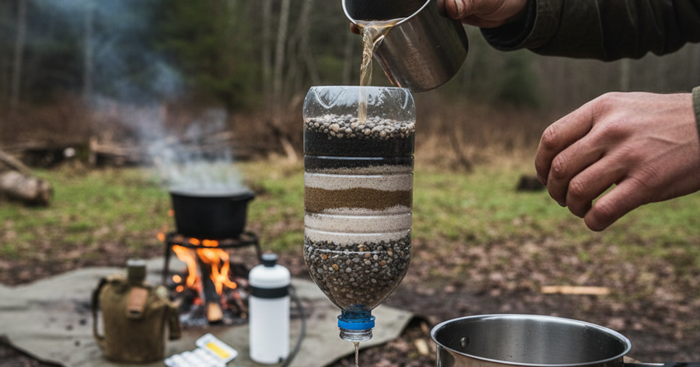
No single filter handles every contaminant, which is why serious preppers run layers. A gravity system like a Berkey needs no power and no pressure — critical if the contamination event coincides with a grid outage — and processes several gallons a day on a countertop. Adding PF-2 elements extends reduction to fluoride and arsenic compounds.
For a smaller footprint, a LifeStraw Home pitcher fits in a refrigerator door and targets bacteria, parasites, microplastics, lead, and PFAS — a good fit for apartment dwellers with no storage space. For your bug out bag and vehicle kit, a Sawyer Squeeze weighs a few ounces and is rated for up to 100,000 gallons.
The hard limit: hollow-fiber and carbon filters are not designed for industrial solvents, fuel, or high chemical loads. If the advisory names a chemical, filtration is not your answer — stored or hauled water is.
Chemical Treatment When You're Hauling Water
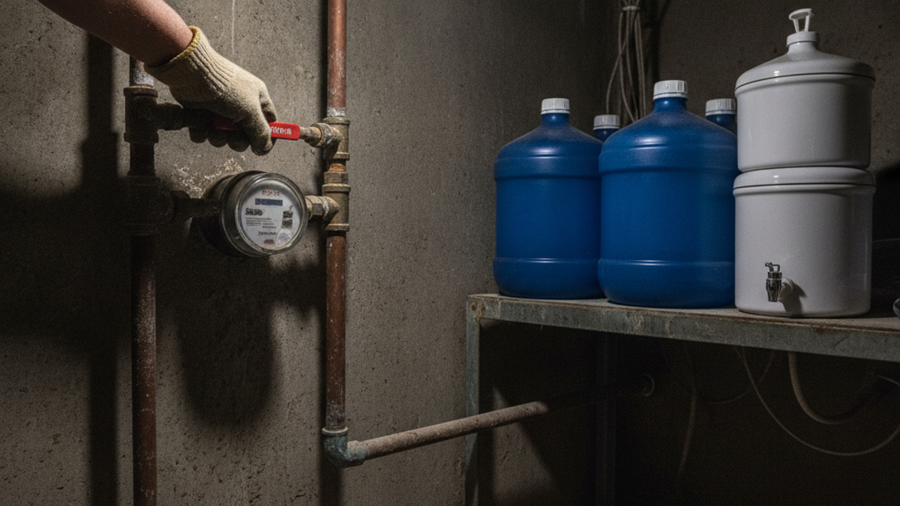
If you end up collecting from a distribution point, a neighbor's well, or rainwater, chemical tablets are your backup sterilizer. Katadyn Micropur MP1 tablets use chlorine dioxide and are effective against Cryptosporidium with sufficient contact time. Aquatabs are cheap, compact, and work in 30 minutes — stash a strip in every vehicle, workplace kit, and apartment stockpile. For a deeper comparison, see our guide to choosing the right water purification method for every scenario.
Step-by-Step Instructions
Step 1: Verify the advisory from the primary source
Go to your utility's website or official social account, not neighborhood rumor. Confirm whether it's boil-water, do-not-drink, or do-not-use, which pressure zones are affected, and whether a contaminant is named. Sign up for the utility's text alerts now, before you need them.
Step 2: Shut off ingestion points immediately
Turn off the refrigerator icemaker and discard existing ice. Unplug any plumbed coffee maker or water dispenser. Tape a sign on the kitchen and bathroom faucets so children and guests don't drink or brush teeth out of habit.
Step 3: Capture remaining safe water in the house
If the advisory is new and pressure hasn't dropped, fill containers and bathtub liners quickly during a boil-water order only. Remember your water heater holds 40–50 gallons and the toilet tank reservoir holds clean water. Our guide on emergency utility shutoff explains how to isolate your house from a contaminated main.
Step 4: Treat what you can, substitute what you can't
For biological threats, boil one minute at a rolling boil, or filter, or use tablets. For chemical do-not-drink orders, do not treat — switch entirely to bottled, stored, or hauled water from outside the affected zone.
Step 5: Reduce demand across the household
Switch to paper plates, use hand sanitizer between washes, and cook meals that need no rinse water. Divert dishwater and bath water for toilet flushing — see greywater recycling for safe handling.
Step 6: Flush and sanitize when the all-clear comes
Run cold taps five minutes each, flush and dump the first three batches of ice, replace refrigerator and pitcher filter cartridges, and run an empty hot dishwasher cycle. Drain and refill the water heater if a chemical was involved.
Step 7: Rebuild and rotate your reserve
Refill every container, date it, and rotate stored tap water every six months. Log it in your stockpile inventory so it doesn't get forgotten.
Rural Readers: Your Well Isn't Automatically Safe
Private wells sit outside municipal advisories, but they fail differently — submersible pumps need electricity, and shallow wells are vulnerable to surface contamination after flooding. Test annually for coliform and nitrates, and consider a hand pump backup so a grid outage doesn't become a water outage.
Recommended Gear
A workable household water plan is layered: a Berkey gravity system on the counter, stackable storage in a closet, a Sawyer Squeeze in the pack, and tablets everywhere else. Browse more vetted options on our recommended survival gear page.
Frequently Asked Questions
Can I shower during a do-not-drink order?
Usually yes, as long as nobody swallows water — keep showers short and supervise young children. If the utility issues a do-not-use order, stop bathing entirely, because some chemicals absorb through skin or vaporize in hot water.
How long does stored tap water stay safe to drink?
Municipally treated tap water stored in clean, food-grade, sealed containers away from sunlight and heat is generally fine for six months to a year. Rotate every six months for best taste, and run it through a filter before drinking if it's been sitting longer.
Is bottled water enough for emergency preparedness?
Bottled water is a fine starting point but a poor foundation — it disappears from shelves within hours of an advisory, costs far more per gallon, and takes up more space than it should. Build around refillable containers plus filtration, and treat bottled water as convenient overflow.
Affiliate Disclosure: SHTFPlan.net participates in the Amazon Services LLC Associates Program. Some links are affiliate links — we may earn a small commission at no extra cost to you.