Motorcycle Bug-Out Rig: How to Escape on Two Wheels When Highways Turn Into Parking Lots
A dual-sport motorcycle can slip past gridlock that traps cars for days. Here's how to choose, outfit, and load a two-wheel bug-out rig that actually gets you out.
When Hurricane Rita bore down on the Texas Gulf Coast in September 2005, roughly 2.5 to 3 million people tried to leave at once. Interstate 45 out of Houston became a 100-mile parking lot. Cars overheated, fuel stations ran dry, and people sat motionless for 20 hours to cover 100 miles — a pace slower than walking. More than 100 deaths were attributed to the evacuation itself, not the storm. That single event should permanently change how every prepper thinks about bugging out in a four-wheeled vehicle.
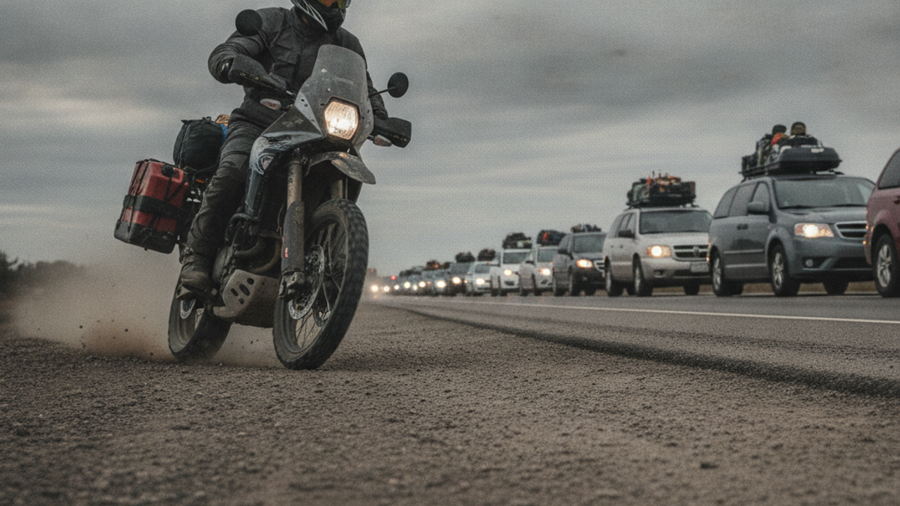
A dual-sport motorcycle solves the specific problem that kills evacuations: gridlock. A 400-pound bike with knobby-ish tires can split lanes, ride the shoulder, cut across a median, hop a curb into a strip-mall parking lot, and continue down a power-line easement or fire road when the interstate is a solid wall of steel. It burns a third of the fuel of an SUV. It fits in an apartment parking space or behind a suburban garage door. And unlike a bicycle, it will carry you and 60 pounds of gear 200 miles before breakfast.
It also comes with hard tradeoffs: no cargo capacity to speak of, no armor, no climate control, and a learning curve measured in months, not weekends. Here's how to build a two-wheeled bug-out rig that actually works.
What You'll Need
Tools
- CruzTOOLS RoadTech M3 motorcycle tool kit
- Motion Pro Trail Tool multi-tool
- Tubeless tire plug repair kit
- Lithium jump starter
Supplies
- Soft saddlebag luggage system
- Rotopax 1-gallon fuel containers
- Spare tube, tire irons, and CO2 cartridges
- Paper topographic maps and a compass
- Fuel stabilizer and a siphon hose
How to Choose the Right Dual-Sport Motorcycle for Bugging Out
Forget the 600-pound adventure tourer with the aluminum panniers. When you drop it — and you will — you need to be able to pick it up alone, on a slope, in the rain, loaded. That points you toward the 250cc–650cc dual-sport class.
- Weight: Under 350 lbs wet is ideal. A Honda CRF300L (~311 lbs), Suzuki DR650 (~366 lbs), Kawasaki KLR650, or Yamaha XT250 all qualify as realistic choices.
- Simplicity: Carbureted or basic fuel-injected singles with minimal electronics survive better in an off grid, no-dealer environment. Fewer sensors, fewer failure points.
- Parts availability: Choose a model with a 15-year production run and a huge aftermarket. Obscure bikes are orphans when supply chains break.
- Fuel economy: 55–75 mpg is typical, which stretches a small tank remarkably far.
- Street legal: A plated dual-sport can use highways legally during normal times, which means you can actually practice your routes.
Apartment dwellers have an advantage here most people overlook: a dual-sport fits in a single parking stall, a storage unit, or even a ground-floor patio with a cover and a ground anchor. You do not need acreage to own a serious SHTF escape vehicle.
How to Pack a Motorcycle Bug-Out Rig Without Ruining the Handling
Load low, load forward, and load light. Weight high on a rack turns a nimble bike into a tank-slapper on gravel. Keep total cargo under about 50–60 pounds including fuel and water.
Soft luggage beats hard cases for a bug-out rig: it won't break your leg in a tip-over, it doesn't scream "loot me," and it compresses. A Giant Loop Great Basin saddlebag straddles the rear seat with no rack required and keeps the mass centered over the axle — ideal for a bike you may need to muscle through a ditch. For wet-weather regions, Nelson-Rigg Hurricane dry saddlebags are fully waterproof roll-tops that keep your food, documents, and spare socks dry through a day of driving rain.
Your packing priorities, in order: water and water purification (a 3L bladder plus a squeeze filter), 72 hours of emergency food storage in bar and pouch form, a sleep system, a trauma kit, tools, and then comfort items. Your bug out bag should be packable inside the luggage, not strapped on top — so that when the bike dies, you strip it, shoulder the pack, and keep walking. If you can't carry your load 10 miles on foot, it's too heavy. See our guide to building the survival fitness to carry your bug-out bag.
Fuel Range and Storage: The Real Limiting Factor
A 2.1-gallon CRF300L tank at 70 mpg gives you roughly 145 miles. A DR650 with a 3.4-gallon tank runs about 160. That's often enough to reach a bug-out location, but not with margin — and in a real grid-down event, gas pumps don't work without electricity.
Carry two Rotopax 1-gallon gasoline containers mounted on the rear rack or pannier frames. They're DOT/EPA-compliant, sealed, and designed to be bolted to a vehicle. Two gallons buys another 120–140 miles — enough to turn a one-tank run into a 250-mile reach. Store gasoline treated with stabilizer and rotate it every 90 days; ethanol-blended fuel degrades fastest. Cache additional fuel along your route if you can — our guide to buried survival caches covers sealing and burying supplies where you'll actually be able to find them.
Building a Roadside Repair Kit That Fits Under the Seat
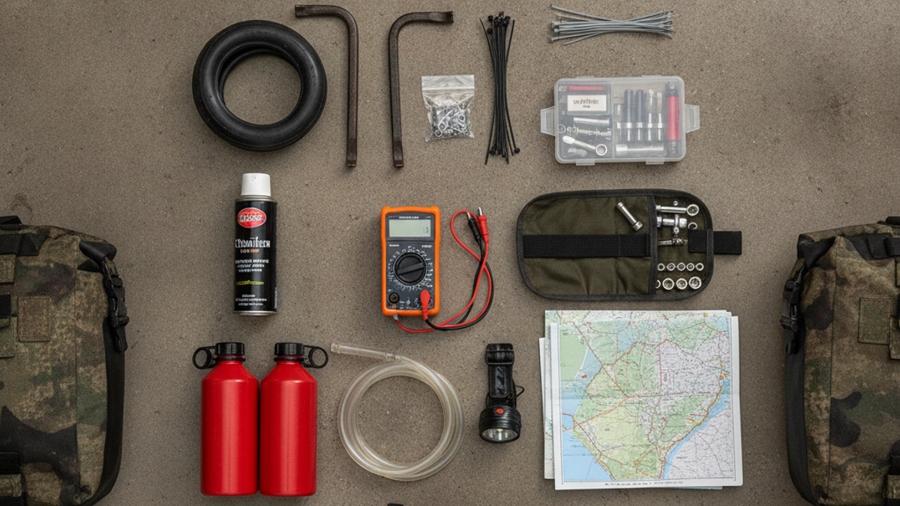
On a motorcycle, a flat tire is a mission-ending event. It's also the single most common failure. Carry a plug kit and inflation, and practice using it in your driveway before you need it in a dark ditch. The Stop & Go tubeless tire plug repair kit uses mushroom plugs inserted from the outside and is the gold standard for tubeless wheels. For a lighter, cheaper option, the Slime motorcycle tire plug kit with CO2 inflator packs into a space smaller than a water bottle. If your dual-sport runs tubed spoke wheels, you need tire irons, a spare tube, and the skill to swap it — budget 30 minutes of practice time, repeatedly.
Beyond tires: a bike-specific tool roll like the CruzTOOLS RoadTech M3 covers metric fasteners, spark plug, and chain adjustment in one compact package. For ultralight loadouts, the Motion Pro Trail Tool consolidates a dozen functions into a single pocketable unit. Add zip ties, safety wire, JB Weld, a spare master link and chain lube, fuses, and a tube of tire sealant. A dead battery from a parasitic draw or a long sit is common; a compact NOCO Boost Plus GB40 jump starter will restart your bike dozens of times and also charge your phone and headlamp. For deeper field fixes, read keeping your bug-out vehicle running when there are no repair shops.
Step-by-Step Instructions
Step 1: Select and license a sub-350-pound dual-sport
Buy a street-legal, plated dual-sport in the 250–650cc range with proven parts availability. Test that you can lift it from its side by yourself, fully loaded, on gravel. If you can't, it's the wrong bike for an evacuation where no one is coming to help.
Step 2: Install luggage and mount auxiliary fuel
Fit soft saddlebags and a tail bag, keeping the load centered over the rear axle and below seat height. Bolt one or two 1-gallon fuel containers to a rack or pannier frame with locking hardware. Re-torque all mounting bolts after your first 50 loaded miles.
Step 3: Build and stow your repair and survival kit
Pack tire plugs, inflation, a tool roll, chain spares, and a trauma kit under the seat or in a dedicated bag that never comes off the bike. Keep your 72-hour survival kit — water filter, food, sleep system, headlamp, and maps — separately packable so you can shoulder it and walk away if the bike fails.
Step 4: Map three routes out and drive them in daylight
Identify a primary, alternate, and contingency route from home to your destination, with at least one that avoids all limited-access highways. Ride each one, photograph choke points — bridges, tunnels, rail crossings — and note gas stations, water sources, and dead zones. Mark everything on a paper topo map; GPS may not survive the event.
Step 5: Train off-pavement until dirt feels normal
Take a dual-sport or adventure riding course and then log at least 20 hours on gravel, sand, mud, and grass. Practice emergency braking on loose surfaces, slow-speed u-turns, curb hops, and picking up a loaded bike. Add a night ride and a cold-rain ride, because real evacuations don't happen in good weather.
Step 6: Run a full loaded shakedown evacuation
Pick a weekend, load the bike exactly as you would under pressure, and ride your primary route to your destination and back. Time your exit from the front door to rolling — target under 10 minutes. Note every item you never touched and every item you wished you had.
Step 7: Maintain and inspect on a fixed schedule
Monthly, check tire pressure and tread, chain tension and lube, oil level, battery voltage, and fuel rotation. Keep the tank above half at all times; a bike with a quarter tank is a very heavy bicycle. Start the engine and let it reach operating temperature at least every two weeks.
Route Planning and Riding Like a Grey Man
A motorcycle is loud, exposed, and visibly fast — the opposite of invisible. That cuts both ways. In a disorderly evacuation, a lone rider on a loaded bike reads as a target for carjacking at any forced stop. Mitigate it: use dusty, neutral-colored luggage instead of tactical black MOLLE; avoid stickers, flags, and anything that advertises prepper affiliation; wear ordinary commuter gear rather than full racing leathers. The grey man vehicle principles apply to two wheels just as much as four.
Operationally, speed is your armor. Never stop in a crowd. Fuel up and rest at pre-identified points away from population centers. Keep your helmet on, keep the engine running at brief stops, and maintain constant situational awareness — your mirrors are your rear security. In dense urban survival conditions, prefer surface streets and industrial corridors over interstates; the choke points are at bridges and freeway ramps, which is exactly where our guide to urban evacuation routes tells you to go around rather than through.
Finally, be honest about the limits. A bike carries one adult plus gear. If you have a family of four, the motorcycle is a scout and supplement — a way for one person to run reconnaissance, retrieve a cache, or get home from work when roads are impassable — not the family escape plan. Pair it with a vehicle plan, a foot plan, and in some regions a water bug-out option. Redundancy is the whole point of emergency preparedness.
Frequently Asked Questions
What is the best motorcycle for a bug-out vehicle?
A lightweight, street-legal dual-sport in the 250cc–650cc range with a long production history and wide parts availability. The Honda CRF300L, Suzuki DR650, Kawasaki KLR650, and Yamaha XT250 are the standard answers for good reason: simple engines, 55–75 mpg, manageable weight, and massive aftermarket support. The best bike is ultimately the one you can lift, maintain, and ride confidently on dirt.
How far can a motorcycle bug-out rig travel on one tank?
Most small dual-sports carry 2–3.5 gallons and return 55–75 mpg, giving 130–200 miles per tank. Adding two 1-gallon auxiliary fuel containers extends that to roughly 250–340 miles. Plan your route around a conservative 80% of your theoretical range, because headwinds, loaded weight, and low-gear off-road travel all cut efficiency significantly.
Is a motorcycle or a bicycle better for escaping a gridlocked city?
A motorcycle wins on range and speed; a bicycle wins on silence, fuel independence, and the ability to be carried over obstacles. If you're escaping within the first few hours of an event, the motorcycle is far superior. For long-duration grid-down movement with no fuel supply, consider a bicycle bug-out plan as your fallback layer.
Want the rest of our tested recommendations? Browse our recommended survival gear and equipment page for vetted survival gear across every category.
Affiliate Disclosure: SHTFPlan.net participates in the Amazon Services LLC Associates Program. Some links are affiliate links — we may earn a small commission at no extra cost to you.