Workplace Emergency Kit: How to Survive a Disaster When You're Stuck at the Office
Most preppers fortify their homes but forget they spend 8+ hours a day at work. Here's how to build a workplace emergency kit that could save your life.
Most preppers spend considerable time fortifying their homes, stocking emergency food storage, and perfecting their bug out bag — but far too many overlook one of the most dangerous gaps in their emergency preparedness plan: what happens when disaster strikes while you're at work. According to the Federal Emergency Management Agency (FEMA), the average American spends roughly 8 to 10 hours per day away from home. That's a significant window of vulnerability. Whether it's an earthquake, a severe weather event, a power grid failure, or a more serious SHTF scenario, being caught at the office without a plan can be fatal.
Urban professionals face a unique set of challenges. You're in a high-rise or office park, miles from your family, probably without your primary survival gear, and surrounded by hundreds of other people who are equally unprepared. This guide will help you close that gap — from building a practical workplace survival kit to assembling a get-home bag that will actually get you home.
Why Your Office Is One of the Worst Places to Be When SHTF
Think about the average modern office building. You're dependent on elevator access, electronic key cards, HVAC systems, and municipal water. When the grid goes down, these systems fail almost immediately. Stairwells become the only exit in high-rise buildings. Bathrooms stop functioning within hours. And if you work in a dense urban environment, you're surrounded by thousands of panicked people who are all trying to do the same thing: get out.
A 2018 FEMA study found that only 39% of Americans have discussed or developed an emergency plan with their households. Workplace-specific preparedness is even lower. Most corporate emergency plans focus on fire drills and shelter-in-place procedures — not on what happens when you need to navigate 15 miles of chaos on foot to reach your family.
This is where the prepper mindset gives you a decisive advantage. Urban survival isn't about having the most gear — it's about having the right gear, in the right place, at the right time.
Building Your Workplace Survival Kit: What to Keep at Your Desk
Your workplace survival kit is your first line of defense. It doesn't need to be elaborate or obvious — in fact, discretion is an asset. The goal is to maintain a grey man profile in the office. You don't want to be the person everyone immediately turns to for supplies when things go sideways, as that creates its own security problem.
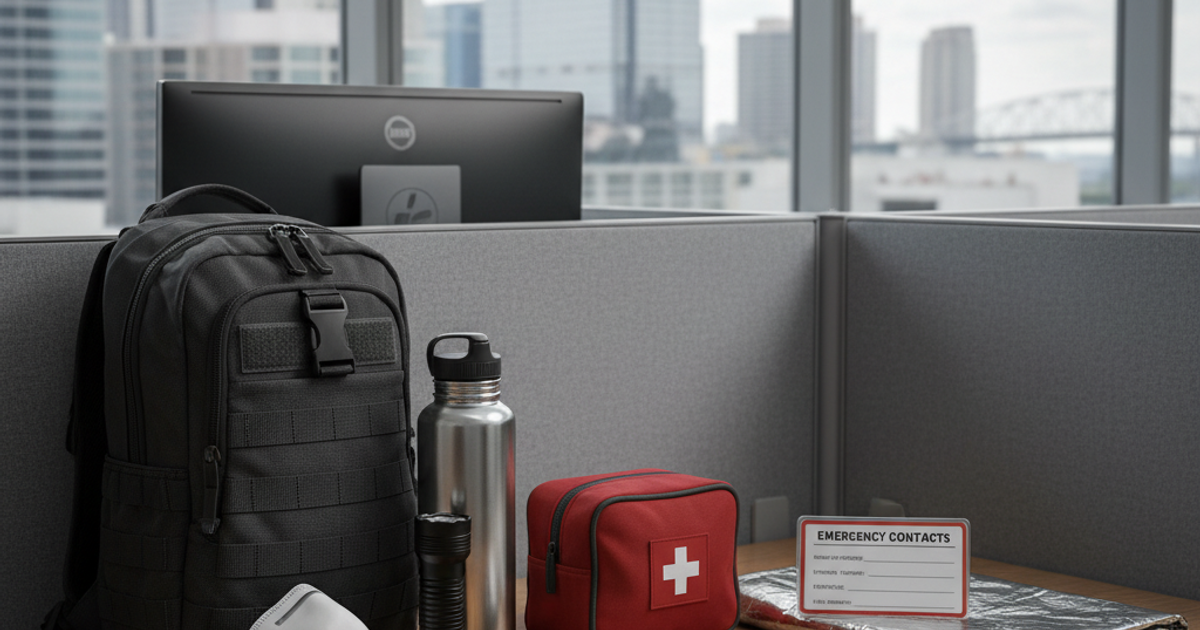
Store your kit in a low-profile backpack, a gym bag, or even a spare laptop bag. Keep it under your desk or in a locker. Here's what it should contain:
Water and Water Purification
Water is your most critical survival resource. Keep at least one liter of bottled water at your desk at all times, along with a reliable water purification method. The LifeStraw Personal Water Filter Straw is an outstanding choice for office kits — it's compact enough to slip into a jacket pocket, filters up to 1,000 liters, and removes 99.9999% of waterborne bacteria. If you're stuck in a building with standing water, a compromised tap supply, or need to drink from an outdoor source during a get-home scenario, this small device could save your life.
Emergency Food for the Office
You don't need a full 72-hour supply at the office, but having enough calories to sustain you through a 24-hour shelter-in-place or a multi-hour get-home walk is essential. Wise Company emergency food bars are designed specifically for this kind of compact emergency food storage — they're calorie-dense, have a long shelf life, and won't melt or spoil in a desk drawer. Store a few bars in your kit and rotate them annually.
Lighting and Power
When the power fails, modern office buildings become genuinely dangerous environments. Emergency lighting runs on batteries that often last only 90 minutes. A good tactical flashlight belongs in every office kit, but equally important is keeping your communication devices charged. The Anker PowerCore 20000mAh portable charger can fully recharge a smartphone four to five times, giving you extended communication ability well into a grid-down situation. Keep it charged and in your bag every single day.
First Aid and Medical Supplies
A basic trauma kit should live in your office bag. At minimum: hemostatic gauze, a compression bandage, nitrile gloves, over-the-counter pain relief, any personal prescription medications, and a space blanket. For a deeper dive into building a trauma kit, see our guide on First Aid Without a Doctor: Building a Trauma Kit for Long-Term Emergencies.
Tools and Self-Defense
A quality folding knife is one of the most versatile pieces of everyday carry survival gear you can have. The Benchmade folding knife for everyday carry is a top-tier choice — it's legal to carry in most jurisdictions, discreet enough for the office environment, and capable enough for utility tasks and self-defense if needed. Pair it with a quality multi-tool for maximum versatility. Know your local laws regarding blade length and carry regulations before committing to a specific model.
Assembling Your Get-Home Bag: The Urban Prepper's Most Important Kit
A get-home bag (GHB) is not a bug out bag — it has a single, focused purpose: getting you from your workplace to your home or a predetermined rally point when normal transportation is unavailable. It should be lighter than a full bug out bag, faster to deploy, and optimized for urban navigation.
The 5.11 Tactical Rush 24 backpack is an excellent platform for a get-home bag. It carries enough volume for a full GHB loadout, includes organization features that make gear accessible under stress, and its modular MOLLE system allows customization. Importantly, it doesn't look outlandish in an urban environment — a critical factor for maintaining a grey man profile in a crowd.
What Goes in a Get-Home Bag
- Comfortable walking shoes or boots — Keep a dedicated pair at the office. Heels and dress shoes will wreck your feet and your pace over any significant distance.
- Paper maps — Map out at least three routes home before an emergency happens. GPS and digital maps fail when networks are down. Know your routes cold.
- Water and filtration — Your LifeStraw plus at least 32 oz of water to start.
- Emergency food bars — Enough for 1,200 to 2,400 calories.
- Emergency cash — Small bills only. ATMs and card readers go down. Cash is still king in the early hours of a crisis.
- Dust mask or N95 respirator — Earthquakes, building collapses, and smoke events generate serious airborne particulates.
- Gloves and rain gear — Weather doesn't pause for emergencies.
- Portable battery bank and charging cables — Your Anker PowerCore keeps communication alive.
- Whistle and signal mirror — If you're trapped or injured, these can save your life.
- Basic first aid supplies
- A change of civilian clothes — If you're in a suit or uniform that marks you as a target, being able to change your profile matters. This is core grey man doctrine.
Situational Awareness: Your Most Valuable Survival Tool
No survival kit replaces situational awareness. Before you ever need to reach for your gear, your senses should be working. Know the exits in your building — all of them, not just the main stairwell. Identify rally points two and three blocks away in case your building becomes inaccessible. Know which direction is home relative to your office. Study your route on calm days so you know bottlenecks, bridges, tunnels, and choke points. For a comprehensive breakdown of this critical skill, read our guide on Situational Awareness: How to Detect Threats Before They Become Dangerous.
Pay attention to people around you. In the early stages of a SHTF event, panic spreads faster than most physical hazards. Crowds become dangerous. Knowing when to move, when to shelter, and when to stay invisible is often more valuable than any piece of gear in your bag.
The Commuter's Dilemma: Planning for the Drive Home
If you commute by car, your vehicle is an extension of your emergency preparedness system. Keep a vehicle emergency kit that complements your office kit — jumper cables, road flares, a trauma kit, extra water, and a paper map of your home region. For a detailed breakdown of what should live in your car, see our guide on Vehicle Emergency Kit: How to Prepare Your Car for Any Disaster.
If you commute by public transit, your get-home bag becomes even more critical. Know walking distances between transit hubs and your home. Practice the walk on a weekend — know where the water sources, hospitals, and police stations are along your route.
Shelter-in-Place vs. Get Home: Making the Right Call
Not every emergency requires immediate movement. In some scenarios — active shooter situations, chemical releases, severe weather — sheltering in place is the correct tactical decision. Your workplace kit should support 24 to 48 hours of shelter-in-place capacity. Only attempt to move when you have confirmed that movement is safer than staying put.
Develop decision criteria in advance. If you have family members at home — children, elderly relatives, or dependents with medical needs — establish clear communication protocols and rally points so everyone knows the plan before it's needed. Review our Family Emergency Plan guide to ensure your household is coordinated.
What You'll Need
- Gallon-sized resealable plastic bags or small waterproof container
- Three days' worth of non-perishable food (energy bars, nuts, dried fruit)
- One gallon of water per person (or water purification tablets)
- First aid kit with essential medications
- Flashlight with extra batteries
- Portable phone charger or power bank
- Emergency whistle
- Multi-tool or pocket knife
- Emergency blanket or warm layer
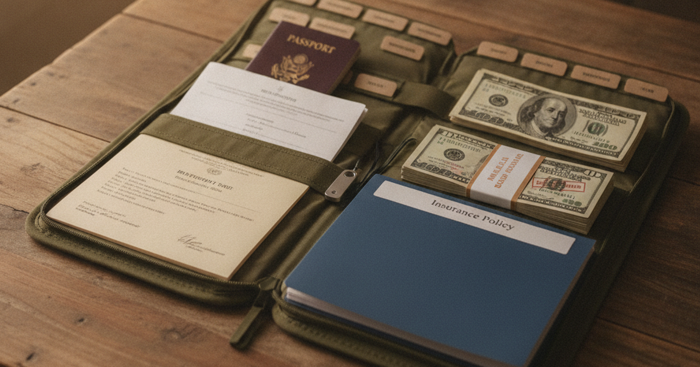
- Copies of important documents in waterproof bag
- Cash in small bills
- N95 masks and work gloves
Step-by-Step Instructions
Step 1: Assess Your Workspace Risks
Identify the specific emergency scenarios most likely to affect your office location, such as earthquakes, floods, fires, or severe weather events. Review your building's emergency exits, stairwells, and designated assembly areas so you can navigate them even in darkness or chaos. Contact your building management or HR department to understand existing emergency protocols and shelter-in-place locations. Document any workplace-specific hazards like chemical storage areas or structural weak points that you should avoid during a crisis.
Step 2: Select a Discreet Storage Location
Choose a storage spot for your emergency kit that remains accessible but doesn't violate workplace policies or create clutter at your desk. Ideal locations include a locked desk drawer, a personal locker, or underneath your workstation in a labeled container. Ensure the location is known to at least one trusted coworker in case you're away from your desk when disaster strikes. Avoid storing your kit in communal areas where items might be borrowed or relocated without your knowledge.
Step 3: Pack Food and Water Supplies
Store at least three days' worth of non-perishable, high-calorie foods that require no preparation or refrigeration, such as protein bars, trail mix, peanut butter packets, and beef jerky. Include one gallon of water per day per person, or if space is limited, pack water purification tablets and a collapsible water bottle to treat available water sources. Rotate your food and water supplies every six months to ensure freshness, setting calendar reminders for replacement dates. Consider any dietary restrictions or allergies when selecting items, and include a manual can opener if you pack canned goods.
Step 4: Assemble Critical Safety and Communication Tools
Pack a reliable flashlight with extra batteries, as office buildings may lose power and emergency lighting during disasters. Include a fully charged portable phone charger or solar-powered battery bank to maintain communication with family and emergency services. Add an emergency whistle to signal for help if you become trapped, plus a small battery-powered or hand-crank radio to receive emergency broadcasts. Include a detailed contact list with phone numbers for family, out-of-state contacts, and local emergency services, since your phone may die or lose service.
Step 5: Include First Aid and Personal Supplies
Stock a compact first aid kit with adhesive bandages, gauze, antiseptic wipes, pain relievers, and any prescription medications you take regularly. Add personal hygiene items like tissues, hand sanitizer, feminine products, and any specific medical supplies such as an inhaler, EpiPen, or glucose tablets. Include a spare pair of glasses or contact lenses if you wear corrective eyewear, as well as any mobility aids you might need. Pack an emergency blanket, a change of comfortable clothes, and sturdy walking shoes in case you need to evacuate or shelter in place overnight.
Step 6: Secure Important Documents and Cash
Create copies of essential documents including your driver's license, insurance cards, emergency contacts, and medical information, storing them in a waterproof, resealable bag. Keep at least $50-100 in small bills and coins, as ATMs and card readers may not function during widespread emergencies. Include a small notebook and pen to record important information, leave messages, or document the situation. Add a local map of your area with evacuation routes marked, since GPS and cell service may be unavailable.
Step 7: Test and Maintain Your Kit Regularly
Schedule quarterly reviews of your emergency kit to replace expired items, update contact information, and ensure all tools remain functional. Test your flashlight, charge your power bank, and verify that batteries haven't corroded or lost charge. Familiarize yourself with how to use every item in your kit so you won't waste precious time reading instructions during an actual emergency. Share your preparedness efforts with coworkers and encourage them to build their own kits, creating a more resilient workplace community that can support each other during crises.
Frequently Asked Questions
What should I put in a get-home bag for work?
A get-home bag for work should include comfortable walking shoes, at least 32 oz of water plus a LifeStraw filter, emergency food bars with 1,200–2,400 calories, paper maps of multiple routes home, emergency cash in small bills, a portable battery bank, a folding knife, basic first aid supplies, an N95 mask, rain gear, and a change of civilian clothes. The goal is to carry everything you need to travel 10–20 miles on foot under urban emergency conditions without drawing attention to yourself.
How is a get-home bag different from a bug out bag?
A get-home bag (GHB) is purpose-built for a single mission: getting from your workplace or another location back to your home or family rally point. It's typically lighter, more urban-focused, and optimized for a 24-hour window. A bug out bag (BOB) is designed for longer-term displacement — typically 72 hours or more — and includes more comprehensive survival gear for leaving a compromised area entirely. Many preppers maintain both, keeping their GHB at work and their BOB at home or in their vehicle. See our Complete 72-Hour Bug Out Bag Checklist for a full BOB loadout.
Is it legal to keep a survival kit or knife at work?
In most cases, yes — basic survival supplies, food, water, and first aid gear are universally permitted in workplaces. For knives and other tools, legality depends on your local jurisdiction and your employer's specific policies. Most folding knives with blades under 3 inches are legal to carry in the majority of U.S. states and permissible under most workplace policies. Always check state and local knife laws, and review your employer's handbook. When in doubt, keep your folding knife in your bag rather than on your person during work hours.
Affiliate Disclosure: SHTF Plan participates in the Amazon Services LLC Associates Program. Some links are affiliate links — we may earn a small commission at no extra cost to you.