When the AC Dies: How to Survive an Extreme Heat Emergency and Prevent Heat Stroke Without Power
A summer blackout during a heat wave kills more people than most hurricanes. Here's how to cool your home, ration your body's water, and treat heat stroke when there's no air conditioning.
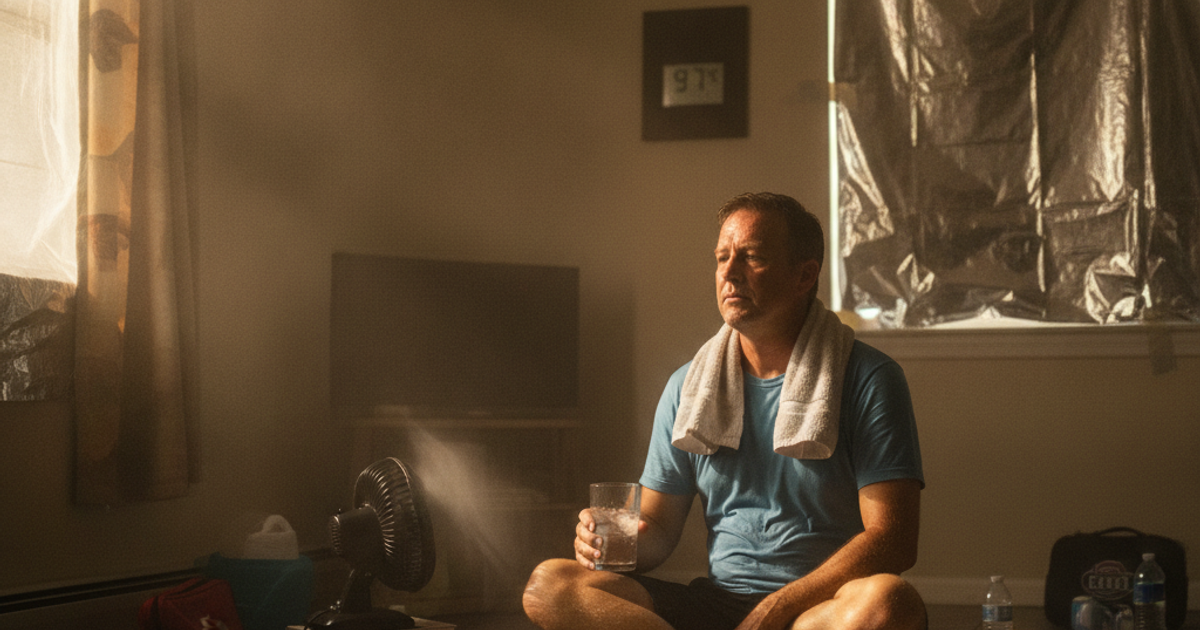
Heat kills more Americans than hurricanes, tornadoes, and floods combined. The National Weather Service attributes an average of roughly 150 to 200 deaths per year to heat, while the CDC's mortality data — which captures heat as a contributing cause — puts the real number closer to 1,200 annually. During the 2021 Pacific Northwest heat dome, more than 800 excess deaths were recorded across Oregon, Washington, and British Columbia in a single week. Nearly all of those victims died indoors, and the overwhelming majority had no functioning air conditioning.
Now consider what happens when the grid fails during a heat wave. Air conditioning is the single largest driver of summer peak demand, which means the hottest days are exactly when transformers blow, substations trip, and rolling blackouts begin. Texas in February 2021 taught the country that grid failure kills in winter. Phoenix, Las Vegas, or St. Louis losing power for 72 hours in July would be substantially worse. A 2023 study in Environmental Science & Technology modeled a combined blackout and heat wave in Phoenix and estimated that roughly 800,000 people would require emergency medical attention and more than 13,000 could die.
Whether you live in a fifth-floor apartment, a suburban split-level, or a rural farmhouse, the physics are the same: without mechanical cooling, your home becomes a heat trap. Here's how to survive it.
What You'll Need
Tools
- Battery-powered clip fan
- Portable power station (1000Wh class)
- 100W folding solar panel
- Digital indoor/outdoor thermometer with humidity readout
Supplies
- Electrolyte drink mix
- High-retention cooler
- Reflective emergency blankets or Reflectix panels
- Cotton sheets, bandanas, and spray bottles
- Stored drinking water — one gallon per person per day minimum, two in extreme heat
How to Passively Cool a House Without Electricity
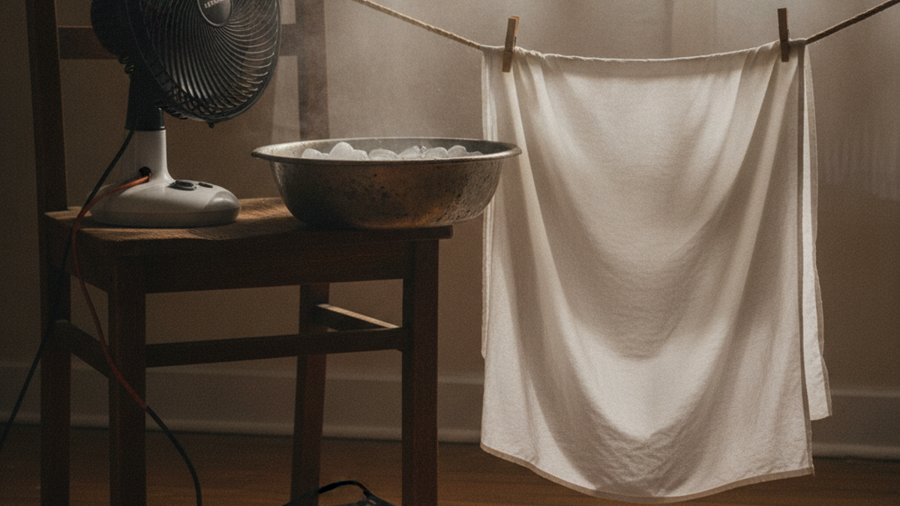
Passive cooling is about managing three things: solar gain, air exchange, and thermal mass. Get those right and you can hold indoor temperatures 10 to 20°F below peak outdoor readings.
Block the sun before it enters
Roughly 76% of the sunlight hitting a standard double-pane window becomes heat inside your home, according to Department of Energy figures. Exterior shading is dramatically more effective than interior shading because it stops the energy before it crosses the glass. Renters can accomplish this with cardboard covered in aluminum foil (shiny side out) wedged into window frames, reflective emergency blankets taped over south- and west-facing glass, or clip-on outdoor shade cloth on a balcony rail. Homeowners can hang tarps, prop plywood, or lean sheets of Reflectix against the outside of the worst windows. Prioritize west-facing glass — afternoon sun striking a west window during the hottest hours of the day is the single largest heat load most homes face.
Use the night, seal the day
In most climates, outdoor temperatures drop below indoor temperatures sometime between 10 p.m. and 6 a.m. That window is your only free cooling. Open windows on opposite sides of the structure to create cross-flow, place a fan in a window to exhaust hot ceiling air, and flush the building's stored heat. Then, at first light, close everything — windows, blinds, curtains — and don't reopen until dusk. In high-humidity climates like the Gulf Coast, night air may bring moisture without much cooling; check your thermometer instead of guessing.
Retreat to the coolest zone
Heat stratifies. Basements run 10 to 15°F cooler than main floors and are the best refuge available in a suburban or rural home. Apartment dwellers on upper floors face the worst conditions — top-floor units can run 5 to 10°F hotter than ground floor. If you're in a high-rise, identify the interior stairwell, the parking garage, or a north-facing ground-floor common area as backup. The concrete mass of an underground garage is genuinely life-saving thermal ballast. Rural readers with a root cellar, well house, or shaded barn already have a cool zone; see our guide on building a low-cost underground food storage system, which doubles as a human refuge.
Battery Fans and Portable Power for a Summer Blackout
Moving air is worth roughly 4°F of perceived cooling, and evaporative cooling from a fan plus damp skin is worth far more. Fans are also cheap to run: a 20-inch box fan draws about 60 watts, while a small DC clip fan draws 5 to 15 watts. That's the key insight for blackout planning — you don't need generator-scale power to survive heat, you need enough to run fans and charge devices.
A rechargeable OPOLAR battery-powered clip fan will run 8 to 20 hours per charge depending on speed and can be clamped to a bed frame, stroller, or wheelchair — critical for the elderly, infants, and anyone bedridden. Buy two or three; they're the cheapest heat insurance available.
For sustained operation, a Jackery Explorer 1000 portable power station can run a box fan for roughly 14 to 16 hours and simultaneously keep phones, radios, and a CPAP machine alive. Apartment preppers with limited storage should consider the smaller EcoFlow River 2, which weighs under 8 pounds and recharges in about an hour. Pair either unit with a 100W portable solar panel — a heat wave is, by definition, a sunny day, so solar input is abundant exactly when you need it. For a deeper dive, read our guides on choosing portable power for any emergency and selecting the right solar system.
Hydration and Electrolytes: What Actually Prevents Heat Illness
Sweating in extreme heat can exceed 1.5 liters per hour. That sweat carries sodium — roughly 900 to 2,000 mg per liter — and replacing fluid without replacing salt can cause exercise-associated hyponatremia, a dangerous dilution of blood sodium that mimics heat exhaustion and has killed marathon runners.
Stock electrolyte powders alongside your water. Liquid I.V. Hydration Multiplier packets are compact, shelf-stable, and palatable enough that reluctant drinkers will actually consume them. LMNT Recharge carries a much higher sodium load (1,000 mg per stick) and is the better choice for heavy sweaters and outdoor laborers. For children, the elderly, and anyone with vomiting or diarrhea, Pedialyte AdvancedCare Plus powder packs use a clinically formulated oral rehydration ratio and should be in every family medical kit.
A Coleman Xtreme 5-day cooler pre-loaded with frozen water jugs gives you cold drinks, cold compresses, and a place to protect insulin or antibiotics. Review how to keep food and medicine safe when refrigeration fails before you need it. Also stock and rotate real water volume — see choosing and rotating emergency water containers.
How to Recognize and Treat Heat Exhaustion and Heat Stroke
Heat exhaustion presents with heavy sweating, cool clammy skin, weakness, nausea, muscle cramps, headache, and dizziness. Mental status remains normal — the person knows who and where they are. Core temperature is typically under 104°F.
Heat stroke is a medical emergency with a mortality rate that climbs steeply with every minute of delay. The defining sign is altered mental status: confusion, slurred speech, bizarre behavior, combativeness, seizure, or unconsciousness, combined with a core temperature above 104°F. Skin may be hot and dry, but in exertional heat stroke the victim is often still sweating — do not use dry skin as your rule-out.
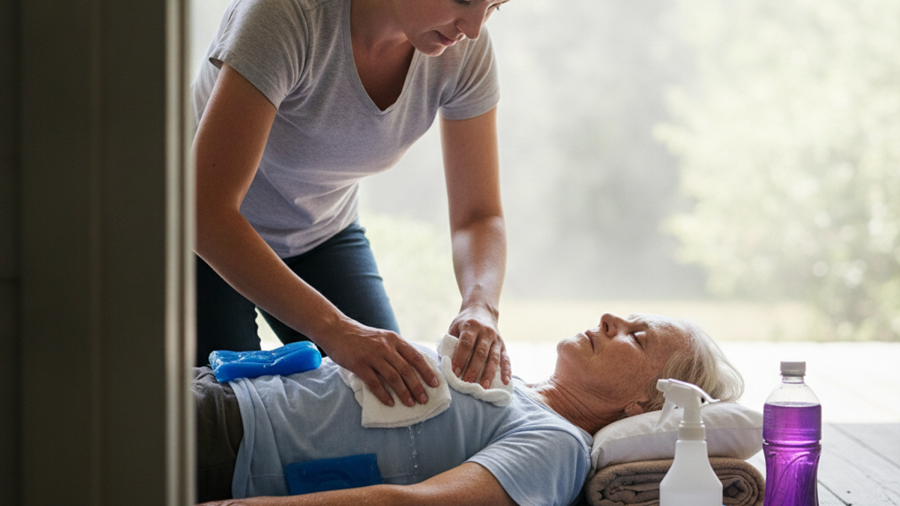
Treatment without a hospital: cool first, transport second. Cold-water immersion is the gold standard, dropping core temperature roughly 0.2°C per minute. Fill a bathtub, stock tank, kiddie pool, or trash can with the coldest water available and immerse the victim to the neck, supporting the head. If immersion isn't possible, use the "tarp taco" method — lay the person on a tarp, pour water in, and rock it — or apply continuous cold wet sheets rotated every two minutes while fanning vigorously, plus ice packs to the neck, armpits, and groin. Target 101–102°F, then stop cooling to avoid overshoot. Never give fluids by mouth to someone who is confused or vomiting. Read our companion guides on field medicine without a hospital and storing critical medications off-grid.
Step-by-Step Instructions
Step 1: Check the forecast and pre-cool your home
When a heat advisory or excessive heat warning is issued, drop your thermostat 4 to 6 degrees below normal for 12 hours beforehand. This charges the thermal mass of drywall, flooring, and furniture, buying you several extra hours of tolerable temperature after the power fails.
Step 2: Freeze water and load your cooler
Fill every empty jug, bottle, and freezer bag with water and freeze them solid. Transfer half to your cooler when the power drops and leave half in the freezer to protect food. Frozen jugs serve triple duty as cold drinking water, cold compresses, and refrigeration.
Step 3: Seal and shade every sun-facing window
Install reflective panels, foil-covered cardboard, or emergency blankets on all east, south, and west windows. Close interior blinds behind them. Seal gaps under exterior doors with rolled towels to slow hot-air infiltration.
Step 4: Establish a single cooling room
Pick the lowest, most shaded, most interior room in your dwelling and consolidate everyone there. Close doors to unused rooms. Concentrating people, fans, and battery capacity in one space is far more efficient than trying to cool the whole structure.
Step 5: Deploy fans and connect your power station
Position one fan for airflow across bodies rather than around the room. Run fans on the lowest tolerable setting to extend runtime, and set your solar panel outside at midday to recharge. Log your battery percentage every few hours so you know your real reserve.
Step 6: Hydrate on a schedule, not on thirst
Thirst lags dehydration, especially in adults over 65. Set a timer and drink 8 to 12 ounces every 30 minutes, mixing in an electrolyte packet every second or third serving. Monitor urine color — pale straw is the target; dark amber means you're behind.
Step 7: Cool your body directly with water
Take cool (not cold) showers or sponge baths every few hours. Wear a damp cotton bandana on the neck, keep a spray bottle at hand, and soak your feet in a basin of cool water. Evaporative cooling on skin works even in humid conditions when combined with airflow.
Step 8: Check on vulnerable people twice daily
Adults over 65, infants, pregnant women, people on diuretics or beta-blockers, and anyone with heart or kidney disease are at highest risk. Physically knock on doors — don't rely on phone calls. Assess mental status, not just how they say they feel.
Frequently Asked Questions
How long can you survive in a house with no air conditioning during a heat wave?
It depends on humidity as much as temperature. A healthy adult can tolerate 95°F at low humidity for days with adequate water and airflow, but at high humidity a wet-bulb temperature above 88°F becomes dangerous within hours because sweat can no longer evaporate. Vulnerable individuals can deteriorate in under 12 hours in a poorly ventilated top-floor apartment. If indoor temperatures exceed 95°F and you have no fan or cooling capability, relocating to a cooling center, a mall, a library, or a friend's home is the correct decision — this is not the moment for prepper self-reliance pride.
Can a portable power station run an air conditioner during a blackout?
A 5,000 BTU window unit draws roughly 450 to 500 watts running, with a startup surge that requires an inverter capable of handling it. A 1,000Wh station will run one for about two hours — useful for pre-cooling a small sealed bedroom before sleep, but not for continuous operation. For all-day cooling you need either 2,000Wh-plus of battery with substantial solar input or a standby generator. Realistically, fans plus passive cooling plus water is the sustainable strategy.
What's the difference between heat exhaustion and heat stroke?
Mental status. Heat exhaustion victims are miserable but lucid. Heat stroke victims are confused, incoherent, combative, seizing, or unconscious. If someone in extreme heat cannot tell you their name, the date, and where they are, treat it as heat stroke and begin aggressive cooling immediately while arranging transport.
Extreme heat is the quiet killer in the preparedness world — less dramatic than a hurricane, far deadlier in the aggregate. Build the plan, buy the fans and the electrolytes, and stage them now. For more essential equipment, browse our recommended survival gear and equipment.
Affiliate Disclosure: SHTFPlan.net participates in the Amazon Services LLC Associates Program. Some links are affiliate links — we may earn a small commission at no extra cost to you.